





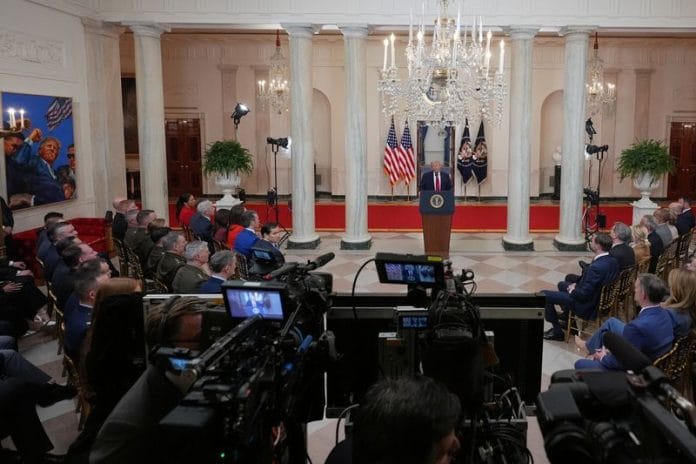



New Delhi: US President Donald J. Trump told various American media Sunday that he believes there is a “good chance” to reach a deal with Iran by Tuesday 8 pm ET (Wednesday in India), a day ahead of his deadline.
The US and Iran, along with regional mediators including Pakistan, Egypt and Turkey, are making a last-ditch effort at a two-phased deal, which would begin with a 45-day ceasefire and eventually lead to a peace accord, according to Axios, the American news website.
“There is a good chance (to make the deal), but if they don’t make a deal, I am blowing up everything over there,” Trump told the American news website. In an exclusive interview with the American newspaper The Wall Street Journal Sunday, Trump reiterated his threats to destroy every power plant in the West Asian nation, unless a deal is reached.
“If they don’t come through, if they want to keep it closed, they’re going to lose every power plant and every other plant they have in the whole country,” Trump told the American newspaper.
Trump, in an expletive-laden post on social media Sunday, promised to attack key civilian infrastructure in Iran, including bridges and power plants if Tehran did not open the Strait of Hormuz. Any attacks on civilian infrastructure could potentially constitute a war crime.
However, this has not deterred the American President from making the threats. He has been giving Iran ultimatum after ultimatum for the last two weeks, threatening their civilian infrastructure if the global waterway remains effectively closed.
Efforts to reach a ceasefire reportedly hit a roadblock Friday, but negotiations between regional mediators have been ongoing in the background over the weekend. According to Axios, Iran is concerned that any deal would leave them in a situation similar to Gaza or Lebanon, where the ceasefire is on paper, with Washington and Tel Aviv allowed to carry out aggressive action against Tehran whenever they choose to do so.
The American news website pointed out that the mediators are working on potential confidence building measures, which would see Iran reopen the Strait of Hormuz and hand over their stockpile of highly enriched uranium. Iran is clear that it will not hand over the uranium for only 45-days of ceasefire, Axios reported.
Trump’s threats led to a furious response from Iran, with Parliamentary Speaker Mohammad Bagher Ghalibaf declaring that the American President is dragging the US “into a living hell for every single family”.
“Your reckless moves are dragging the United States into a living HELL for every single family, and our whole region is going to burn because you insist on following Netanyahu’s commands. Make no mistake: You won’t gain anything through war crimes,” Ghalibaf said in a post on the social media platform X.
1/ Your reckless moves are dragging the United States into a living HELL for every single family, and our whole region is going to burn because you insist on following Netanyahu’s commands.
Make no mistake: You won’t gain anything through war crimes.
— محمدباقر قالیباف | MB Ghalibaf (@mb_ghalibaf) April 5, 2026
The Iranian Speaker added that the only solution to the ongoing conflict is “respecting the rights of the Iranian people” and ending the conflict that has been on-going for over five weeks. Over the weekend, the Americans dramatically rescued one of their airmen who was missing following the downing of a F-15E fighter jet last week by Iran.
The war started by the US and Israel has engulfed the wider region, with Iran carrying out its retaliatory strikes against the Gulf Arab states, targeting key American military installations and infrastructure in countries like Oman, the United Arab Emirates, Saudi Arabia, Kuwait, Bahrain and Qatar.
Iran has also been able to effectively close the Strait of Hormuz, leading to a spike in oil prices, as well as energy shortages around the world. Qatar’s capacity to produce liquefied natural gas has also been dramatically limited following strikes on its Ras Laffan industrial city by Iran last month.
For India, the ongoing war has led to New Delhi negotiating with Tehran to allow passage of its stranded ships in the Strait of Hormuz. At least eight ships have transited the global waterway in the last five weeks.
Foreign Secretary Vikram Misri participated in an international summit convened by the United Kingdom last week, reiterating India’s stance of dialogue and diplomacy being the only solution to the war. The UK-led summit looked at diplomatic ways to reopen the Strait of Hormuz, as well as future security architecture once the war ends.
(Edited by Viny Mishra)