



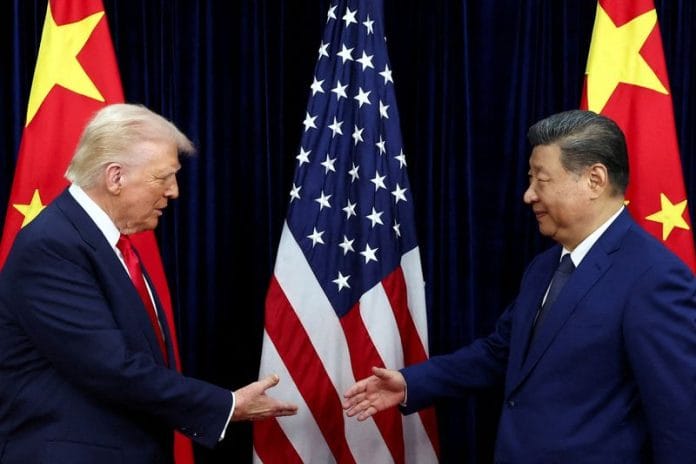
New Delhi: When US President Donald Trump lands in Beijing Wednesday for a three-day summit with Chinese President Xi Jinping, the visit will carry more weight than a bilateral trade reset.
It is the first visit to China by a sitting US president in over eight years, and it arrives at a moment when the two powers are navigating a war in West Asia, unresolved pressure over Taiwan, and a trade relationship still being rebuilt.
The timing alone signals the summit’s complexity. Beijing hosted Iranian Foreign Minister Abbas Araghchi a week ago, where he met Chinese Foreign Minister Wang Yi.
The US-Iran ceasefire, agreed on 8 April, remains in place but movement towards a durable resolution to the war has been slow. China’s role in what comes next is the central question Washington is bringing to the table.
China is Iran’s largest economic backer and lifeline. Trump has been pressing Beijing to use that leverage to push Iran towards a peace deal. During the ceasefire negotiations in Islamabad, Pakistani Deputy Prime Minister Ishaq Dar made a point of travelling to Beijing, and China is reported to have pushed Tehran to accept the deal.
US Secretary of State Marco Rubio has gone further, urging Beijing to use its ties with Tehran to reopen the Strait of Hormuz, through which roughly one-fifth of the world’s oil and gas passes. Iran has effectively closed the global waterway since the conflict began at the end of February.
The economic friction over Iran is already concrete. On 24 April, the US Treasury imposed sanctions on five Chinese “teapot” refineries—small independent processing facilities—for allegedly purchasing Iranian crude.
Beijing called the measures unilateral and a violation of international law. Its commerce ministry went further, issuing a ‘prohibition order’ that bars recognition, enforcement or compliance with the American sanctions, framing the action as necessary to safeguard “national sovereignty, interests and security”.
The Trump-Xi summit was originally scheduled for April before being pushed back as the US-Israel military campaign against Iran intensified. The two leaders last met in October in Busan, South Korea, on the sidelines of the APEC (Asia-Pacific Economic Cooperation) summit—itself a meeting made possible only after representatives from both sides worked through bilateral trade tensions in Geneva and London, following the rupture triggered by Washington’s tariffs and Beijing’s retaliatory export controls on rare earth processing technologies.
On trade, the two sides are expected to establish a Board of Trade and a Board of Investment. The Board of Trade, as currently envisaged, would have the limited but significant mandate of identifying which goods the two countries would continue to exchange even under conditions of strained relations.
US Trade Representative Jameison Greer, in a recent interview, said that America was not seeking to reshape China’s economy but to rebalance trade. In an earlier call with Chinese Vice-Premier He Lifeng, Greer raised the board’s potential role in optimising trade in “non-sensitive” goods and discussed agricultural market access in China for American producers.
The Chinese Vice-Premier will meet US Treasury Secretary Scott Bessent in South Korea’s Seoul earlier Wednesday as a precursor to the Trump-Xi summit.
April data from China’s General Administration of Customs show that exports to the US grew 11.3 percent year-on-year to $36.8 billion, while imports from the US rose 9 percent to $13.7 billion. China’s trade surplus widened to $23.1 billion, up from $16.8 billion in March—a number Washington may scrutinise closely even as both sides speak of rebalancing.
Taiwan is expected to feature in talks.
Rubio said last week that the issue was firmly on the agenda, with both Washington and Taiwan seeking stability.
“Our policy remains unchanged. We don’t want to see any forced or compelled change in the situation now. We think it would be destabilising to the world,” Rubio told reporters.
Taiwan’s Foreign Minister Lin Chia-lung said it remained confident of stable relations with Washington, but would be closely watching how the issue is addressed during the summit.
After the Busan meeting last year, Trump claimed that Beijing would not act on Taiwan while he remained president–”because they know the consequences”.
Trump arrives in Beijing Wednesday and is scheduled to hold bilateral talks with Xi Thursday, followed by a visit to the Temple of Heaven. A state banquet and a working lunch with Xi are also planned before he departs Friday.
Jaydeep Gadhavi is an alum of ThePrint School of Journalism, currently interning with ThePrint.
Also Read: India to host Iranian FM Araghchi for BRICS meet this week, US Secy of State Rubio end of the month