





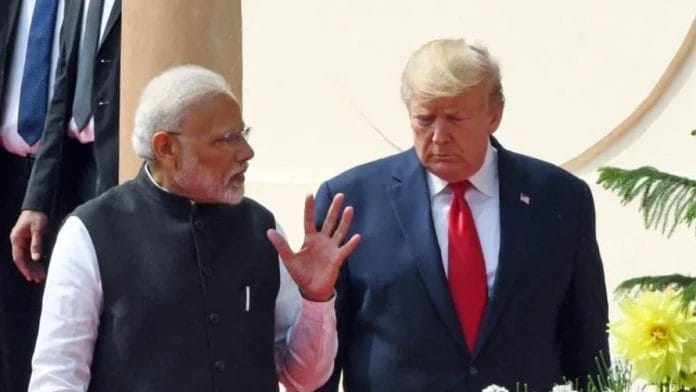



New Delhi: US President Donald Trump has “greenlit” legislative efforts to grant him authority to impose sanctions up to 500 percent on countries continuing to purchase Russian oil, including China, India and Brazil, Senator Lindsey Graham announced Wednesday.
“After a very productive meeting today with President Trump on a variety of issues, he greenlit the bipartisan Russia sanctions Bill that I have been working on for months with Senator Blumenthal and many others. This will be well-timed, as Ukraine is making concessions for peace and Putin is all talk, continuing to kill the innocent,” Graham said in a statement on X.
The Republican Senator added: “This Bill will allow President Trump to punish those countries who buy cheap Russian oil fueling Putin’s war machine. This bill would give President Trump tremendous leverage against countries like China, India and Brazil to incentivise them to stop buying the cheap Russian oil that provides the financing for Putin’s bloodbath against Ukraine.”
The Bill, called the ‘Sanctioning Russia Act of 2025’, has at least 84 co-sponsors in the 100-member Senate, would give Trump the final say on tariff levels. Democratic Senator Richard Blumenthal from Connecticut is a co-sponsor.
Graham, one of the strongest anti-Russia voices in the US Senate, has been pushing the 500 percent tariff bill for months and first announced Trump’s approval for such efforts last June. He highlighted the initiative earlier this week while returning from Florida alongside the American President on Air Force One.
The legislative push comes as the US continues pressuring India to reduce Russian oil purchases. Last month, Indian Ambassador to the US Vinay Kwatra held a dinner for American congresspersons, including Graham, where discussions included Russian oil purchases.
The US imposed 25 percent penalty tariffs on Indian goods in August last year over New Delhi’s continued oil purchases from Moscow. India’s overall tariff limit currently stands at 50 percent – one of the highest imposed by the US. However, India has maintained it will continue purchasing oil based on prevailing prices.
India’s Russian oil purchases surged after the 2022 Moscow-Kyiv war began. In response, G7 nations led by the US instituted a $60 per barrel price cap designed to harm Moscow’s revenue streams without damaging global energy markets. Former US Ambassador to India Eric Garcetti had publicly said the cap was designed keeping India in mind.
Indian refiners bought over $50 billion worth of Russian crude in the 2024-2025 financial year. But the current financial year has seen India reduce purchases by around 10 percent, according to Ministry of Commerce and Industry data. Nevertheless, the high tariff rate has been in place.
The US is India’s largest export market, with goods exports crossing $50 billion in the financial year until November 2025. But New Delhi is diversifying its export markets, and has announced free trade agreements while negotiating similar deals with the European Union, Eurasian Economic Union and Israel, among others.
At the same time, India-US negotiations over a trade deal have stalled in recent months. India has made what it considers its “final offer” and is awaiting the US’s decision.
Earlier this week, Trump said at an event that Prime Minister Narendra Modi was “not that happy” with him over US sanctions imposed on Indian exports.
Also Read: US invasion of Venezuela is end of international order. India must focus on cold calculations
India’s exports to USA is not large enough to get concerned. So India must continue to buy Russian oil as long as it is economical. Let Trump keep barking.