





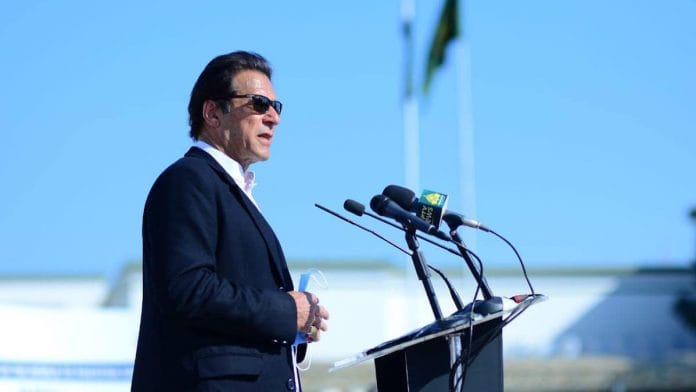



Islamabad: Pakistan Prime Minister Imran Khan on Wednesday said India will be benefitted economically by having peace with his country as it will enable New Delhi to directly access the resource-rich Central Asia region through Pakistani territory.
Delivering the inaugural address at the launch of the two-day Islamabad Security Dialogue, Khan also said that his government after coming to power in 2018 did everything for better ties with India and it was for India to reciprocate.
India will have to take the first step. Unless they do so, we cannot do much, he said.
India last month said that it desires normal neighbourly relations with Pakistan in an environment free of terror, hostility and violence. India has said the onus is on Pakistan to create an environment free of terror and hostility.
India has also told Pakistan that “talks and terror” cannot go together and has asked Islamabad to take demonstrable steps against terror groups responsible for launching various attacks on India.
Khan discussed Pakistan’s vision of comprehensive national security, built on the pillars of traditional and non-traditional security, including his vision for economic prosperity and human welfare.
Khan dwelt at length on the issue of peace in the region, including peace between Pakistan and India, saying “the unresolved Kashmir issue was the biggest hurdle between the two countries.”
If India gives the Kashmiris their right under the UN (resolutions), it will be greatly beneficial for Pakistan as well as for India, he said and added, India can access Central Asia after peace.
Khan said that having a direct route to the Central Asian region will economically benefit India. Central Asia is rich in oil and gas.
Central Asia, in the modern context, generally includes five resource-rich countries — Kazakhstan, Kyrgyz Republic, Tajikistan, Turkmenistan and Uzbekistan.
Pakistan has been unsuccessfully trying to drum up international support against India for withdrawing Jammu and Kashmir’s special status and bifurcating it into two Union territories in August, 2019.
India has categorically told the international community that the scrapping of Article 370 of the Constitution was its internal matter. The Ministry of External Affairs has also underlined that the Union Territory of Jammu and Kashmir is an integral and inalienable part of India.
India and Pakistan had announced on February 25 that they have agreed to strictly observe all agreements on ceasefire along the Line of Control (LoC) in Jammu and Kashmir and other sectors.
Ties between India and Pakistan nosedived after a terror attack on the Pathankot Air Force base in 2016 by terror groups based in the neighbouring country.
Subsequent attacks, including one on Indian Army camp in Uri, further deteriorated the relationship.
The relationship dipped further after India’s war planes pounded a Jaish-e-Mohammed terrorist training camp deep inside Pakistan on February 26, 2019 in response to the Pulwama terror attack in which 40 CRPF jawans were killed.
The relations deteriorated after India announced withdrawing special powers of Jammu and Kashmir and bifurcation of the state into two union territories.
Talking about non-traditional threats to Pakistan, Khan said that climate change, food security and a weak economy were among the biggest challenges in the quest to realise the full concept of security.
He acknowledged that improving the national economy was the biggest challenge but his government was trying to reduce trade deficit and control inflation so that the financial condition of common people could improve.
We cannot become a secure nation when a small rich minority is surrounded by the sea of poor people National security is achieved when a nation stands up to secure itself, he said at the dialogue organised by the National Security Division and think-tanks comprising the Advisory Board of National Security Committee.
Khan also praised all-weather ally China for its “successful” handling of poverty and lifting more than 700 million people out of poverty in the last three decades. It is their big achievement whether you like China or not, he said.
Khan said that Pakistan’s 25 per cent population was suffering from extreme poverty and another 25 per cent was just slightly better.
He said the government already launched Ehsaas programme to give cash to the poor people and another programme of giving targeted subsidies to the poor was being launched.
Khan also talked about peace in Afghanistan and reiterated support for the ongoing peace process by saying that Pakistan would be the greatest beneficiary of a stable Afghanistan.
The Islamabad Security Dialogue is envisioned as an annual flagship security forum based on the model of major dialogues on security and international policy.
The National Security Division, in collaboration with leading think-tanks that are part of its advisory board, has taken this initiative to provide a platform for critical thinking and robust intellectual discourse on some of the most pressing challenges and opportunities being faced by Pakistan and the wider region, according to an official statement.
The two-day event is being attended virtually by international thinkers and scholars, members from the Federal Cabinet, diplomatic corps, former government officials, academia, think-tanks and civil society members.
Also read: Imran Khan’s ‘ghabrana nahin’ advice to Pakistanis on price rise is now a viral anthem
No.. India should not. Pak is not doing enough to stop cross border terrorism and dismantling the terror infrastructure. That’s why it has been in grey list since several months and not worried at all even if get black listed. Looks like Pak is happy with grey list nomination and it is normal for it.Several decades has passed but no change in Pak’s policy towards terrorism.Lets not pretend of Peace .
If we keep fighting like this there will be no benefit but lots of losses economically as well as in lives. The thing you are saying that cross border terrorism the thing is there is no way Pakistanis could come in india without knowing us since we laid wires and other technological equipment. So it’s not them but mostly indians which are treated differently due to their religion or ethnicity or caste.
Cross border firing is another things don’t relate it to terrorism its fighting between forces across border.
The solution is to recognize everyone and give equal rights to all( not only pretend) same goes for pakistan . We should stop fighting and make peace it’s the only way to get prosperous for both countries.