





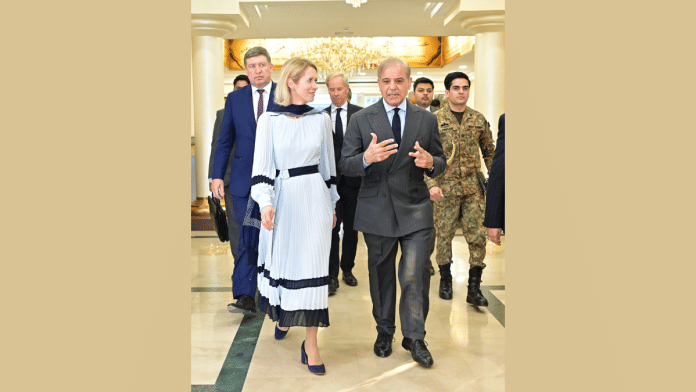


New Delhi: Labelling Pakistan as ‘a major regional power’, EU Vice President Kaja Kallas Monday said Islamabad was an important partner for the EU and praised Pakistan’s role in mediating between the United States and Iran, saying Islamabad’s diplomacy had helped avert a return to “full-blown war” and earned widespread recognition across Europe.
Kallas, who is also the European Union’s High Representative for Foreign Affairs and Security Policy, was in Islamabad for the 8th round of the Pakistan-EU Strategic Dialogue. Speaking alongside Deputy Prime Minister and Foreign Minister Mohammad Ishaq Dar in Islamabad, Kallas highlighted Pakistan’s growing role in regional diplomacy, saying she had “commended Pakistan for its constructive and meaningful role” in facilitating talks between the United States and Iran.
“Pakistan has been the main mediator between the United States and Iran, and your diplomatic efforts have helped to prevent a return to full-blown war on several occasions,” Kallas said during the joint news conference.
“These efforts are widely recognised and appreciated across Europe,” she added.
Kallas also said Pakistan’s mediation had helped create what she described as a “tenuous diplomatic opening” to preserve the fragile ceasefire between Washington and Tehran and potentially restore normal shipping through the strait.
At the same time, she also warned that short-term de-escalation would not be enough to secure lasting peace. “Any temporary understanding between the United States and Iran must be followed by deeper talks on Iran’s nuclear stockpile and other critical issues,” she said. “Lasting stability will require more comprehensive solutions.”
Kallas then said that the EU stood ready to support a long-term settlement, arguing that Brussels possessed unique diplomatic and economic tools that could help sustain any future agreement.
“We bring economic leverage, extensive experience on nuclear issues, long-standing partnerships across the Gulf region, and direct channels of engagement with Iran,” she said.
“I see a practical role for the European Union in helping ensure that any eventual agreement is durable, whether through maritime security initiatives, economic incentives that promote long-term stability, or other forms of cooperation.”
For his part, Dar described Kallas’s visit as a significant step forward in relations between Pakistan and the European Union.
“This visit marks an important milestone in Pakistan-EU relations,” he said.
Dar noted the unusually short interval between the current Strategic Dialogue and the previous round held in November 2025, calling it one of the fastest turnarounds in the history of bilateral engagements between the two sides.
He also pointed out that the last visit by an EU high representative had taken place in 2019, after which high-level exchanges largely stalled for several years.
He described the EU foreign policy chief as one of his most frequent international interlocutors and said their regular exchanges reflected growing trust between Islamabad and Brussels, including during discussions following Operation Sindoor.
“We remained in close contact during last year’s India-Pakistan conflict, and we have continued our consultations during the ongoing regional tensions involving the United States and Iran,” Dar said.
In a joint communiqué issued after the Strategic Dialogue, both sides said they would continue to strengthen cooperation under the Pakistan-EU Strategic Engagement Plan and “continue exploring opportunities to further strengthen relations in all areas of common interest.”
The European Union is Pakistan’s largest export market. At the same time, Pakistan is the largest beneficiary of the bloc’s Generalised Scheme of Preferences Plus (GSP+), which grants preferential access to European markets in exchange for commitments on human rights, labor standards, and governance.
The communiqué noted that both sides “reiterated the importance of continuing cooperation within the framework of the Generalised Scheme of Preferences (GSP+).” Kallas briefed Pakistani officials on the EU’s forthcoming GSP+ framework, while Pakistan expressed “its keen interest in joining the new scheme.”
Turning to Afghanistan, Kallas expressed concern over continuing instability and violence, warning that recent fighting had carried serious humanitarian consequences and risked further radicalisation in the region. She reiterated the European Union’s longstanding call for restraint and de-escalation.
In South Asia, Pakistan raised the Kashmir issue yet again, and the EU brought up the Russia-Ukraine war. According to the communiqué, “both sides expressed support for a peaceful resolution of conflicts through dialogue and diplomacy, in accordance with the principles of the UN Charter.”
Last year, a joint statement by Poland and Pakistan on Kashmir saw Jaishankar draw the line with Sikorski, who is also the Polish Deputy Prime Minister, in his opening remarks during their bilateral meeting in New Delhi in February. The EAM had urged Warsaw to “show zero-tolerance for terrorism and not help fuel terrorist infrastructure in our neighbourhood,” while also hitting out at the selective targeting of India’s Russian oil purchases.
(Edited by Varnika Dhawan)
Also Read: Pakistan inflation rises to highest in 2 years as West Asia conflict pushes energy costs
Whatever Pakistan’s intentions, they have averted a full scale war. I don’t understand why our government doesn’t have the magnanimity to say that loud.
It is not capitulating, rather a stronger/powerful neighbour giving some credit.
At the end of the day, we have live next to each other. The paranoia is costing us a lot of money.