





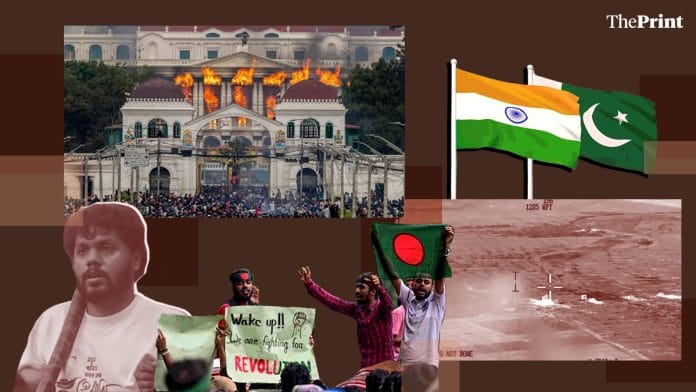



New Delhi: In 2025, South Asia saw crises that were both old and new. Old, simmering friction between India and Pakistan erupted into an 87-hour confrontation that kept the world on tenterhooks. In Nepal, the new generation, Gen Z, looked up from its cell phones and took to the streets, a likely ripple effect of the youth-led stir that toppled Sheikh Hasina’s 15-year regime in Dhaka. Bangladesh too remained on the boil for various reasons.
These were just some key events that made for news in South Asia this year, apart from goings-on in Afghanistan, Sri Lanka and the Maldives. ThePrint takes a deeper look.
On 7 May, India launched Operation Sindoor against terror infrastructure in Pakistan in response to the 22 April terror attack in Pahalgam, Jammu & Kashmir. It led to a confrontation, diplomatic standoff and year-long frost in an already volatile region. In a first, India also kept in “abeyance” the 1960 Indus Waters Treaty between the two countries.
Pakistan, even as its fragile democracy slid further, promoted its Army Chief General Asim Munir as Field Marshal in the wake of Operation Sindoor. Trump, who anointed his “favourite field marshal”, continued to claim, till the year-end, that it was the White House that resolved a “nuclear conflict”.
While a ceasefire was agreed upon on 10 May, Pakistan left no chance to claim “victory” even until the year-end when the nation’s foreign minister asserted that the four-day skirmish had changed the perception of Pakistan as “diplomatically isolated” in front of “big powers”, a likely reference to the US and Quad. It even signed an arms deal with Libya that includes the supply of JF-17 fighter jets, a multirole combat aircraft jointly developed by Pakistan and China that was used during the May conflict with India.
Asim Munir’s Pakistan, meanwhile, saw democracy on the edge. In November, the country passed yet another hurried amendment—27th Constitutional Amendment—that gives lifetime legal immunity to the Army Chief, now the Chief of Defence Forces, abolishes the post of the Joint Chief of Staffs and curtails powers of the Supreme Court.
The country also saw increased military interference in civilian affairs with the Prevention of Electronic Crimes Act being amended in September to broaden government powers over online speech, and the arrest of human rights lawyers over social media posts “criticising” the military and the intelligence agencies.
On the eastern front, Bangladesh was on the boil. From a rise in fundamentalism to shifting politics, the year saw the country’s interim administration change its diplomatic alignments as it warmed up to Pakistan, a country it once sought its liberation from.
In an affirming move, the Bangladesh High Commissioner to India claimed that the country’s soil will never be used for anti-India activities. However, ties with India—largely frozen after deposed prime minister Sheikh Hasina’s ouster—further deteriorated after the assassination of independent politician Sharif Osman Hadi which led to an anti-India tirade in the country. Diplomatic missions were attacked, visa offices were shut, trade across the borders was closed off.
The second-last day of the year saw the curtains fall on the power duel that defined Bangladesh politics for decades, with the death of Hasina’s political rival and Bangladesh Nationalist Party (BNP) leader Khaleda Zia. With her son Tarique Rehman having returned to the nation after a 17-year exile, Bangladesh seems to be heading for yet another era of dynasty politics.
What stood out in 2025, however, was what happened in Nepal.
The Himalayan country saw youth-led protests against nepotism and corruption, dubbed globally as the Gen-Z protests, that led to toppling of the K.P. Oli-led government.
What happened in Nepal was the culmination of simmering discontentment—the youth of the country had been battling unemployment for decades now. They felt left out as stakeholders. However, as the country descended into chaos with key institutions torched, the army stepped in and an interim political arrangement was reached.
With India, Nepal had diplomatic tension over the Lipulekh pass. Meanwhile, Nepal’s anti-graft body charged a Chinese firm in the “largest corruption case” in the country’s history.
With an interim government in place under former Chief Justice Sushila Karki, the country heads to elections next year. It will be keenly watched by its neighbours.
Also Read: Op Sindoor is India’s first AI-enabled operation. How ‘heavy use’ of modern tech by Army played out
Afghanistan, Sri Lanka, Maldives & Bhutan
Four years after cutting diplomatic ties with Kabul, India recalibrated its approach to the Taliban this year. In October, Taliban foreign minister Amir Khan Muttaqi visited India and met with External Affairs Minister S. Jaishankar.
An engagement with the media during his visit also led to a controversy. Muttaqi held a press conference from which women journalists were initially excluded.
India also reopened its embassy in Kabul, signalling an open engagement with the regime. Shortly after Muttaqi, New Delhi also hosted the Afghan commerce minister.
India, which earlier backed the Northern Alliance and NATO-backed governments in Afghanistan, has traditionally viewed the Taliban as aligned with Pakistan’s military and intelligence interests. It was also repeatedly targeted by the Taliban between 2008 and 2013. The shift came as Taliban-Pakistan relations deteriorated.
Sri Lanka, in a first, saw former president Ranil Wickremesinghe arrested in August over allegations that he misused public funds during a private trip to London in 2023 while serving as the country’s head of state. He is the highest-ranking opposition leader to be detained in the ongoing anti-corruption drive launched by the country’s new Left-leaning administration.
PM Harini Amarasuriya also made her first official visit to India in October, focusing on education, technology, trade, and fisher welfare, holding talks with PM Narendra Modi.
Towards the end of the year, Sri Lanka was caught in the grip of Cyclone Ditwah that claimed more than 600 lives.
In the Maldives, in a controversial move the government in February suspended three Supreme Court judges an hour before a critical hearing on constitutional amendments that proposed to tighten executive control over the judiciary.
Concerns over governmental control also extended to the media when in September the Muizzu government replaced current media regulations with a new Maldives Media and Broadcasting Regulation Act. It saw widespread protests by journalists. However, the country’s foreign policy towards India saw a positive shift after Muizzu’s previous ‘India-out’ campaign. In July, Modi visited the country as a state guest, signalling a reset in ties.
India-Bhutan ties too were on an upward slope. In November, Modi visited the country as he inaugurated the Punatsangchhu-II hydropower project and took part in the 70th birthday celebrations of His Majesty The Fourth King of Bhutan, father of the current monarch.
Bhutan is the only country in South Asia that has remained out of the China-led Belt & Road Initiative (BRI).
(Edited by Nida Fatima Siddiqui)