





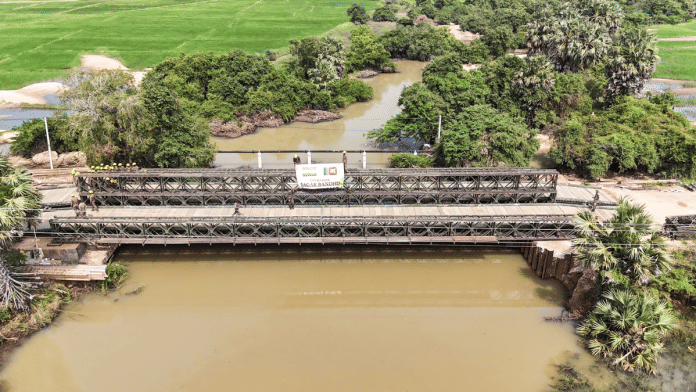



New Delhi: Indian Army engineers restored vital road connectivity in Sri Lanka’s central and Uva province by reconstructing a Bailey bridge within a day despite harsh weather over the weekend.
The task was undertaken by 24 Indian army engineers and is part of India’s Operation Sagar Bandhu launched last year. India was the first responder to the country after Cyclone Ditwah wreaked havoc leaving at least 600 dead. A Bailey bridge is a prefabricated, portable truss bridge to create temporary or permanent crossings.
As part of the operation, 24 Indian Army bridging experts began the reconstruction that has now re-established inter-provincial traffic flow and eased travel time too, enabling faster movement of relief material, machinery, essential services and aiding the return of normalcy for those affected in the hilly region.
The bridge launch was preceded by preparatory strengthening works on both banks to enhance load bearing capacity of the abutments. The Engineer Task Force (ETF) also employed indigenously developed drones, Laser Range Finders (LRFs) and advanced survey tools for precision site.
The ETF from the Army was deployed under Sagar Bandhu and had earlier launched Bailey bridges to restore connectivity and offer medical relief under India’s “Neighbourhood First” policy. The project follows the completion of a larger 120-foot dual-carriageway Bailey bridge on the A-35 highway in northern Jaffna last month.
India’s HADR efforts in Sri Lanka
India has rapidly expanded its relief work in the country since the cyclone struck. As part of Sagar Bandhu, India dispatched 53 tons of emergency supplies, along with specialised search and rescue teams, medical personnel and engineering units.
Along with that, 9.5 tons of emergency dry rations from INS Vikrant and INS Udaygiri were handed over in Colombo. Later, 31.5 tons of relief material was sent by IAF aircrafts with relief materials and medical Humanitarian and Disaster Relief (HADR) supplies, including two BHISHM Modular Trauma Cubes, over 4 tons of essential medicines and medical items, an Aarogya Maitri team of trauma specialists and emergency physicians, and two specialized Urban Search and Rescue (USAR) teams of India’s elite National Disaster Response Force (NDRF).
Later, an additional 12 tonnes of essential relief supplies arrived in Trincomalee region of Sri Lanka aboard INS Sukanya. The IAF C-17 Globemaster airlifted a modular Indian Army field hospital—including ambulances, trauma care units, operation theatres, and 73 personnel—to support urgent medical needs. 500 mobile water purification units were also dispatched.
India was also the first country to deploy trained disaster responders in Sri Lanka, ensuring that specialised teams reached within the first 24 hours of Cyclone Ditwah. Until last month, four modular Bailey bridge systems along with specialised teams of Indian Army Engineers, were airlifted by four IAF C-17 Globemaster aircraft for deployment in Sri Lanka.
(Edited by Vidhi Bhutra)
Also read: Barbados to Sri Lanka, countries that bestowed honours on PM Modi in 2025