



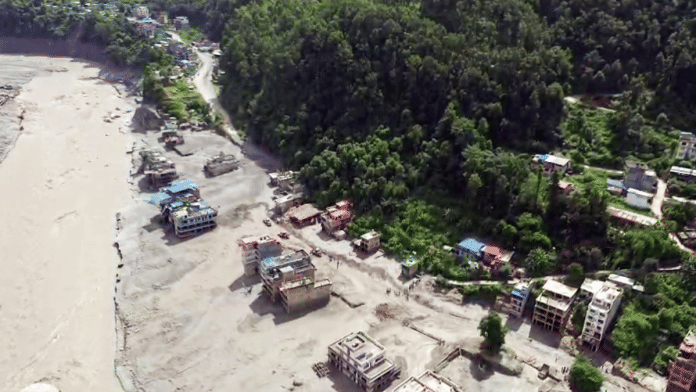
New Delhi: Nepal is seeking compensation from major greenhouse gas emitters, US, India and China for the Rasuwa flash flood.
Nepal Foreign Minister Shishir Khanal Tuesday said Nepal’s own greenhouse gas emissions were “practically negligible”, yet the country was bearing the brunt of a crisis it had done little to create.
“We are shifting our diplomatic framework from ‘aid’ to ‘justice and compensation’. This is not a matter of charity; it is a matter of legal and moral liability. The major industrial emitters—such as China, which is the world’s top emitter, the United States at number two, and India at number three—have a historical responsibility to compensate vulnerable nations like Nepal,” Khanal said in an interview with local television channel Kantipur TV.
India emits approximately 4.4 billion metric tons of CO₂-equivalent each year, contributing 7.3 percent to 8.3 percent of annual global greenhouse gas, making it the third-largest greenhouse-gas emitter globally. China remains the world’s biggest emitter, accounting for roughly 29 percent to 33 percent of global CO₂ emissions. The United States ranks second, with annual emissions of nearly 6.2 billion metric tons, roughly 12.7 percent to 15 percent of global emissions.
Nepal PM Balen Shah has also called for Nepal to raise the issue of compensation more forcefully with the international community.
Khanal said: “To this end, the Ministry of Finance has officially dispatched a formal climate compensation claim letter to our international partners. We will be raising this issue with absolute firmness and clarity at every upcoming international forum.
“This is a matter of civilisational survival. If our Himalayan glaciers disappear, the water security of over two billion people in South Asia—dependent on rivers like the Ganges and the Trishuli—will be permanently compromised. We are advocating not just for Nepal, but for the survival of South Asian civilisation.”
Nepal is now considering taking that message directly to the United Nations. Government officials have begun discussions over whether Prime Minister Shah should attend the 81st United Nations General Assembly and use the gathering to highlight the effects of climate change on Nepal, including the recent Bhotekoshi floods, while demanding climate justice.
The council of ministers has already decided that Foreign Minister Khanal will attend the General Assembly. But officials are weighing whether Shah should travel now too, arguing that the issue could carry greater political weight if presented personally by the prime minister. The issue was also raised at a meeting convened by Nepalese Finance Minister Swarnim Wagle, attended by several cabinet ministers and experts, according to local media.
India has long stressed the principle of climate equity, pointing to its relatively low per-capita emissions and arguing that climate responsibilities must reflect countries’ historical emissions, development needs and capacity to act.
New Delhi has also maintained that Western nations, which industrialised earlier, have consumed a disproportionate share of the world’s carbon budget. At the same time, India has supported international efforts to address loss and damage in vulnerable developing countries and has called on developed nations to provide adequate financing to help them cope with climate-related impacts.
After the floods, Nepal has now formally approached the Fund for Responding to Loss and Damage for urgent financial assistance following the devastating flash floods in the Bhotekoshi river basin on 26 August, according to The Kathmandu Post.
The fund was agreed upon at COP27 in 2022 and became operational at COP28. Nepal’s request is reportedly its first application for assistance from the mechanism.
Maheshwar Dhakal, a joint secretary at Nepal’s Ministry of Forests and a member of the fund’s board, was quoted saying the scale of the disaster had created an enormous burden involving search and rescue operations, emergency relief, rehabilitation and reconstruction.
“Since we are genuinely suffering from the adverse effects of climate change, we have approached the board,” Dhakal said. He added that Nepal was seeking an urgent response rather than waiting for the board’s next scheduled meeting in December.
In its letter, Nepal said the floods had struck a fragile transboundary mountain river system and demonstrated how extreme events in the Himalayan cryosphere can rapidly move from high-altitude areas into densely populated regions downstream.
Nepal’s death toll from the Bhotekoshi flash floods along its border with Tibet has surpassed 1,000, according to the country’s disaster management authorities with at least 3,900 people missing.
India has sent 68.5 tonnes of relief supplies, along with technical teams, forensic experts and specialised equipment to support search-and-rescue efforts. The fourth relief flight, carrying an additional 11 tonnes of assistance, arrived in Nepal Monday, MEA said.
(Edited by Viny Mishra)
Also read: No sirens, just scrambling. The uneven reality of Nepal’s early warning systems
Per capita emission numbers please. Thank you.