





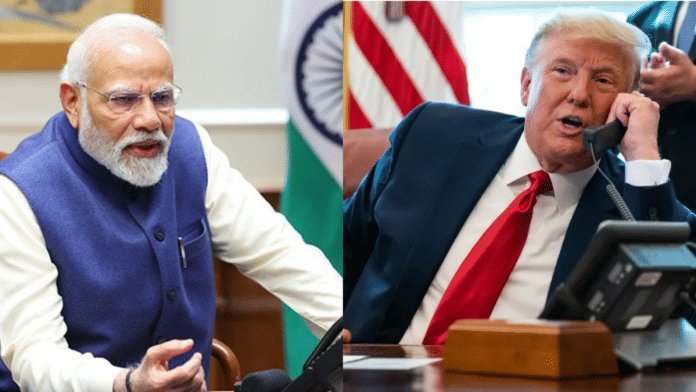



New Delhi: Prime Minister Narendra Modi and US President Donald Trump discussed the situation in West Asia and the “importance of keeping the Strait of Hormuz open and secure” during a call late Tuesday evening.
“Received a call from my friend President Donald Trump. We reviewed the substantial progress achieved in our bilateral cooperation in various sectors. We are committed to further strengthening our Comprehensive Global Strategic Partnership in all areas. We also discussed the situation in West Asia and stressed the importance of keeping the Strait of Hormuz open and secure,” Modi said in a statement after the call ended on the social media platform X.
US Ambassador Sergio Gor, in a separate statement, called the call “very productive” and asked everyone to “stay tuned!” for the outcomes.
This is the second call between Modi and Trump in the last three weeks. The call comes as the fragile ceasefire between the US, Israel and Iran continues to hold for the last week.
Received a call from my friend President Donald Trump. We reviewed the substantial progress achieved in our bilateral cooperation in various sectors. We are committed to further strengthening our Comprehensive Global Strategic Partnership in all areas. We also discussed the…
— Narendra Modi (@narendramodi) April 14, 2026
The call also comes about 48 hours after the direct talks between the US and Iran did not reach a favourable conclusion to end the ongoing conflict in West Asia. The direct talks were held in Islamabad. The US delegation was led by Vice President J.D. Vance and consisted of Special Envoy Steve Witkoff and Jared Kushner, President Trump’s son-in-law.
The Iranian delegation included Foreign Minister Seyed Abbas Araghchi and Mohammad Ghalibaf, the Speaker of the Parliament of Iran.
The Strait of Hormuz remains effectively closed by Iran, following the start of the war on the last day of February. At a press briefing in New Delhi, Iranian Ambassador Mohamad Fathali Monday said that Iran is looking to introduce a new “mechanism” to allow the transit of ships through the global waterway.
The US has instituted a naval blockade on Iran, which came into effect on 13 April. The blockade is a part of Trump’s efforts to force open the Strait of Hormuz, despite the ceasefire.
For Iran, the blockade against its ports in the Persian Gulf and the Gulf of Oman is set to impact its ability to export oil, which remains a major lifeline for Tehran’s struggling economy. Last year, Iran exported roughly $30 billion worth of oil, primarily to China, as the country faces a number of sanctions imposed by the US.
The US’ naval blockade also curtails any imports to Iran, as Trump seeks to increase pressure on Tehran to accede to his demands. The two sides have been unable to agree to limitations on Iran’s nuclear programme. Furthermore, Iran has laid claim to the Strait of Hormuz as a part of its territorial waters.
Modi and Trump’s discussions on the state of the bilateral relationship revolved around trade. India and the US had announced a joint framework for an interim trade deal in February, days before the American Supreme Court struck down Trump’s powers to impose global tariffs through the International Emergency Economic Powers Act (IEEPA).
The deal remains in limbo, until the US is able to legally impose a global tariffs architecture. Currently, all countries face a 10 per cent tariff, through a different legislative Act—Section 122 of the Trade Act of 1974. However, it is timebound for 150 days till July 2026.
India has maintained that any trade deal with the US, once the new tariff architecture is in place, must ensure preferential access to Indian goods. The US is India’s largest export market despite almost six months of 50 percent tariffs imposed by Trump between August 2025 and February 2026.
Last week, Foreign Secretary Vikram Misri travelled to the US and met with a number of senior officials including Secretary of State Marco Rubio and Secretary of Energy Chris Wright. Rubio is set to travel to India at the end of May.
India is also looking to host the Quad Foreign Ministers’ meeting during Rubio’s visit to New Delhi, but is waiting on the availability of Australian Foreign Minister Penny Wong, as reported by ThePrint.
(Edited by Tony Rai)
Also Read: Trump’s fanboys in BJP are now proved wrong. Lesson here is to never personalise diplomacy