





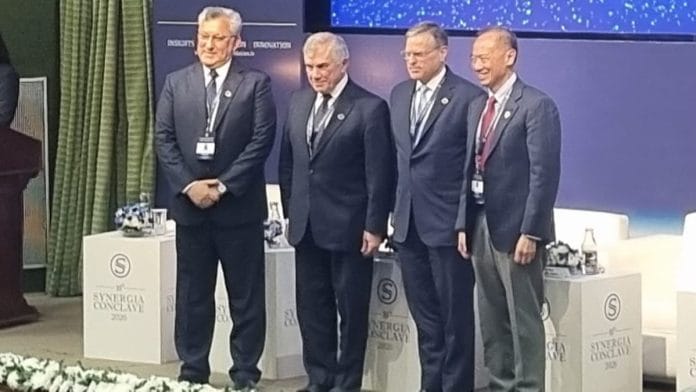



New Delhi: The McMahon Line, which was drawn up between the British Raj and the local Tibetan government, lacks international validity because China’s Qing Dynasty, which then held suzerainty over Tibet, was not a party to the agreement, George Yeo Yong-Boon, former foreign minister of Singapore, said Thursday.
Speaking at the 10th Synergia Conclave in New Delhi organised by the Synergia Foundation at the Manekshaw Centre, George Yeo said the McMahon Line was drawn at a time when England already acknowledged Chinese suzerainty over Tibet, rather than before, but the Qing Dynasty was not a party to the agreement.
“Therefore, it has no international validity. The British also asserted different lines at different times, which the Chinese were sometimes not even aware of,” George Yeo added.
While discussing the border dispute between India and China, George Yeo said the issue was fundamentally rooted in colonial history, rather than a natural antagonism between the two countries.
He added that the shifting borders drawn during the Raj were largely designed to keep China and Russia away from the Indian Subcontinent, which London considered its sphere of influence.
George Yeo argued that Beijing settled its land borders with most neighbouring countries, except India and Bhutan. Bhutan, he added, was waiting for India before reaching a settlement.
Strategic realities & the red line
Beyond the border dispute, George Yeo said stability in East Asia exists largely because Washington, DC, understands Beijing’s red line regarding Taiwan and that crossing it would have consequences.
“East Asia is, in fact, stable. I’m not saying accidents can’t happen, but it is stable. It is stable because the Americans know there will only be war over Taiwan if they cross the red line. China has drawn a very clear red line. So if they do not want an event there, they should move away from the red line,” he said.
George Yeo also highlighted China’s dominance in the production and processing of rare earth elements, which he said makes it indispensable for Western defence and high-tech industries.
He explained that while light rare-earth elements are found worldwide, China almost exclusively processes heavy rare-earth elements, such as terbium and dysprosium. Combined with its position as the world’s manufacturing hub, this gives Beijing significant leverage in the global economy, he opined.
Emphasising China’s energy capacity, he said the country already produces roughly three times the energy generated by the US and is rapidly diversifying into advanced, renewable, and cheaper energy sources.
To illustrate the difference, George Yeo said, “In China, the unit cost of electricity per household is about six cents, while in Germany it is more than 40 cents.”
(Edited by Madhurita Goswami)
Also Read: China restricts govt use of OpenClaw AI apps over security concerns