




New Delhi: The Quad Tuesday announced new initiatives aimed at strengthening maritime surveillance and port infrastructure across the Indo-Pacific, amid rising concerns over China’s expanding military footprint in the region.
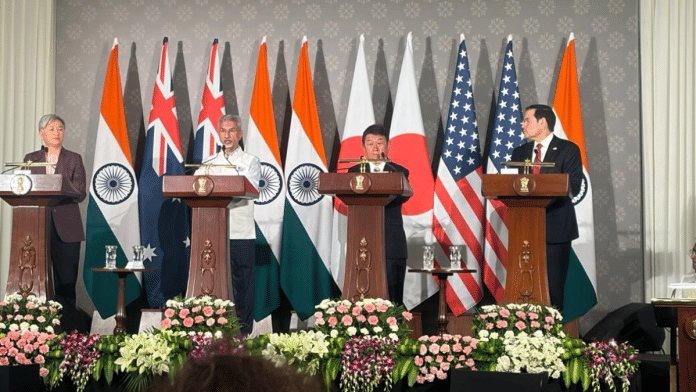
At a joint press briefing in Hyderabad House, US Secretary of State Marco Rubio said the Quad had agreed to launch an Indo-Pacific Maritime Surveillance Cooperation Initiative, alongside an expansion of the Indo-Pacific Maritime Domain Awareness Initiative among the four-member nation grouping.
India, Japan and Australia are the other three members of the grouping that was formed in 2007 and revived in 2017.
Rubio also announced a new Quad initiative focused on enhancing port infrastructure in the Pacific Islands and an Energy Security Framework.
He described the grouping as evolving into “a partnership of action,” announcing four major initiatives aimed at strengthening economic and strategic resilience across the Indo-Pacific.
“On the stage today are countries that collectively are about a third of the world’s GDP, and almost 2 billion people,” Rubio said, appearing alongside India’s External Affairs Minister S. Jaishankar, Australia’s Foreign Minister Penny Wong and Japan’s Foreign Minister Takeshi Iwaya.
“These aren’t just countries that have economic reach,” he added. “They are countries who share strong values, strong, vibrant democracies.”
Among the most significant initiatives unveiled was the launch of the Indo-Pacific Maritime Surveillance Collaboration, which Rubio said would integrate the surveillance capabilities of the four countries to improve information sharing across the region.
Related to that effort, the Quad announced an expansion of the Indo-Pacific Maritime Domain Awareness Initiative, providing near-real-time commercial maritime tracking data to Indo-Pacific partners to combat illegal fishing, trafficking and maritime threats.
“The reason why maritime security is so important is the fact that 60 percent of global maritime trade passes through the Indo-Pacific,” Rubio said.
The announcements came against the backdrop of growing concerns over freedom of navigation and strategic competition in Asian waters. While none of the ministers directly named China, the language of the meeting repeatedly echoed long-running Quad concerns over contested sea lanes and coercive maritime behavior.
Wong pointed to the broader geopolitical and economic uncertainty facing the region, including the implications of instability in the Middle East. “We know the world is more unpredictable,” the Australian Foreign Minister said. “We know the economic volatility is increasing.”
Referring to the Iranian closure of the Strait of Hormuz, she warned of consequences “for our energy security, for our economies and for our people,” while stressing on “the importance of maintaining the principle of freedom of navigation.”
The Quad ministers also announced a new partnership focused on Pacific infrastructure, beginning with a pilot port project in Fiji under the Quad Ports of the Future Partnership.
“We are also announcing the strongest ever commitment from the Quad to the Pacific through the ‘Quad: Ports of the Future’ partnership,” Wong said.
Rubio described the Fiji project as the first coordinated Quad port infrastructure initiative and suggested it could become a model for future projects across the Pacific Islands, where strategic competition for influence has intensified in recent years.
A third pillar of Tuesday’s announcements centered on supply chains and industrial resilience. Rubio added the four nations would establish a Quad Critical Minerals Framework to coordinate investments and strengthen supply chains for mining, processing and recycling critical minerals.
The ministers introduced a new Quad Indo-Pacific Energy Security Initiative, aimed at strengthening regional energy resilience through cooperation in technology, market analysis, policy coordination and emergency response mechanisms.
“The partners will work to identify areas of cooperation in technology, management, policy, international market analysis, and emergency response exercises,” Rubio said, adding that the US Department of Energy would host Quad partners later this year for a fuel security forum.
The Quad, he said, was determined to move beyond being “a place where we got together every now and then and discussed the problems of the world” and instead become“a forum of action where we can begin to turn our collective interests into action.”
The Japanese foreign minister said that the four countries discussed the Critical minerals framework by the QUAD and support for the de-nuclearisation of North Korea.
Similarly, Jaishankar framed the grouping as central to maintaining a “free and open Indo-Pacific,” while stressing deeper collaboration on supply chains, maritime commerce and critical technologies.
“As maritime democracies, pluralistic societies and market economies, we share the responsibility towards a free and open Indo-Pacific,” he said earlier during his opening remarks.
The meeting highlighted growing cooperation on cyber enforcement, undersea cable connectivity and anti-scam operations in Southeast Asia. Wong said the four countries were “working together to strengthen cooperation against scam centres” while expanding cyber coordination.
India and the US also signed a Critical Minerals Framework after the briefing. Rubio said. The groundwork was laid for this at the Critical Minerals Forum that was hosted in Washington D.C in February. The initiative gained momentum later that month when the Modi government signed on to Pax Silica at the India AI Impact Summit in New Delhi later that month.
(Edited by Tony Rai)