





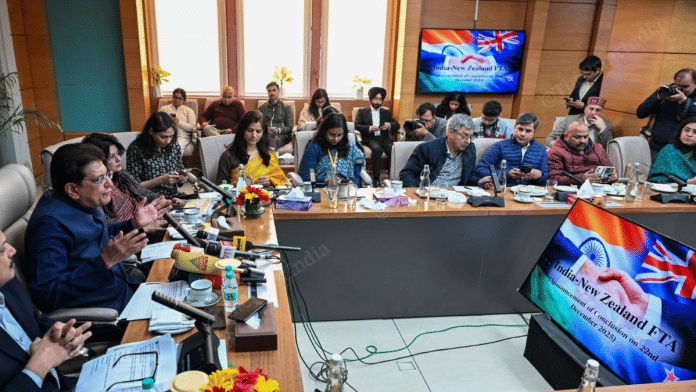



New Delhi: India and New Zealand Monday announced the conclusion of negotiations for a free trade agreement that is set to be signed during the first quarter of next year. However, New Zealand Foreign Minister Winston Peters, whose New Zealand First is a member of the governing coalition, announced that his party will vote against the trade deal.
Prime Minister Narendra Modi said that agreeing upon the FTA is an “important moment for India-New Zealand relations, with a strong push to bilateral trade and investment”!
“My friend PM Christopher Luxon and I had a very good conversation a short while ago following the conclusion of the landmark India-New Zealand Free Trade Agreement,” he said in post on X.
He added the FTA ensures enhanced market access, deeper investment flows, numerous opportunities for innovators, entrepreneurs, farmers, MSMEs, students and youth.
The negotiations for the FTA began in March this year and were concluded within nine months. It is currently undergoing a final legal review.
At a press conference Monday, Commerce Secretary Rajesh Agarwal said the expectation is to have the agreement signed by the two sides before the end of the first quarter of 2026.
The agreement is the seventh trade deal announced by India since 2021 and the third agreement with a Five-Eyes nation, following deals with Australia and the United Kingdom.
Additionally, India is set to agree to a terms of reference with Canada in the early months of 2026, and is currently negotiating a deal with the US. If it is able to conclude negotiations with both Washington D.C. and Ottawa, then New Delhi would have bilateral trade agreements with all members of the Five-Eyes alliance.
Also Read: India-Oman FTA lets Muscat export marble blocks, reducing New Delhi’s dependence on Turkey
Market access
The agreement with New Zealand will see 100 percent market access for Indian goods once it enters into force, possibly as early as the second half of 2026. In return, India will offer market access for roughly 70.03 percent of its tariff lines for goods from New Zealand, while seeing the average duties fall to 9.06 per cent by the tenth year of the agreement coming into effect.
However, the deal excludes access to the Indian market of dairy, animal products, vegetable products, artificial honey, arms and ammunition, copper and its articles, aluminium and its articles amongst other such exclusions.
An important moment for India-New Zealand relations, with a strong push to bilateral trade and investment!
My friend PM Christopher Luxon and I had a very good conversation a short while ago following the conclusion of the landmark India-New Zealand Free Trade Agreement.…
— Narendra Modi (@narendramodi) December 22, 2025
The exclusion of dairy products from the deal has led to Peters, a member of the ruling coalition in Wellington, to come out against the deal.
In a statement on X, Peters, who has also formerly served as the former deputy prime minister of New Zealand, called the deal “neither free nor fair” with too much being given to India for little in return.
“New Zealand First urged its coalition partner not to rush into concluding a low-quality deal with India, and to use all three years of this Parliamentary cycle in order to get the best possible deal. We also indicated we felt it would be unwise for National to sign up to a deal with India when a Parliamentary majority for that deal was uncertain,” said Peters.
He added, “This is not a good deal for New Zealand farmers and is impossible to defend to our rural communities. The India FTA would be New Zealand’s first trade deal to exclude our major dairy products – including milk, cheese and butter. In the year to November 2025, New Zealand exports of these products were worth around $24 billion, or 30% of our total goods exports.”
The sixth National Government led by Prime Minister Christopher Luxon since November 2023 has a governing majority of 13 seats in the 123-seat New Zealand Parliament. Peters’ New Zealand First currently has eight members in the House of Representatives of the country.
The next steps of the agreement for Wellington includes the official signing of the deal, followed by the Foreign Affairs, Defence and Trade Select Committee reviewing the final agreement, and a national interest analysis. Public submissions will be called for, followed by the committee submitting its report to the Parliament.
The New Zealand Parliament will then consider the legislation required to implement the agreement. Peters has announced his New Zealand First will not support the governing coalition.
Key outcomes
Trade in both goods and services between India and New Zealand stands at $2.4 billion as of the 2024-2025 financial year.
Piyush Goyal, the Indian Minister for Commerce and Industry, announced Monday that the goal is to double this figure to $5 billion within five years after the FTA comes into force.
New Zealand’s total global trade was roughly $89 billion in 2024. India’s merchandise trade with New Zealand was worth $1.298 billion in the 2024-2025 financial year.
Under the agreement, Wellington will drop all duties on 8,284 tariff lines the moment the FTA is operationalised. While the average tariff for Indian exports to New Zealand is currently roughly 2.2 per cent, in key sectors such as textiles, leather, automobile goods and auto components, exporters from India face an average tariff of 10 per cent.
New Zealand will also allow greater access to 118 sectors under services, apart from offering a number of mobility schemes including visas for Indian students studying in the country.
A quota of 5,000 visas for Indians seeking temporary work visas for up to three years in New Zealand will be introduced as well, while 1,000 young Indians will have the opportunity to enter the country through the Work Holiday visa scheme.
Furthermore, New Zealand has promised roughly $20 billion in investments in India over the next 15 years. The investment will be through the foreign direct investment (FDI) route only, as announced by Goyal.
India in return will offer market access to 106 service sectors and the most-favoured-nation tariffs will be extended to a further 45 services sectors. In agriculture, New Zealand will be allowed to export kiwifruits, manuka honey, apples and albumin with reduced tariffs with specific quotas introduced for each of the agricultural goods.
Roughly 30 per cent of tariff lines in goods such as wood, wool, sheep meat, leather and raw hides will see an immediate elimination of duties by India once the FTA comes into force.
A further 35.6 per cent of tariffs lines that includes goods such petroleum products, vegetable oils and mechanical machinery will have a phased elimination over a period of time, while 29.97 percent of goods are excluded from the agreement including dairy products, animal products other than sheep meat and vegetable products.
Around 4.37 percent of tariff lines for goods such as wines, pharmaceuticals, polymers, aluminium and steel articles will see a reduction in duties by India. Amongst the other documents agreed to include a “Side Letter on consultations related to the dairy sector in review of the FTA.”
Goyal made it clear that consultations on dairy products under the FTA will be activated only if India allows access to foreign dairy products in a different trade deal with an economy of a “comparable size” with New Zealand.
“This (side letter) does not matter as India will not open up its dairy sector. Furthermore the letter allows for discussions and makes no commitments,” said Goyal.
(Edited by Ajeet Tiwari)
Also Read: FTA signed, UK eyes easier entry for its beauty, skincare brands in Indian markets
New Zealand is a small country compared to a market of our size. We don’t really gain much but they gain so much from it and they think it’s unfair ?
Our market size continues to grow while they have peaked out. Farmers in our country can’t be screwed without getting necessary reforms in place.