


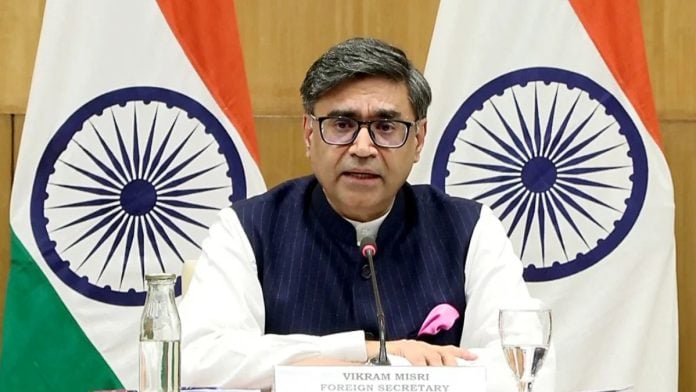
New Delhi: The 2018 Eminent Persons Group report on India-Nepal boundary issues is no longer “relevant” in the relationship between the two countries, as New Delhi and Kathmandu are “looking forward”, said Foreign Secretary Vikram Misri Monday. The two governments are also looking at reviewing the Treaty of Friendship, which was signed in 1950 and the current basis for ties, he added.
The discussions around boundary issues, to be steered by the Foreign Secretaries of the two countries, along with development aid worth Rs 15,000 crore ($1.6 billion) were among the major outcomes of Nepal Prime Minister Balendra (Balen) Shah’s two-day visit to the Indian capital.
Briefing the media following Shah’s visit, Misri categorically said that the visit underlined the need for a “future looking” relationship, pointing to the Joint Vision Document issued by the two governments after the two Prime Ministers met Monday morning.
“I would say that the [Eminent Persons Group report] is in the past. We are looking at a forward looking approach to this particular issue [boundary], we are not looking backward, and to me therefore, the report is not relevant. It pertains to the past. We need to look ahead, we need to look forward,” said Misri, when questioned on the report that was finalised by the committee looking into it in 2018, but has not been submitted or finalised by the two governments yet.
India and Nepal had constituted the Eminent Persons Group (EPG) in July 2016, consisting of eight members—four each from the two countries—to review the entire gamut of the legal relationship between them (such as the Treaty of Friendship), as well as any pending boundary disputes.
The EPG was established for a term of two years. By July 2018, it had finalised its report, but did not submit it to the respective governments—leaving it in cold storage. Misri’s latest comments point to the end of the EPG process, with Prime Minister Narendra Modi and Shah agreeing once again to review the entire gamut of ties, in a different process.
“The two leaders agreed that the bilateral partnership should reflect contemporary political, economic and technological realities, and should be based on an updated and forward-looking legal framework, where existing bilateral agreements,including the 1950 Treaty of Peace and Friendship, could be reviewed on the basis of mutual consent. All outstanding matters, including those related to water resources, energy, trade & commerce and boundary, are to be resolved through mutual discussion and dialogue,” read the joint vision statement, titled “Viksit Bharat and Samunnat Nepal: Re-imagining the Partnership”, issued Monday.
Misri pointed out that this was not the first time the idea of “reviewing” the treaties appeared in “bilateral documents”. He added that the “mechanics” for updating the treaties has not yet been decided, but highlighted the possible process going forward.
“I invite your attention to the mechanisms that are already existing between the two sides. There is the mechanism of foreign office consultations. The two Foreign Secretaries lead that. There is also the joint ministerial commission between the two countries. The Foreign Ministers lead that,” the Indian Foreign Secretary explained.
He added: “Obviously we need to first see which are the areas under this that we want to get into…But we do see the point that with the new government in place, with the desire to have a more contemporary, relevant and forward looking framework for the relationship between the two countries, that this document, which is already more than 75 years old, can perhaps be re-looked at.”
Misri continued his explanation by pointing out that both countries would have certain priorities which would have to be re-examined, and that once the “homework” is done by both governments, they would find a mechanism that is appropriate to look into the treaties.
These outcomes stem from the Modi-Shah bilateral meeting that lasted for over two hours Monday at Delhi’s Hyderabad House. The Nepal PM had arrived in India Sunday. He also called on Indian President Droupudi Murmu Monday evening before departing for Kathmandu.
The boundary issue has been a long-simmering dispute, which came to the fore earlier this summer as well, when Kathmandu objected to India and China opening the Lipulekh pass for the Kailash Mansarovar pilgrimage. Nevertheless, Misri has pointed to a “forward looking framework” to discuss all these issues, which has been agreed to by both PMs.
Rs 15,000 cr in assistance to Nepal
The other major outcome is the Rs 15,000 crore assistance package announced by India for Nepal. Prime Minister Modi pointed to the glacial floods that hit Nepal at the end of August this year, which left over 1,000 people dead and caused widespread destruction, with losses estimated at around $5 billion.
“India will extend development assistance of INR 15,000 crores (NPR 24,000 crores) comprising a grant assistance of INR 3,500 crores (NPR 5,600 crores) for post-disaster reconstruction and new infrastructure projects in Nepal; and a Rupee-denominated Line of Credit of INR 11,500 crores (NPR 18,400 crores) for energy sector projects. Specific projects as well as modalities for the provision of development assistance will be finalized through mutual consultations,” the Joint Press Release said.
Misri explained that the Rs 11,500 crore Line of Credit will be almost entirely focused on energy infrastructure projects in Nepal, while Rs 3,500 crore will be a grant for reconstruction. This is the largest rupee-denominated financial assistance given by India to Nepal.
The two leaders also agreed to a High-Level Monitoring Group, led by the Foreign Secretary of Nepal and the Ambassador of India, to ensure the implementation of the envisaged projects. Misri highlighted that the terms of reference for the Line of Credit will be negotiated by the respective foreign offices, while the project-specific funding will be screened by the monitoring group.
(Edited by Mannat Chugh)