





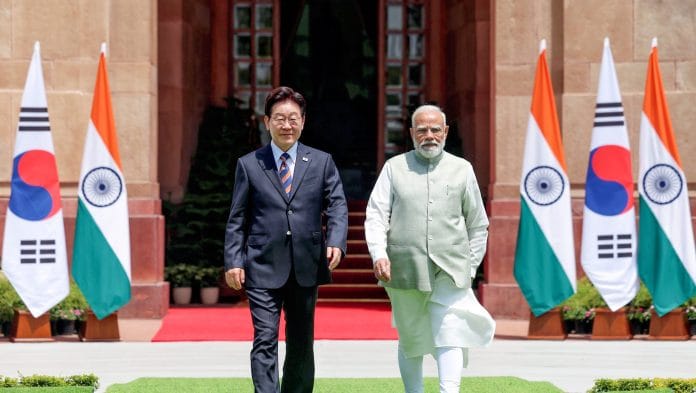


New Delhi: India is looking at different kinds of anti-aircraft missile systems and other military hardware, including co-development and technology transfer with South Korea, after Prime Minister Narendra Modi held bilateral talks with South Korean President Lee Jae-myung Monday.
The two leaders also agreed to discuss the establishment of a Korea-India Defence Accelerator to support defence startups as New Delhi and Seoul focus on deepening their strategic and commercial relationship. Lee Jae-myung’s visit to India comes amidst the West Asia conflict and North Korea testing a number of missile systems last week, heightening the situation across the Korean peninsula.
“Defence cooperation is another important area [of our ties]. There are a number of areas where we already collaborate in. South Korea supplies K-9 Vajra. There are already two phases of supplies that have happened. We are looking at the third phase, which will involve greater technology transfer,” P. Kumaran, Secretary (East) in the Ministry of External Affairs, said at a special briefing on the visit of President Lee.
Kumaran added, “We are also looking at other kinds of anti-aircraft guns and missile systems. We are looking at co-development, technology transfer and co-designing new generation defence systems. We are looking at collaborating in the procurement of more types of defence hardware.”
For almost a decade, India has been procuring the K-9 Vajra self-propelling artillery guns, a locally manufactured version of South Korea’s K9 Thunder artillery system, with the first order for 100 of these platforms first placed in 2017 for Rs. 4,500 crore. Hanhwa Corporation, the Korean defence conglomerate, partnered with Larsen and Toubro Limited (L&T). In 2022, India moved to procure more K-9 Vajras. In 2024, the Ministry of Defence signed a contract to procure 100 K-9 Vajras for the Indian Army at Rs. 7,628.7 crore.
Apart from focusing on more phases of closer defence cooperation, the two leaders also agreed to roughly 19 agreements, including four joint statements, and made six announcements across different sectors.
Lee Jae-myung landed in New Delhi Sunday for his maiden visit to the country, about a year since coming to power in Seoul. EAM S. Jaishankar called on the Korean President Sunday, highlighting New Delhi’s keen interest in reviewing and upgrading the already existing Comprehensive Economic Partnership Agreement (CEPA) between the two countries, Kumaran explained.
Modi and President Lee held bilateral discussions on Monday. The South Korean President is set to depart from New Delhi on Tuesday. This is the first visit by a South Korean president in eight years. The two leaders agreed to expand the existing bilateral trade to $50 billion by 2030.
“There are a number of areas, such as the trade imbalance, remaining. The CEPA came into force in 2010, when trade was around $14 billion between the two countries. Now it is at roughly $27 billion, but quite unbalanced. Our exports are around $6.5 billion, and their exports are worth $18.5 billion. Non-tariff barriers are also subject to the negotiations,” Kumaran added.
The Secretary (East) added that because this is a comprehensive trade deal, “we are also looking at investments and exports of services, which is one of India’s strengths.”
The two countries are looking to wrap up negotiations for CEPA “2.0” within the year. The South Korean President extended an invitation for Modi to visit the East Asian nation, an invitation accepted by the Indian Prime Minister. The goal is to have the CEPA negotiations “concluded” before the Prime Minister’s visit, said Kumaran.
The two leaders also discussed the multi-fold issues surrounding their individual regions, apart from a conversation on understanding how the West Asian conflict has impacted their respective economies.
India has supported the denuclearisation of the Korean Peninsula, a position appreciated by President Lee. The two leaders also discussed the importance of non-proliferation of sensitive technologies and preventing these technologies from falling into the hands of non-state actors.
Emphasis on shipbuilding
The other area that was comprehensively discussed by the two leaders is the manufacturing of ships. The two leaders agreed to a comprehensive framework for a partnership in shipbuilding, shipping and maritime logistics.
“Broadly, there is an acknowledgement that both countries are rich in terms of maritime traditions, serve a number of common interests and complementary strengths. South Korea has technology, globally acknowledged strengths in the area of shipbuilding, and we offer scale and are very eager to cooperate with them to produce a number of vessels, including next-generation vessels and green vessels,” said Kumaran.
He added, “Today’s agreement is in the nature of a comprehensive framework. Several initiatives have been taken as part of this. At the level of industries, one includes a non-binding MoU (memorandum of understanding) between HD Korea Shipbuilding (HD KSOE), the identified cluster developer and facilitator, the capital provider is the Maritime Development Fund, for joint development, financing, implementation and operation for a large greenfield shipyard in Southern India.”
The “emphasis” is on upgrading existing shipyards, including developing block-fabrication facilities and setting up new dry docks to construct large and specialised vessels, explained the Secretary (East).
The South Korean government will also be aiding India with skill training programmes, as well as financing and developing port infrastructure across India.
(Edited by Vidhi Bhutra)
Also read: Sunny smiles on a sunny morning: South Korean President & First Lady’s ceremonial reception