



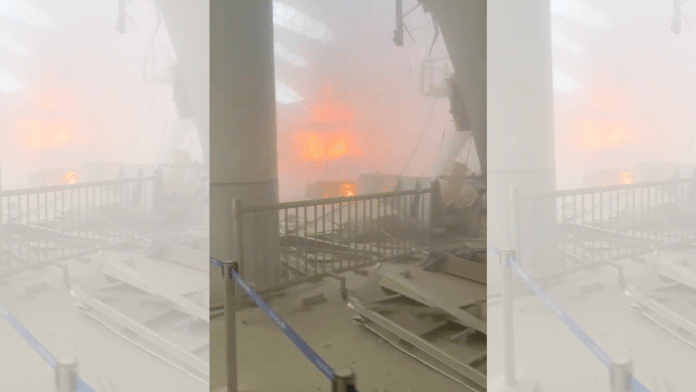
New Delhi: India has condemned the attack on Kuwait’s international airport Wednesday which left one Indian national dead and several others injured. Kuwait has claimed that the attacks emanated from Iran.
“We condemn the attack on the Kuwait International Airport today in which an Indian national has died and several of our nationals are injured. Since the onset of the conflict in West Asia, we have strongly urged that civilian population and civilian infrastructure must not be targeted. We again call upon parties to cease such attacks,” the Indian Ministry of External Affairs said in a statement.
“We offer our deepest condolences to the bereaved family. Our Embassy is extending all possible assistance to those injured. We remain in close contact with local authorities for the welfare of Indian nationals,” it added.
Kuwait’s military has said that it intercepted 13 ballistic missiles and 17 drones Wednesday morning. Bahrain has also said that it intercepted 3 Iranian ballistic missiles and a number of unmanned aerial vehicles the same day.
Iran’s Islamic Revolutionary Guard Corps (IRGC) says that its attacks were aimed at the US Fifth Fleet headquartered in Bahrain.
The strikes are latest in the ongoing back and forth between US and Iran, despite ongoing negotiations to end the war.
“The Ministry of Foreign Affairs expresses the State of Kuwait’s condemnation and denunciation, in the strongest terms, of the brutal and ongoing Iranian attacks using ballistic missiles and drones, the latest of which occurred at dawn today, targeting once again civilian and vital facilities, including Kuwait International Airport, resulting in the death of one individual, injuries to others, and damage to vital facilities, including diplomatic missions,” the gulf nation’s Ministry of Foreign Affairs said in a statement.
US President Donald J. Trump in an interview published by the New York Post, Wednesday, said that he hopes to hold a meeting soon with the new Supreme Leader of Iran, Mojtaba Khamenei. The Iranian leader has not been seen in public since the war began on 28 February. The younger Khamenei was made Supreme Leader in March, following the death of his father, Ayatollah Ali Khamenei, in the initial US-Israel strikes on the last day of February.
The US and Iran have been negotiating an end to the war, while a ceasefire continues to hold since 8 April. However, despite the ceasefire in place, the US and Iran have engaged in a back and forth in recent days. The US claims the strikes to be “self-defence”, while Iran maintains they are in retaliation to Washington’s actions.
Iran has, for the better part of the last three months, effectively closed the Strait of Hormuz, the international waterway connecting the Gulf countries with the rest of the world. The international waterway accounted for a fifth of global energy supplies before the war began.
A number of Indians, including Indian mariners, have been killed during the conflict. The Indian diaspora in West Asia number over nine million. India has consistently called on all warring parties to cease attacks on civilian infrastructure and maritime vessels.
In April, the Iranian Ambassador to India, Mohammad Fathali, was summoned by the Ministry of External Affairs after the Islamic Revolutionary Guard Corps (IRGC) opened fire on Indian-flagged vessels stranded in Hormuz.
Meanwhile the situation in Lebanon continues to deteriorate, with Israel striking Southern parts of the country. However, Tel Aviv has maintained the partial ceasefire brokered by the US earlier this week by not striking Beirut.
(Edited by Niyati Kothiyal)
Also read: Why Israel’s capture of crusade-linked Beaufort Castle in southern Lebanon is unlike any other siege