



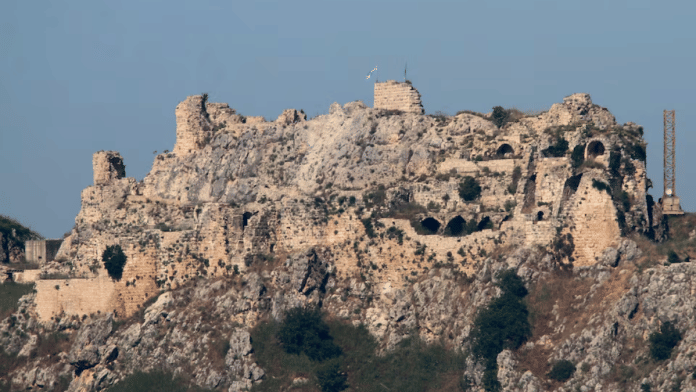
New Delhi: On Sunday, the Israeli forces announced the capture of the 900-year-old Beaufort Castle, also known as Qalaat al-Shakif, in southern Lebanon as part of a ground offensive beyond the original demarcation line of the Litani river.
The move marks Israel’s deepest military advance into Lebanon in more than two decades and comes despite a ceasefire nominally in place since April. According to the Israeli military, the latest operation was aimed at expanding what it calls a “Forward Defense Line” inside southern Lebanon.
“The IDF has crossed the Litani River and expanded its operations against Hezbollah targets north of the river. The operation is currently expanding to additional areas,” the Israel Defense Forces said in a press release.
Hezbollah had established significant military infrastructure in and around the Beaufort area with Iranian support, the Israel Defense Forces (IDF) said. The group, according to Israeli officials, used positions around the ridge to coordinate military activities and launch attacks against Israeli territory.
The military claimed that hundreds of rockets had been fired from the area toward Israel and Israeli troops operating in southern Lebanon.
Israeli Defence Minister Israel Katz announced that Israeli soldiers had raised the national flag over the fortress and added that Israel intended to maintain control of the position while continuing operations against Hezbollah infrastructure.
Prime Minister Benjamin Netanyahu described the operation as evidence of Israel’s determination and military initiative, calling Beaufort both a historic symbol and a strategic achievement.
His Lebanese counterpart Nawaf Salam accused Israel of pursuing a “scorched-earth policy” and imposing collective punishment on southern Lebanon.
History & significance
Perched atop a steep rocky ridge overlooking the Litani valley, Beaufort castle has been a strategic military position for centuries. Located around Nabatiyeh and around 14 km from the Israeli border, the fortress commands sweeping views across southern Lebanon and northern Israel. Its elevated position allows its occupier monitoring of troop movements and military activity across a vast area.
The castle was originally built by Crusaders in the 12th century, although earlier fortifications are believed to have existed on the site. The Crusaders named it “Beaufort” or “beautiful fortress” in Old French.
Over the centuries, the fortress has watched a change of hands repeatedly. Crusaders, Saladin’s forces, the Mamluks, the Ottomans, French colonial authorities, the Palestine Liberation Organisation (PLO), Israeli forces and Lebanese armed groups; all have controlled the site at different points in history.
Israel has captured Beaufort Castle, a 900-yr old fortress perched atop a strategic ridge in Lebanon. This is Israel's deepest military push in Lebanon in more than 25 yrs. Why does the castle's capture matter? @QundeelSamah explains. https://t.co/nVeeROh4c5 pic.twitter.com/894PA0R6jl
— ThePrintIndia (@ThePrintIndia) June 1, 2026
Today, Beaufort is regarded as one of the best-preserved medieval castles in West Asia and is recognised as a significant cultural heritage site. But its importance has more to do with its geography as it offers an extensive view of southern Lebanon and northern Israel.
Military planners have long considered it as one of the most valuable observation points in the region. Controlling the castle provides more than surveillance advantages. It enhances the artillery positioning opportunities and the ability to monitor military movements over a wide area. For that reason, Beaufort has repeatedly found itself at the centre of regional conflicts.
Why did Israel capture now
The fortress became particularly significant during the 1982 Lebanon War. Israeli forces captured Beaufort Castle from the PLO as part of a broader military campaign that eventually reached Beirut. The battle for the fortress became one of the defining episodes of the war.
Following its capture, Israel transformed Beaufort into a major military outpost and maintained control of the site throughout its occupation of southern Lebanon. Until the withdrawal in 2000, the fortress served as one of the most visible symbols of Israeli military presence in Lebanon. During that period, Hezbollah repeatedly targeted Israeli positions around the castle, turning it into a focal point of the conflict.
The fortress became closely associated with the occupation as seen in its presence in Israeli films, books and public debates about the human and political costs of the war. Following Israel’s withdrawal, the site underwent restoration and was reopened to visitors.
Israel’s capture of Beaufort has prompted strong international criticism. In a post on social media platform X, French President Emmanuel Macron wrote, “Nothing justifies the major escalation currently underway in southern Lebanon. France will continue its support for the Lebanese authorities in their efforts to restore state sovereignty and the country’s territorial integrity.”
French Foreign Minister Jean-Noël Barrot told French news television network BFMTV that the situation was a “major mistake for Israel,” describing Tel Aviv’s growing occupation of Lebanese territory as “unacceptable”.
Germany and the UK have also expressed concern over the escalation. British Foreign Secretary Yvette Cooper warned that the conflict has displaced civilians and it must end. “Israel’s military escalation in Lebanon has killed and displaced civilians, destroyed infrastructure, and eroded space for diplomacy,” Cooper wrote on X. “It must end.”
German Foreign Minister Johann Wadephul said that the Israeli army’s advance further into southern Lebanon was a “cause for serious concern”.
(Edited by Tony Rai)