





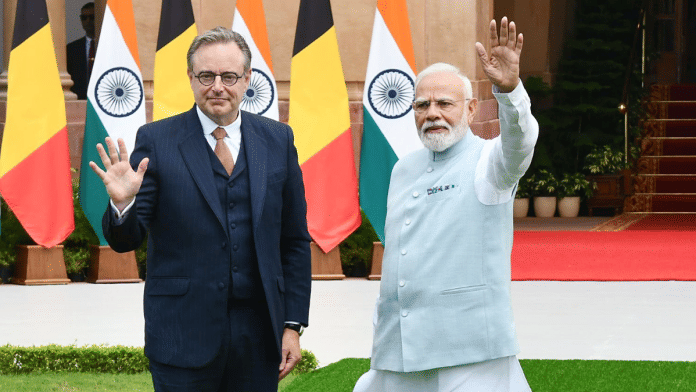

New Delhi: India and Belgium Thursday announced deeper engagement in emerging sectors such as refining and recycling of critical minerals, cooperation in semiconductors, and intelligence sharing following the meeting between Prime Minister Narendra Modi and Belgian Prime Minister Bart De Wever in the national capital.
“A clean energy future and reliable supply chains are our shared priorities. The MoU signed today on renewable energy will give fresh momentum to our cooperation on sustainability. We have decided to enhance cooperation in the processing and recycling of critical minerals,” Prime Minister Narendra Modi said during the joint press statement at Hyderabad House.
Modi added: “Belgium’s expertise in semiconductors complements India’s scale. In this regard, we will work together to link Belgium’s IMEC institute with India’s semiconductor ecosystem.” The Indian Prime Minister further stated that the two countries will sign a mobility agreement in the near future to help facilitate movement of talent labour.
De Wever is in India for a three-day official visit—his first since taking office in February 2025. Apart from holding bilateral talks with Modi Thursday, he also visited Rajghat and paid tribute to Mahatma Gandhi. The Belgian PM is travelling to Mumbai where he will hold further meetings Friday before departing India.
He underlined that India is growing “increasingly important” for Brussels in his own press statement, while highlighting that the European country will no longer be “naive” when it comes to international trade.
Among agreements signed between the two countries are a letter of intent on defence cooperation, a memorandum of understanding (MoU) on combating transnational crimes and cybercrimes, a MoU on renewable energy and an agreement for diplomatic training.
This is the second major Belgian delegation to travel to India in the last 18 months. In March 2025, Belgian Princess Astrid led an economic mission which saw over 40 MoUs signed. This is the first visit by a Belgian Prime Minister in two decades.
The conclusion of negotiations for the Free Trade Agreement between India and the EU has also provided an opportunity for European nations to deepen their economic engagement with India.
“The two leaders expressed satisfaction at the growth and diversification of bilateral economic ties and welcomed expanding cooperation in areas such as semiconductors, chemicals, pharmaceuticals, defence industrial collaboration, critical minerals refining and recycling, sustainable industries, and nuclear energy, including by exploring emerging opportunities for cooperation involving private sector stakeholders,” the Joint Statement agreed to by both leaders said.
De Wever announced that he is “looking forward to welcoming” Modi to Belgium in December, maybe even a visit to the city of Antwerp to sign the agreement. India and the EU are currently completing the legal vetting process of the agreement. Once the vetting process is complete, the EU Parliament must authorise the Commission President to sign the deal on behalf of the organisation, before the actual signing ceremony can take place.
At a more strategic level, India and Belgium have sought to deepen its defence and security ties. Minister of Defence Rajnath Singh held meetings with his Belgian counterpart Theo Francken earlier Thursday morning, where roughly 10 agreements were signed.
De Wever condemned the terrorist attack in Pahalgam last year, as well as conveyed Belgium’s “solidarity” in standing with India in its fight against cross-border terrorism, according to the Joint Statement.
“Prime Minister Bart De Wever conveyed Belgium’s solidarity with India in the fight against terrorism, including cross-border terrorism. He once again condemned the terrorist attack on innocent civilians in Pahalgam, Jammu & Kashmir, India in April 2025. Both leaders underscored their commitment to a comprehensive/global approach to counterterrorism and affirmed that terrorism, in any form and manifestation and anywhere, could never be justified, and called for its perpetrators to be held accountable in accordance with international law,” said the Joint Statement.
The statement added: “They agreed that the international community must act together, against terrorists and terrorist entities including those designated by the UNSC 1267 sanctions regime, terrorist networks, their safe havens and their financing, including through the UN and FATF. The leaders called for strengthened international cooperation in preventing and combating terrorism, including through sanctions mechanisms at the national, regional and international levels.”
A substantial portion of the discussions between both leaders were on the global situation. Both of them agreed to the necessity of “comprehensive, just and lasting peace” to end the Russia-Ukraine war, while calling for dialogue and diplomacy to resolve the crisis in West Asia.
The Joint Statement further highlighted that both countries back their respective bids for non-permanent terms to the United Nations Security Council (UNSC).
(Edited by Gitanjali Das)
Also Read: ‘New Delhi was seen as difficult & protectionist, EU-India FTA a new chapter,’ says Polish envoy