





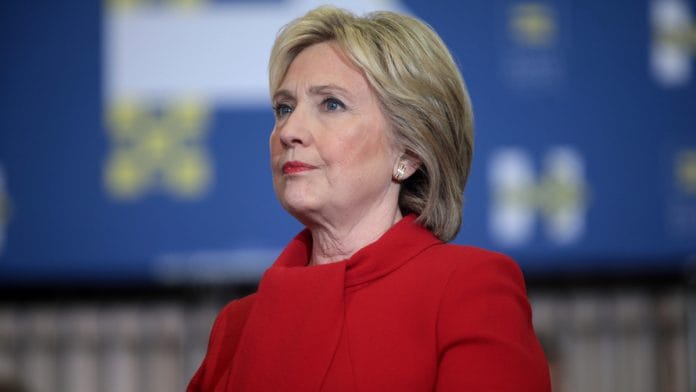

New Delhi: Former Secretary of State Hillary Clinton Monday said that India and China could play a central role in helping US President Donald Trump find a way out of the escalating conflict with Iran.
“If you want to figure out how Trump can get out of this, I think the key to it is probably China and India,” Clinton said during a conversation hosted by the Hamptons Institute. “Because if you look at who buys the most oil and gas from Iran, it is China and India.”
Clinton said China, in particular, has a strong interest in preventing the conflict from escalating, given its reliance on Iranian energy. “The Chinese have the highest interest in trying to get this resolved,” she said. “That is who I would be pressuring more than anybody else right now.”
Asked whether she would impose secondary sanctions on China to force Beijing to help resolve the crisis, Clinton said she would use the threat as leverage.
“I would certainly tell the Chinese I was unless they were going to help us to try to get the Iranians to open the Strait of Hormuz and try to go back at least to the status quo ante,” she added.
Clinton also argued that the United States had misjudged the resilience of Iran’s political and military establishment. While American intelligence had enabled strikes against senior Iranian leaders, she said, killing the leadership had not produced the collapse of the Iranian government that some in the Trump administration may have expected.
“It was pretty amazing that there was intelligence to target the Ayatollah and the leaders of the clerical and military and political branches of the Iranian government,” Clinton said. “However, it did not collapse the Iranian regime,” she stated. “It did not have the promised effect that I think it promised to Trump and his major advisers.”
“If you want to know who runs the country and who runs the economy, it is the military,” she added.
The lesson, she argued, should be a shift away from military pressure and toward diplomacy. Clinton said China and India’s economic relationship with Iran could give Washington an avenue for pressuring Tehran to reopen the Strait of Hormuz and restore conditions that existed before the current escalation.
“It does seem to me that that is where the best pressure would come if Trump were willing to use diplomacy instead of bluster,” she said.
Clinton also said the United States was already seeking to restrict Iran’s oil revenue, describing the country as effectively blockaded while noting that Iranian oil was still being moved through alternative routes.
“The Chinese have the highest interest and try to get this resolved,” she said. “That is who I would be pressuring more than anybody else right now.”
Trump Monday launched an ‘economic D-Day’ campaign against Iran, imposing sweeping secondary sanctions aimed at cutting off Tehran’s access to global trade and crippling its remaining economic lifelines, including some in China. The escalation comes after a fragile 60-day ceasefire between the United States and Iran expired.
In a reply, China said it would defend its interests after Washington unveiled plans for the “economic asphyxiation” of Iran. “China has already stated many times that it firmly opposes illegal unilateral sanctions… China will take all necessary measures to firmly safeguard its own rights and interests,” Chinese Foreign Ministry spokesman Lin Jian said at a regular briefing.
China is Iran’s biggest trading partner and its main oil customer, accounting for about 90 per cent of Iran’s oil exports. In March, the US-China Economic and Security Review Commission described China and Iran as part of an informal “Axis of Autocracy’ claiming China helps Iran get around US sanctions, while Iran provides China with relatively cheap oil. The two countries also work together to challenge the US-led international order through groups such as BRICS and the Shanghai Cooperation Organization (SCO), the commission claimed.
India, the world’s third-largest oil importer and consumer, had not imported Iranian crude since May 2019 after US pressure forced Indian buyers to stop purchases. But supply disruptions linked to the US-Israel conflict have increased pressure on Indian refiners to secure alternative sources. However, India does get about 40 percent of its crude oil, 60 percent of its liquefied natural gas (LNG), and roughly 90 percent of its liquefied petroleum gas (LPG) imports through the Strait of Hormuz.
Indian refiners resumed buying Iranian oil in April as disruptions to supplies through the Strait of Hormuz tightened energy markets across West Asia. India has also purchased 44,000 metric tons of Iranian liquefied petroleum gas (LPG) carried by a sanctioned vessel in April.
(Edited by Nivedita Patil)
Also Read: Iran maintained strategic ties with India while Khamenei remained critical of Modi govt