





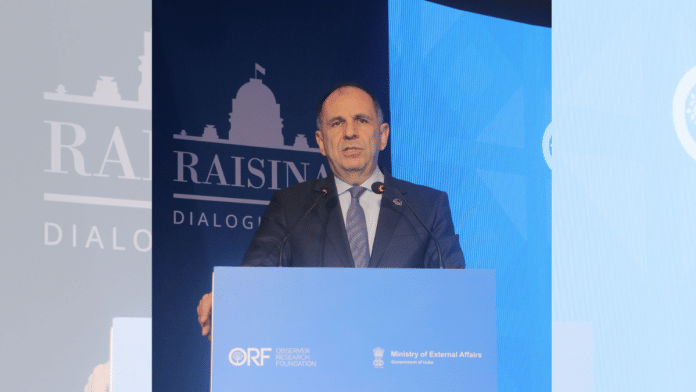

New Delhi: The India-Middle East-Europe Economic Corridor (IMEC) was a “project of peace” and Greece is at India’s doorstep to Europe, the country’s foreign minister Giorgios Gerapetritis gave that message Thursday at the Raisina Dialogue in New Delhi.
“This (IMEC) seems like a project that is long overdue… In order to preserve and restore peace, (in) a challenging time, we cannot afford to lose a single day. The war in Gaza and the turmoil in the Middle East is undoubtedly alarming and destabilising. But it cannot undermine the powerful effect behind IMEC,” Gerapetritis said at India’s annual premier conference on geopolitics.
The Greek minister added, “Instead, it can be a way of healing wounds in the broader region (West Asia)… It gives us all the more impetus to promote peace, given that IMEC is a project aiming at stability and prosperity for all participating countries.”
Gerapetritis said that both New Delhi and Athens were “ready” to do everything in “their power” to make IMEC a reality, “for the sake of democracy, for the sake of global prosperity”.
IMEC, announced on the sidelines of the G20 leaders’ summit last September, is a project that will reshape the trading route between Europe, West Asia and the Indian subcontinent.
The project will involve a sea route connecting western India with Saudi Arabia, followed by a rail link to the United Arab Emirates (UAE) and possibly Jordan or Israel, before taking a ship to Europe.
Greece, strategically located in the Mediterranean, is also home to one of the largest ports in Europe, that of Piraeus. Athens has been viewed as a key partner of the IMEC.
“Greek ports can and should be the corridor’s doorstep to Europe. Since ancient times, Greece’s strategic location at the physical and cultural crossroads, where three continents meet, has been a corridor for trade in goods and knowledge,” emphasised Gerapetritis.
The project has faced challenges since its announcement in September due to the war in Gaza and the situation in West Asia as a result of it.
‘India central to European Indo-Pacific strategies’
Countries across the world and the European Union (EU) were “prioritising” the Indo-Pacific region, asserted Dammu Ravi, secretary (economic affairs) in the Ministry of External Affairs, during his address.
“In the 21st century, many countries are increasingly prioritising the Indo-Pacific. Nations, the European Union (EU) in particular — we see the policies and strategies of the Indo-Pacific becoming increasingly important for them,” Ravi said.
He added, “India becomes central to the Indo-Pacific policies and strategies of the (European) countries. It is very natural why we are imagined that way. The growth that India is showing and demonstrating the openness of the economy, the investments and skills (sic).”
In his address, Ravi also emphasised the need for supply chain diversification, especially in the production and export of critical minerals and energy. He explained that such concentration of production would be perilous for the growth in the Indo-Pacific region.
“I know that like-minded countries across the vast expanse of the geographical spread of the Mediterranean Sea-Atlantic Ocean to the Indian Ocean will be able to stitch the narrative in a positive way and stitch collaborations for the good of people and prosperity,” he said.
(Edited by Tikli Basu)
Also read: With Modi at the helm, India and the Arab world have become closer than ever. Here’s why