



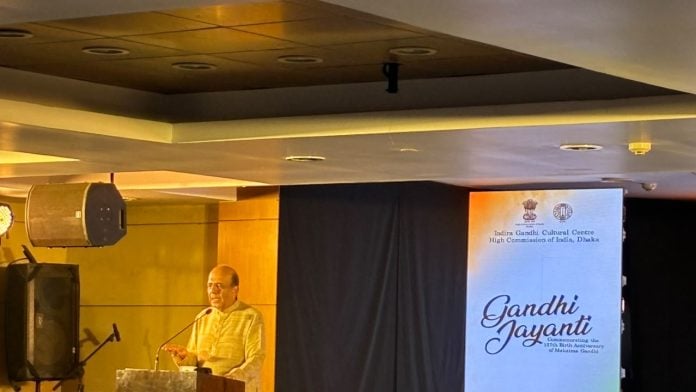
Dhaka: Mahatma Gandhi’s message of “peace and prosperity” coupled with his consistent introspection, is the need of the hour, highlighted Dinesh Trivedi, India’s High Commissioner to Bangladesh.
Speaking at the Indian High Commission’s commemoration of Gandhi’s 157th birth anniversary Friday, Trivedi underlined that “Bangladesh and Gandhi” can never be separated.
“Gandhi symbolises non-violence. He lived non-violence.That means that even the thought of violence is non-Gandhian…Gandhiji must be lived everyday,” said Trivedi.
The Indian High Commissioner added: “Gandhiji’s message does not require a passport or a visa. It is heard across borders. Gandhian philosophy and Gandhian thought is important in today’s world.”
Trivedi highlighted just as a ship follows a lighthouse when at sea, Gandhi’s thought remains a “lighthouse for humanity”, while highlighting the Mahatma’s personal relationship with Rabindranath Tagore, and love for football, a sport followed closely in both India and Bangladesh.
The Indian envoy further added that Gandhi is “important for Bangladesh,” and from a very young age focused on “introspection”. “Gandhiji, even wrote letters to Adolf Hitler, calling for peace. That was his level of belief in non-violence, and focus on peace and prosperity,” added Trivedi.
The commemoration of Gandhi’s birth anniversary this year in Dhaka, is the first headed by Trivedi since he assumed his role in June 2026. Indra Mani Pandey, the Secretary General of BIMSTEC (Bay of Bengal Initiative for Multi-Sectoral Technical and Economic Cooperation) also was present at the commemoration. India and Bangladesh are both members of BIMSTEC, and the secretariat of the organisation is in Dhaka.
Trivedi’s message of Gandhian values comes at a time when ties between New Delhi and Dhaka remain tense. The two sides have taken calibrated steps to stabilise ties, which had cratered following the ouster of former Bangladeshi Prime Minister Sheikh Hasina in August 2024.
In the last seven months, India has made important efforts to stabilise ties with new Prime Minister Tarique Rahman. However, despite the activation of a number of engagement mechanisms, there remains differences between New Delhi and Dhaka, due to Hasina’s continued stay in India.
The former Bangladeshi Prime Minister was ousted following student-led demonstrations against the quota for families of Liberation War fighters.
Hasina remains active in New Delhi, most recently holding a press conference on 5 August that she attended virtually. Dhaka has called for her extradition as an important condition of any visit by Prime Minister Rahman to New Delhi.
Since arriving in Dhaka, High Commissioner Trivedi has engaged heavily with various levels of the government of Bangladesh, to find common ground to take the relationship forward. He has called on Prime Minister Rahman, as well as Foreign Minister Khalilur Rahman.
A number of key challenges remain in the relationship including the renewal of Ganges Water Treaty which is set to expire in December 2026. Trivedi in comments to local media Thursday highlighted that ties are “positive” and that there is no rush for a visit to New Delhi by Prime Minister Rahman.
The Bangladeshi Prime Minister is expected to travel to Saudi Arabia, Türkiye and Japan in the next month.
(Edited by Amrtansh Arora)
Read More: Where are Gandhi’s descendants now? Doctors, filmmaker, RJ, but only a few politicians