



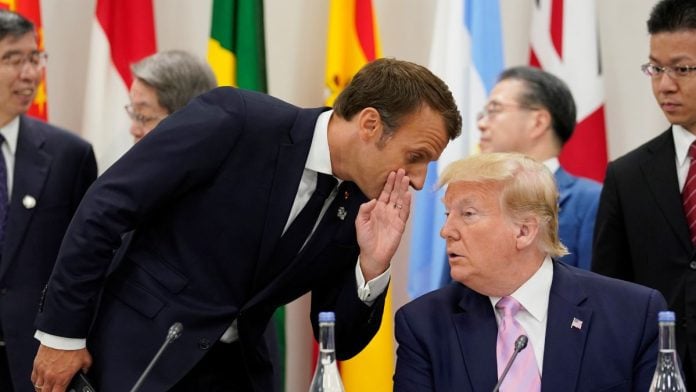
New Delhi: Amid the escalating energy crisis, French President Emmanuel Macron spoke overnight with both US President Trump and Canadian Prime Minister Mark Carney on the need to work together in tackling rising fuel prices, according to French diplomatic sources.
After his overnight call, a statement shared by AFP said G7 countries had agreed to release 100 million barrels of diesel and crude oil from reserves over the next four months.
In his discussions with Trump and Carney, Macron is learnt to have stressed that G7 countries share a common interest in acting in a concerted manner, without export restrictions.
France, which holds the rotating G7 presidency this year, is also working with the International Energy Agency (IEA) on a broader response, sources added. French officials further plan to convene a video conference of G7 leaders at the earliest to coordinate measures aimed at easing price pressures and securing supplies of crude oil and refined products, both within the group and across European markets.
As a result of disruptions to global shipping linked to the closure of the Strait of Hormuz, the price of oil surpassed $100 a barrel, resulting in shortages of key raw materials, Le Monde reported in March.
France is somewhat insulated by its nuclear-powered electricity system, but industries that rely directly on gas remain vulnerable.
The disruptions also threaten France’s broader push to rebuild its industrial base. While defense, aerospace and renewable-energy companies continue to benefit from strong demand, sectors such as automobiles, chemicals and steel remain under pressure from high costs, weak European demand and competition from China, the report added.
The G7 was born out of the 1973 oil shock as a forum for coordinating responses to major economic crises. More than five decades later, another energy shock threatens to reverberate through the global economy. Already strained by US tariffs and disputes over NATO and Greenland, it has since the beginning of the West Asia conflict been divided over US President Donald Trump’s decision to launch a military offensive without consulting other members of the group.
In Italy, Prime Minister Giorgia Meloni has warned of broader economic and social consequences. Higher prices have also weighed on public support for German Chancellor Friedrich Merz and French President Emmanuel Macron, who faces elections in April 2027.
Europe is particularly exposed because of its reliance on refined petroleum products from the Persian Gulf. Nearly half of the European Union’s jet-fuel imports and almost one-fifth of its diesel imports pass through the Strait of Hormuz, according to a Bloomberg report. Faster electrification, lower retail power prices and larger strategic fuel reserves are also moving up Europe’s agenda.
Edited by Amrtansh Arora
Also Read: In Dhaka, India’s envoy Dinesh Trivedi says ‘Bangladesh and Gandhi can never be seperated’