


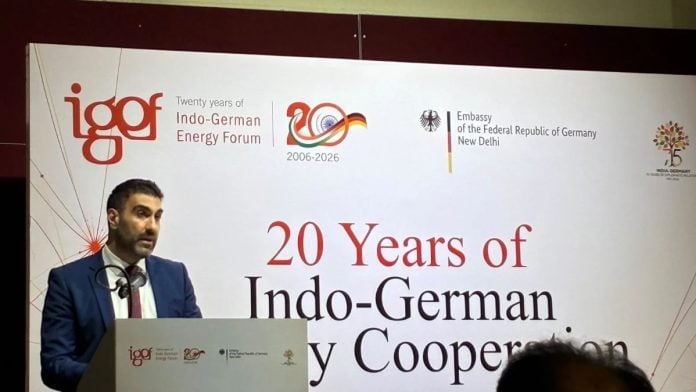
New Delhi: The European Union’s Carbon Border Adjustment Mechanism (CBAM) provides an opportunity for Indian and German businesses to cooperate more closely on developing green technologies, said Alexandre Callegaro, Minister Counsellor and Head of Department of Economic and Global Affairs at the Embassy of Germany in New Delhi Tuesday.
In an exclusive interaction with ThePrint on the 20th anniversary of the Indo-German Energy Forum (IGEF), Germany’s first bilateral energy partnership founded by then Chancellor Angela Merkel and Prime Minister Manmohan Singh, Callegaro highlighted that through IGEF, German technologies can help Indian companies in becoming more energy-efficient, thereby aiding the transition to renewable energies.
“IGEF is a big opportunity for India and Germany because our bilateral cooperation on energy efficiency, and on all the technologies that we’re developing together, can help Indian companies become more carbon-neutral and less carbon-intensive,” Callegaro said.
“IGEF offers Indian companies an advantage with regard to CBAM, because if factories and power plants become more efficient because of our cooperation, the carbon price Indian companies pay on an exported product will be reduced. This will give them an advantage with regard to CBAM.”
CBAM came into effect across the European Union (EU) earlier this year. The adjustment mechanism covers sectors, such as iron and steel, aluminium, cement, fertilisers, electricity and hydrogen.
The EU implemented the regime as a means to ensure that a price for embedded carbon is paid on imports of goods from these sectors. Indian firms have seen it as an additional barrier to entry into EU markets, especially as developing countries still have carbon-intensive industries.
Callegro and the German Embassy celebrated two decades of IGEF Tuesday. The forum was first set up in 2006 to help aid Indian industry through decarbonisation, integration of renewable energy and energy efficiency. There are five main pillars of cooperation—flexibilisation of existing thermal power plants, renewable energies, energy efficiency, green energy financing and grid integration, and green hydrogen.
“The point of our bilateral cooperation is that India sets the priorities. They tell us what they want to do, and we look at how we can support them with the technology, financing and Indo-German business cooperation projects, so that India can implement its goals,” explained Callegaro.
He added: “The latest projects and areas of focus are grid stability and battery storage. In fact, when Chancellor Merz last visited India and Prime Minister Modi in January 2026, we set up a joint working group on battery storage. We’re now looking at green hydrogen cooperation. Since 2024, we have a green hydrogen roadmap, and we will issue a joint call for tenders in the area of green hydrogen soon, because India wants to become a production hub for green hydrogen.”
Chancellor Friedrich Merz made his first visit to India in January this year. After his meeting with PM Narendra Modi, the two leaders released a joint statement expressing “satisfaction” on the “ongoing cooperation on Green Hydrogen, including work under the joint roadmap” within the IGEF.
Germany has shifted its focus on engaging with India in areas such as renewable energy and green technologies in recent years. In 2022, the German government committed at least EUR 10 billion to India by 2030 in areas like energy transition, urban infrastructure and renewable energy. The commitments were made as a part of the Green and Sustainable Development Partnership (GSDP).
Half-way through the 10-year period of the Green and Sustainable Energy Partnership between India and Germany, at least EUR 4.89 billion worth of commitments have been made by Germany. Callegaro underlined that Berlin is confident that it would achieve its target.
Around 90 percent of the funds committed under GSDP have been loans or equity participation in projects, while around 10 percent have been grants, as per the dashboard on projects publicly available.
The GSDP has funded 220 projects so far, with the largest being a EUR 500 million loan for the construction of the metro transportation system in Nagpur. Other projects include green energy power corridors, funding for Bengaluru metro, loans for energy efficient housing construction, and solar energy projects.
“Indo-German collaboration under GSDP has contributed to Government of India’s flagship programmes and projects such as PM e-Bus Sewa, the Solar Rooftop Programme, the National Green Hydrogen Mission, Ahmedabad, Surat and Bangalore Metro Rail Projects, the Water Vision 2047 as well as for, climate-resilient urban infrastructure in Tamil Nadu, battery storage project in West Bengal, the new Indo-German collaboration in the area of agro-photovoltaic and financing for public financial institutions to expand renewable energy,” the joint statement published by the Indian Ministry of External Affairs following Chancellor Merz’s visit to India in January said.
Callegaro pointed out that the bilateral partnership is also increasingly looking at critical minerals as they are “necessary” for energy transition projects.
During Merz’s visit to Ahmedabad this year, the two leaders “welcomed progress in cooperation in critical and emerging technologies, including semiconductors, critical minerals, digitalisation, telecommunications, health and the bioeconomy; which consolidates the Innovation and Technology Partnership Roadmap”.