





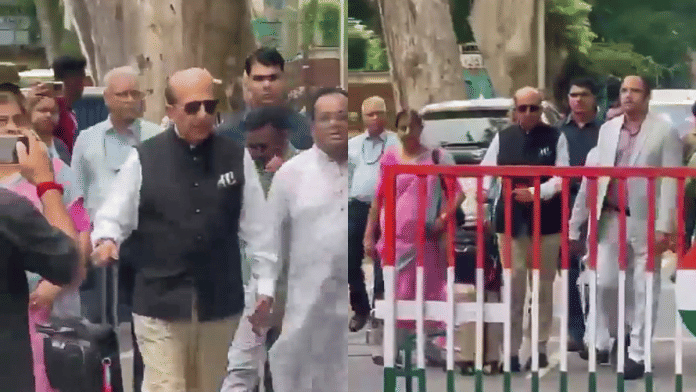


New Delhi: Dinesh Trivedi, India’s high commissioner-designate to Bangladesh, has reached the country to take charge of the Indian mission in Dhaka. Trivedi, a member of the Bharatiya Janata Party, and former union minister is a political appointee.
He crossed into Bangladesh at the Petrapole customs station, entering the South Asian country at Benapole. He was welcomed by the Deputy Indian High Commissioner and the current Charge D’Affaires Pawan Badhe.
Trivedi is expected to present his credentials soon, likely by next week, to the President of Bangladesh and assume formal charge of the mission. His appointment was announced by the Ministry of External Affairs on 27 April.
He will take charge at a time when ties between India and Bangladesh face renewed challenges. Dhaka continues to bristle over claims made by Indian politicians of “pushing in” alleged illegal Bangladeshi nationals across the border.
The controversy began at the end of April when Badhe was summoned by Bangladesh’s Ministry of Foreign Affairs over comments made by Assam Chief Minister Himanta Biswa Sarma over pushing in individuals who had allegedly illegally crossed the border.
Dhaka on 30 April handed over a note verbale detailing their strong objections to the policy. India responded within hours, with details of at least 2,862 individuals detained by Indian authorities for illegally staying in the country, pending verification by Bangladesh.
Bangladesh responded roughly a week later, conveying the issues it found with India’s position on the issue. The back and forth between New Delhi and Dhaka, first reported by ThePrint, has ruffled the relationship that was undergoing a thaw.
Five-time MP Dinesh Hiralal Trivedi was born in a Gujarati family. He did an MBA from the University of Texas at Austin in 1974. He worked in Chicago for two years before returning to India, where he worked for a logistics provider.
Trivedi joined the Congress in the 1980s, but switched over to the Janata Dal in 1990. In 1998, he joined Mamata Banerjee when she started the Trinamool Congress party and became its first general secretary. In 2021, he joined the BJP. He has served as the Union minister for Railways and Union minister of State for Health and Family Welfare.
For almost two years, India-Bangladesh ties have been in a deep freeze, following the ouster of former Prime Minister Sheikh Hasina in August 2024. Hasina fled Dhaka for New Delhi following student-led demonstrations against her government.
Relations broke down between the interim government led by Muhammad Yunus and New Delhi. The former chief adviser of Bangladesh had not made a visit to India during his tenure. However, India and Bangladesh made overtures to stabilise ties following the election of Tarique Rahman as prime minister in February.
External Affairs Minister S. Jaishankar travelled to Dhaka at the end of December to attend the funeral of former Prime Minister Khaleda Zia—Rahman’s mother. Speaker of the Lok Sabha Om Birla and Foreign Secretary Vikram Misri attended Rahman’s swearing-in in February.
Before leaving for Bangladesh, Trivedi visited Netaji Bhawan in Kolkata Thursday, where he highlighted that the two countries share “dreams”.
From the Ganges Water Treaty to issues over illegal immigration and push-in strategies, New Delhi and Dhaka have a number of challenges to wrestle with in the next few months. By December 2026, the Ganges Water Treaty will expire, and negotiations over its future will be a key challenge during Trivedi’s first six months in Bangladesh.
A number of mechanisms remain dormant, including consular-level discussions between India and Bangladesh. In June 2025, Dhaka made a request to reactivate the consular level mechanism, as issues regarding verification of individuals and illegal immigration can be discussed between the two governments. India has not yet responded to Bangladesh’s request to convene the mechanism.
(Edited by Viny Mishra)