





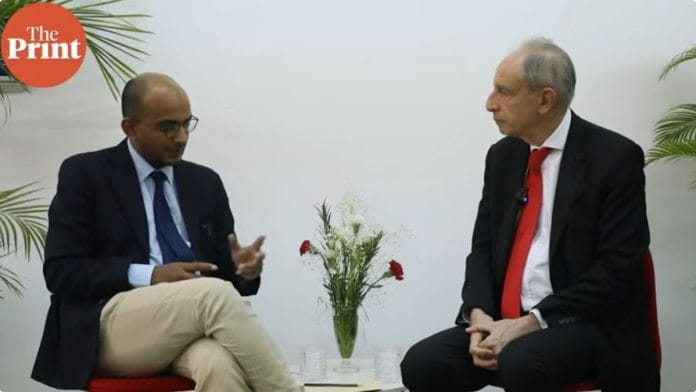



New Delhi: The “no limits” partnership between Russia and China raises concerns for the European Union (EU) and India, with Beijing viewed unfavourably by New Delhi and Moscow unfavourably by Brussels, the Polish Deputy Foreign Minister and Secretary of State Władysław T. Bartoszewski said Tuesday in an interview with ThePrint.
He hoped the growing closeness between Russia and China would allow India to take a longer look at its ties with Moscow, given the concerns New Delhi has with Beijing, especially in the last half decade.
“Keep in mind that this (China) is a country which you do not consider to be a very friendly one, who is helping Russia, which we consider to be a very unfriendly one towards us. So keep that in mind when you continue your relationship. And so we have honest discussions and it’s up to India to make up its mind,” Bartoszewski said.
He added: “Without China, that war would have stopped because China provides Russia with money, with buying oil and gas, the biggest buyer of Russian oil and gas, with access to technologies, with access to munitions, not Chinese, but North Korean… and 80 percent of dual use products, which can be normally in a Chinese fridge, but end up in a Russian missile. So we say to our friends in India, you have a difficult relationship with China.”
Russian President Vladimir V. Putin is set to arrive in India Thursday for a two-day state visit and also attend the annual India-Russia summit. New Delhi has maintained strong ties with Moscow since the outbreak of the war between Russia and Ukraine in February 2022.
Poland has been one of the biggest supporters of Ukraine, sending a number of military platforms including 320 tanks to Kyiv. Bartoszewski puts the figure of total support to roughly 4 percent of Warsaw’s overall gross domestic product.
The International Monetary Fund (IMF) estimates that Poland’s GDP in 2024 was around $914 billion and is set to cross $1 trillion by the end of this year, making it one of the twenty largest global economies in the world.
The Polish Secretary of State told ThePrint that the reason Russia has been able to drag this war out is entirely due to China and their continued support for Moscow over the last four years, from purchasing oil to the sale of dual-use technologies to keep the Russian military ticking.
Bartoszewski pointed out that it is thanks to “Prime Minister Modi and Xi Jinping, the President of China, that Putin did not use tactical nuclear weapons on Ukrainian territory.”
But Prime Minister Modi intervened as well, and Prime Minister Modi can persuade Putin because Putin listens to him, Bartoszewski said. “So, Prime Minister Modi has lots of authority and Putin, so it’s a good opportunity for the Prime Minister to help us towards peace,” he told ThePrint.
In the early days of the war, the European Union (EU), of which Poland is a member, had taken a sceptical view of India’s continued trade with Russia. India’s imports of Russian oil touched $56 billion in the last financial year.
The growth of Russian oil import to India was part of a global effort designed by the US and the G7 economies to cap oil prices emanating from Moscow to hit their war economy without distorting global energy markets, according to Eric M. Garcetti, former United States ambassador to India.
Warsaw, which maintains a border with Ukraine has been impacted by the war, with Russian loitering munitions and unmanned aerial vehicles crossing over into its Eastern regions in September 2025. Bartoszewski also alleged that Russian military intelligence has been behind suspected sabotage attempts cyber warfare with Warsaw.
“We’ve got sabotage attacks and lately an attempted terror attack, where two individuals sponsored or employed or hired by the Russian military intelligence, GRU… we found out… we know who they are… tried to derail a train moving at 100 miles an hour,” Bartoszewski said.
The war has seen Poland expand its military arsenal, becoming one of the largest importers of American arms with its overall military spending crossing 5 percent of its GDP earlier this year. Poland has also expanded its own defence-industrial complex, offering to partner with India in this strategic field.
Defence & strategic cooperation
India and Poland elevated their ties to a strategic partnership in August 2024 during Prime Minister Modi’s visit to Warsaw. A growing part of the relationship is in the defence sector, with Polish companies such as WB Group looking to sell their unmanned aerial vehicles and loitering munitions to New Delhi.
“We have agreed on some security and military cooperation. We expect the Indian military to visit us, to visit our people in this field, to discuss specifics. And cooperation in the production of arms, buying arms, selling arms, cooperation, which we already do. We do supply drones to India already. But we want to increase our cooperation in various spheres, also in cyber defence,” Bartoszewski told ThePrint.
The other area where Warsaw is looking to expand its ties is the mining sector. The Polish Secretary of State highlighted a Polish-India venture for coal mining, given Warsaw’s extensive experience in this area with a focus on cleaner coal processes.
“We are trying to intensify our high-level contacts and fill them with concrete agreements, not to improve our relations because the relations are good, but to put some real business contacts and business achievements into cooperation, cultural cooperation, educational cooperation, military cooperation. Because now that we have a strategic partnership, it has to mean something,” Bartoszewski said.
Another area of potential momentum in ties is the conclusion of a Free Trade Agreement between India and the EU. The agreement is expected to be signed next month ahead of the EU-India summit.
There are a number of issues to be negotiated on steel, the carbon border adjustment mechanism (CBAM) and automobiles. However, the EU and India are focused on finishing the deal within the one year stipulated by the leaders of the two sides earlier this year.
“Yes, there are always difficult issues in such agreements, because there’s always something which one side or the other would like to protect. In India, it’s definitely the agricultural sector, because it’s very important. And I think I hear that it will be possible to conclude the FTA in January next year,” said Bartoszewski.
(Edited by Viny Mishra)
Also read: ‘What game is Putin playing?’ say the Chinese on Russia-India summit