





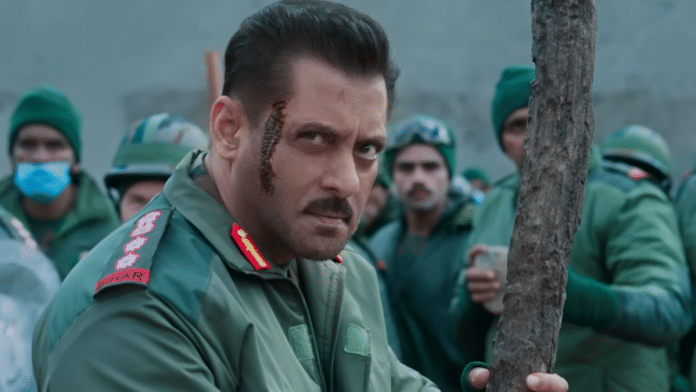



New Delhi: China Tuesday reiterated its claims over the Galwan Valley, days after the teaser video for Salman Khan’s upcoming film Battle of Galwan was released. The video has sparked controversy within China.
The teaser, released on 27 December, is based on the skirmishes that occurred in the summer of 2020 in eastern Ladakh between Indian and Chinese troops. At least four Chinese troops lost their lives, while 20 Indian soldiers were killed during the clashes that led to heightened tensions between the two Asian neighbours and the breakdown in political ties for almost half a decade.
“No over-the-top drama can affect a nation’s sacred territory,” an expert is quoted as saying in a report in Global Times, the daily tabloid of the Communist Party of China (CPC) in an article Tuesday. The state-owned tabloid went on to further report comments from a Chinese Ministry of Foreign Affairs spokesperson from 2020 claiming that the Galwan valley is “located on the Chinese side of the Line of Actual Control (LAC)”.
“A Chinese expert said on Monday that Bollywood films at most provide an entertainment-driven, emotionally-charged portrayal, but no amount of cinematic exaggeration can rewrite the history or shake the PLA’s determination to defend China’s sovereign territory,” Global Times said.
The tabloid added: “However, Chinese netizens have pushed back against such narratives.” A Weibo user under the handle ‘Qingning Riyue v’ commented that the Indian ‘over-the-top’ film seriously contradict the facts. Another Weibo user, ‘Situka 98,’ mocked the film and the related media hype, saying, “When history falls short, Bollywood steps in.”
Global Times emphasised China’s territorial claims over the valley, pointing out the statement made by its ministry of foreign affairs spokesperson from 2020 blaming India for “unilaterally and continuously built roads, bridges and other facilities in the LAC in the Galwan valley”.
Beijing had “lodged representations and protests” with New Delhi at the time, and then blamed Indian troops for crossing the LAC that led to skirmishes, the Chinese tabloid notes. India has maintained that China attempted to capture its territory across the LAC. Since the skirmishes in 2020 the region has been heavily militarised.
Political ties between India and China came to a standstill, with New Delhi maintaining that until “peace and tranquility” returns to the borders, there will be no further diplomatic activity. In October 2024, Foreign Secretary Vikram Misri announced that the two countries arrived at an understanding to disengage at the friction points across the LAC.
The agreement paved the way for Prime Minister Narendra Modi to meet Chinese President Xi Jinping on the margins of the BRICS Summit in the Russian city of Kazan in October 2024. Modi travelled to China earlier this year to attend the Heads of States Summit of the Shanghai Cooperation Organisation, hosted in the city of Tianjin.
Both India and China have introduced a number of confidence-building measures including the resumption of direct flight services, visa services and the Kailash Mansarovar Yatra throughout 2025. High-level interaction between India and China has continued, with Chinese Foreign Minister Wang Yi travelling to New Delhi in August to hold meetings with both National Security Adviser Ajit Doval and External Affairs Minister S. Jaishankar.
China has also moved to ease bottlenecks in the export of rare earth elements to India, especially after the escalation of the trade war between Beijing and Washington earlier this year. India and China have sought to stabilise ties across 2025.
The latest Salman Khan movie, however, has seemingly created a flutter within certain circles in China. Both India and China have yet to arrive at a consensus to solve the boundary dispute across the LAC. China has also continued to claim India’s state of Arunachal Pradesh as a part of its territory, leading to continued friction in ties.
“The film’s theme and timing are inappropriate, as it presents only a one-sided Indian narrative and stokes antagonistic sentiment, at a time when China-India relations have only recently shown hard-won signs of easing, Lan Jianxue, director of the Department of Asia-Pacific Studies at the China Institute of International Studies,” said to Global Times.
(Edited by Shashank Kishan)
Also Read: The truth of Galwan must come out, unlike the 1965 battle with Pakistan in Khemkaran