





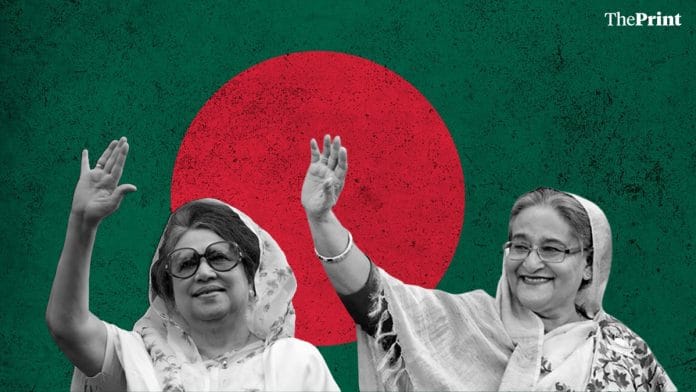



New Delhi: For nearly 40 years of Bangladesh’s history, its politics revolved around the ‘Battle of Begums’. Khaleda Zia, the first female PM in Bangladesh, rarely agreed with Sheikh Hasina, the longest serving female PM in the world. Yet, both the rivals came together as a force in 1990 to topple a military ruler and bring back democracy in the country.
Their much talked about brief alliance, despite differences, helped end nearly a decade of dictatorship under General Hussain Muhammad Ershad.General Ershad seized power in March 1982, forcing President Abdus Sattar, who had taken office after the assassination of Khaleda Zia’s husband and former president Ziaur Rahman in 1981, to hand over authority to the military.
What followed was a state of emergency, suspended democratic rights, imprisoned opponents, and an authoritarian rule. According to the 2013 book, ‘Dynasties and Female Political Leaders in Asia: Gender, Power and Pedigree’, authored/edited by Claudia Derichs and Mark R. Thompson, Ershad’s regime combined repression with political engineering: founding the Jatiya Party, introducing Islamisation policies, adding Arabic to school curriculum, and later declaring Islam the state religion.
The opposition existed, but unity did not come easily. Khaleda Zia, head of the Bangladesh Nationalist Party (BNP), and Sheikh Hasina, daughter of Sheikh Mujibur Rahman and leader of the Awami League, were both heading their parties as well as guarding the legacy of their dynasties.
Throughout the early 1980s, attempts at forming a united opposition remained fragmented. The Awami League had formed a 15-party bloc in January 1983. On the other hand, BNP saw one of its factions joining Ershad’s Jatiya Party. Both parties realised they won’t be able to win the elections.
Later, the Movement for the Restoration of Democracy, bringing together 32 parties spanning socialist, communist and Islamist groups, alongside the BNP and the Awami League, emerged the same year.
The coalition’s demands were strict: an end to emergency rule, restoration of civil liberties, withdrawal of troops to barracks, release of political prisoners, prosecution of abuses committed under martial law, and elections under a neutral interim government empowered to draft a new constitution.
In November 1983, the opposition bloc organised two general strikes. The second turned violent, leaving hundreds injured and dead. Ershad responded by announcing elections which were later widely criticised as unfair. Both Hasina and Khaleda were imprisoned during the campaign ahead of the 1985 polls, held under curfew with civil rights suspended.
In March 1985, Ershad held a military referendum: “Do you support the policies of President Ershad, and do you want him to continue to run this administration until a civilian government is formed through elections?” The result saw 94 percent vote in favour with a turnout of 72 percent.
Elections were then held in 1986 which saw Ershad’s Jatiya Party win, in an election dubbed “controversial”. Six months on, all Opposition parties boycotted the Presidential elections.
In 1986, Hasina chose to participate in elections after Ershad promised an interim cabinet, while Khaleda Zia led a seven-party alliance that boycotted the vote. Hasina won 76 seats, while Ershad’s Jatiya Party secured a majority. Hasina then later boycotted parliament, claiming that flawed elections could not restore democracy. When Ershad sought to legitimise military involvement in civil administration, she returned to street politics.
By 1987, the two rivals found themselves fighting on the same road again. Daily strikes and protests were held in Dhaka. A siege of Dhaka in October brought the capital to a halt. The regime responded brutally. Opposition figures were killed, parliament dissolved, and repression intensified.
Also Read: ‘Begum’ Khaleda Zia was once Hasina’s friend. Her death ends Bangladesh’s most enduring power duel
Divisions & coming together
In June 1988, Ershad declared Islam as the state religion in an attempt to fracture the opposition. The BNP did not oppose the move in principle, deepening ideological rifts with the Awami League, which demanded justice based on the 1972 Constitution for the assassination of Sheikh Mujibur and others in 1975. Citing the Fifth Amendment introduced by Ziaur Rahman, the BNP argued that immunity applied to the killers.
By late 1990, faced with sustained unrest and eroding legitimacy, Khaleda Zia and Sheikh Hasina agreed—once again—on a joint strategy.
Student protests escalated into nationwide demonstrations. On 27 November, university protests erupted across Dhaka. Both leaders were arrested yet again. On 4 December 1990, Ershad resigned, handing power to an interim president, Justice Shahabuddin Ahmed. He was arrested days later.
A neutral caretaker government was formed to oversee elections, ending military rule. It was labelled by many as “the freest and fairest election” in the history of Bangladesh. However, members of minority groups did not participate out of fear of “violent reprisals during pre-poll campaigning”, Thomson and Derirchs’ book mentions.
In the 1991 polls that followed, Khaleda Zia swept to power, winning 140 of the 300 directly elected seats. The BNP formed a government with the support of Jamaat-e-Islami Bangladesh and on 20 March, Khaleda Zia became Bangladesh’s first woman prime minister and only the second woman, after Benazir Bhutto in Pakistan, to lead a democratic government in a Muslim-majority country.
The unity that made that victory possible did not survive. What followed was decades of rivalry that bruised institutions, polarised society, and shaped Bangladesh’s democracy.
Their rivalry saw Hasina and Zia reaching Bangabhaban to pay respect to late president Zillur Rahman in March 2013, without meeting each other. But then, in an unprecedented gesture, Khaleda visited Hasina’s residence Sudha Sadan at Dhanmondi in May 2009 to console her after the death of the Awami League president’s husband M.A.Wazed Miah.
In January 2015, when Khaleda Zia was effectively under siege, her office sealed off by police trucks packed with sand to stop her from leading anti-government protests, she apparently snubbed Hasina to return from her doorstep. The then PM had reached there to offer condolences to her rival at the death of her younger son, Arafat Rahman ‘Koko’, in Malaysia.
However, both the leaders seemed to have made peace in the end. In her last public address, Khaleda Zia sat in a hospital room and said the 2024 ouster of Sheikh Hasina was “the end of tyranny” but she did not take names and warned against “politics of vengeance”.
On her part, Hasina bid a graceful farewell to her rival. “As the first woman Prime Minister of Bangladesh, and for her role in the struggle to establish democracy, her contributions to the nation were significant and will be remembered. Her passing represents a profound loss for Bangladesh’s political life and for the leadership of the Bangladesh Nationalist Party,” she said in her message on ‘X’.
(Edited by Tony Rai)