





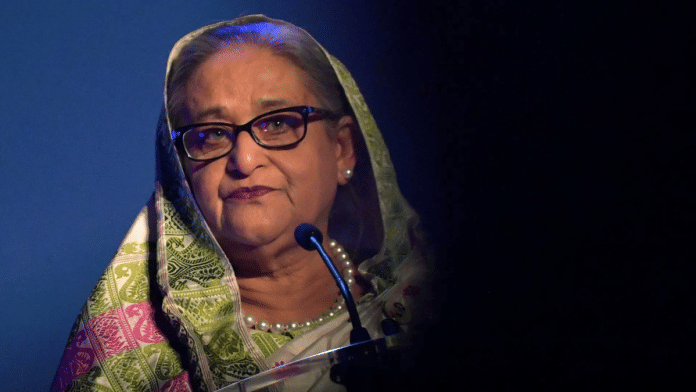



New Delhi: A Dhaka special court Monday sentenced former Bangladesh Prime Minister Sheikh Hasina to 10 years of imprisonment in two separate corruption cases linked to alleged irregularities in the allocation of government land.
The others to be convicted are her nephew, Radwan Mujib Siddiq, and her nieces, Tulip Rizwana Siddiq and Azmina Siddiq.
Tulip Siddiq was sentenced to four years behind bars—two years in each case—while Radwan and Azmina received seven-year jail. According to the case records brought by an Anti-Corruption Court (ACC), Hasina and her relatives acted in collusion and concealed the fact that they already owned houses, flats or housing facilities in the city, Bangladesh based newspaper Prothom Alo reported.
As a result, they violated laws, rules, policies and due legal procedures governing plot allocation, according to the report. While serving as prime minister, Hasina also allegedly abused her power and influenced officials and employees responsible for implementing the project.
All of them were allocated plots measuring 10 kathas (13 sq ft) each in their own names, the records state.
In total, 36 individuals, including senior officials from Rajdhani Unnayan Kartripakkha (RAJUK) and other government agencies, as well as a former state minister for housing and public works, were indicted in the two cases.
The RAJUK, or the Capital Development Authority, is the apex government agency responsible for planning, developing, and managing the expansion of Dhaka and its surrounding areas. Operating under the Ministry of Housing and Public Works, it controls land use, building construction, and urban infrastructure development.
The first case stemmed from an ACC charge sheet filed on 10 March, 2025, against 18 defendants. Over the course of the trial, prosecutors recorded testimony of 31 witnesses. Hearings concluded in mid-January, and the court set 2 February for delivery of its verdict.
Earlier in July, Bangladesh’s International Crimes Tribunal (ICT) indicted Hasina on charges of crimes against humanity. The charges stem from the government’s response to the widespread anti-government demonstrations in July and August 2024, which ultimately led to Hasina’s ouster on 5 August that year.
The tribunal has accused Hasina of ordering mass killings, torture, and enforced disappearances during the seven-week uprising. According to a United Nations report, 1,400 protesters were killed during the crackdown on Bangladesh protests between 1 July and 15 August 2024 under the Hasina government.
Hasina has been in exile in India since 5 August 2024, when her nearly 16-year tenure ended following the widespread protests in Bangladesh.
(Edited by Tony Rai)
Also Read: India halves aid to Bangladesh, boosts support for Afghanistan and Sri Lanka in Union Budget 2026