


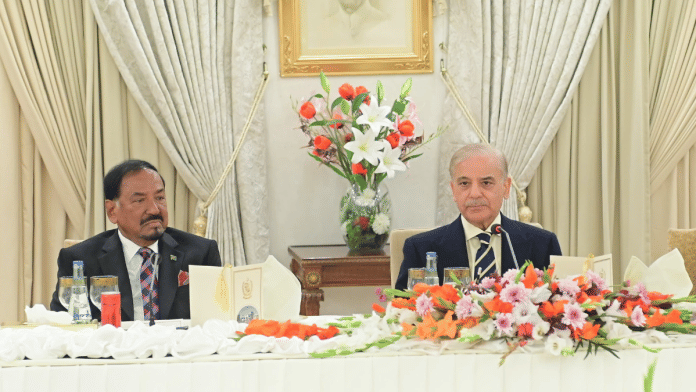
New Delhi: More than five decades after Bangladesh won independence from Pakistan following a bloody war, the Speaker of its Parliament has questioned India’s role in the 1971 Liberation War, saying New Delhi had not helped Bengalis but had instead sought to weaken Pakistan. Hafiz Uddin Ahmad made the remarks during a visit to Islamabad, where he also called for closer ties between the two countries.
Ahmad is a decorated veteran of Bangladesh’s Liberation War who served as a major in the Bangladesh Army. He also met Pakistan Prime Minister Shehbaz Sharif and called for closer ties between the two countries.
His comments are significant not only for their criticism of India but also because of his own history.
Born in 1944, Ahmad was commissioned into the Pakistan Army in 1968 after training at the Pakistan Military Academy in Kakul. He was serving with the 1st East Bengal Regiment when the crisis that led to Bangladesh’s independence erupted in 1971. He subsequently joined the Bengali independence movement, fought Pakistani forces and was awarded the Bir Bikram, Bangladesh’s third-highest gallantry honour.
Now, as Bangladesh’s parliamentary Speaker, he is seeking closer ties with the country against which he once fought.
Ahmad’s criticism of India extended beyond its role in the 1971 war. Speaking to Pakistani journalists, he accused New Delhi of using its control over transboundary rivers to restrict water flows into Bangladesh. Drawing a parallel with Pakistan, which has accused India of weaponising water after suspending the Indus Waters Treaty following the Pahalgam terror attack, Ahmad described the situation as a form of “water violence”. He also alleged that Indian infrastructure projects threatened the agricultural future of northern Bangladesh.
Praising the reception extended to his delegation in Pakistan, he said the visit had ushered in a “new chapter” in bilateral relations and that “the future of this renewed relationship is bright”.
He also made remarks on Kashmir echoing Pakistan’s position. Ahmad said the dispute should be resolved in accordance with United Nations resolutions, a formulation Islamabad has traditionally used in its diplomatic criticism of India’s position. India maintains that Kashmir is a bilateral issue.
During an interaction with Pakistani journalists at Parliament House in Islamabad on Wednesday, Ahmad also described Bangladesh as having effectively become an Indian “colony” during the 15 years of Sheikh Hasina’s rule, which ended with her ouster in August 2024.
Drawing parallels between the political histories of Bangladesh and Pakistan, he criticised the concentration of power under Sheikh Mujibur Rahman, Bangladesh’s founding leader, and his daughter Hasina. He criticised the one-party political arrangement introduced in 1975 and accused Hasina of presiding over an extended period of authoritarian rule.
Ahmad’s efforts to highlight popular goodwill towards Pakistan in Bangladesh also found expression in an unexpected setting: a football stadium. Referring to the recent India-Pakistan final at Dhaka’s National Stadium, Ahmad claimed that almost the entire crowd had supported Pakistan. He said 99.9 percent of spectators had cheered for the Pakistani team, which eventually lost 2–1 to India in the 2026 SAFF Championship final on 17 November.
Ahmad himself has a long association with football. Before his military and political careers, he played for Dhaka’s Mohammedan Sporting Club and represented Pakistan’s national football team in 1968.
Also Read: Bangladesh-bound rocket fuel ingredient tops 7 years of recorded imports—and could make 100 missiles
A changing account of 1971
Bangladesh’s independence remains central to its national identity. The Pakistani military crackdown in March 1971, the ensuing nine-month war and the surrender of Pakistani forces in Dhaka in December remain defining events in the country’s history.
India provided substantial diplomatic support to the Bengali independence movement before intervening militarily in December 1971. The war ended with the surrender of Pakistani forces and the creation of an independent Bangladesh. Ahmad’s remarks challenge the long-standing understanding of India’s role in that conflict.
His account also comes amid continuing political contestation over the legacy of the Liberation War and the Awami League government.
In his Genocide Day statement in March this year, newly elected Bangladesh Prime Minister Tarique Rahman described the 1971 crackdown by (then West) Pakistani forces as “one of the most heinous genocides in history”. A few days later, Pakistan Foreign Affairs spokesperson Tahir Andrabi said that “Pakistan considers the events of 1971 to be complex and open to different interpretations”.
Islamabad finds an opening
Pakistan welcomed the Bangladeshi delegation with considerable diplomatic warmth. Ahmad’s 23–29 November visit, at the invitation of Pakistan’s National Assembly Speaker Sardar Ayaz Sadiq, is the first official visit to Pakistan by a sitting Speaker of Bangladesh’s Parliament.
Apart from Sharif, Ahmad also met Pakistan President Asif Ali Zardari and senior parliamentary officials. Discussions focused on expanding cooperation in trade, parliamentary affairs, education, defence and people-to-people exchanges.
At a dinner hosted by Sharif at the Prime Minister’s House on 25 November, Pakistan’s leadership described the relationship as one rooted in shared history, religion and cultural connections, The Nation reported.
Zardari outlined plans to expand bilateral cooperation in agriculture, food security, education, industry, digital governance and defence. He also referred to around 26 memorandums of understanding under consideration between the two countries.
(Edited by Chingkheinganbi Mayengbam)
One cannot but thank God that the Bangladeshis turned up in suit-coats for the Pakistan visit. If they had clung on to their lungi-ganjee outfit, Pakistan may well have been prompted to undertake a second Operation Searchlight.