





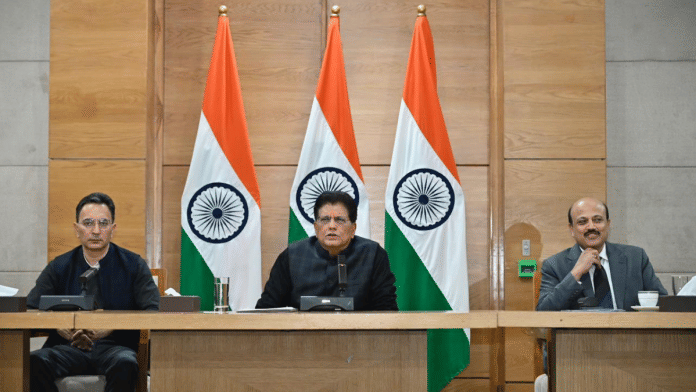



New Delhi: The detailing of the India-US trade deal is ongoing with a joint statement expected within the next few days, Commerce and Industry Minister Piyush Goyal said Tuesday, while adding that “sensitive” sectors such as agriculture and dairy will be protected.
“We stand for national interest and today 140 crore Indians are celebrating a trade deal which is under final stages of detailing between the negotiating teams of both countries. We will shortly be issuing a joint statement by both countries along with the details that we will shortly ink,” Goyal said in a statement to the press here.
He added, “As soon as the final understanding of the deal is inked and the joint statement is finalised, technical processes are completed, full details will be shared. That [the deal] will protect the interest of every Indian and provide huge opportunities for all the people of India. It will protect the sensitive areas, the interests of our agricultural and dairy sectors.”
The Union minister was scheduled to speak at the Lok Sabha Tuesday on the deal, however, the House was adjourned earlier in the day.
The negotiating teams are currently finalising the joint statement which will outline the broad contours of the deal, and is expected to be announced in the next few days. Following the issuance of the joint statement, the two negotiating teams will move towards drafting a final agreement that will eventually be signed by the leadership of India and the US.
The trade deal, announced by US President Donald Trump late Monday evening, will see US tariffs on India reduced from the current 50 percent to 18 percent.
India is set to open a number of sectors for American goods, in a fashion that is likely to mirror the existing free trade agreements New Delhi announced with countries such as the United Kingdom and New Zealand, as well as the European Union (EU).
The deals with the EU and New Zealand for example do allow certain agricultural products easier access to the Indian markets including apples and kiwi fruit, which indicates to an extent the areas New Delhi will be willing to concede to the US’ asks.
Trump announced that India will be reducing all tariffs to zero, a claim that has not been confirmed by New Delhi yet. Trump also announced that India will purchase up to $500 billion worth of American goods as a part of the deal.
The amount is understood to be spread over five years, with people familiar with the matter pointing to India’s intent to import infrastructure for data centres, increase civil nuclear cooperation and increase imports of advanced artificial intelligence technology.
Another person familiar with the matter explained that the deal will help promote India’s exports, which already hit $86 billion in the 2024-2025 financial year.
“This is truly a deal that every Indian can be proud of. We are the fastest growing large economy in the world. Our demand for ICT products, demand for data centre infrastructure, raw materials is continuously rising and in that situation this deal allows India to open up to further power the Indian growth story,” explained Goyal at the press briefing.
The deal will exclude tariff relief on any duties imposed under Section 232 investigations launched by the US government, as these apply globally.
Goyal highlighted that the deal will open up huge opportunities for exports from India’s labour-intensive sectors including marine products, plastics, rubber goods, machineries, aircraft components, gems and jewellery, engineering goods and textile sectors.
आज मीडिया साथियों के साथ प्रेस वार्ता के माध्यम से मैंने प्रधानमंत्री @NarendraModi जी और अमेरिका के राष्ट्रपति @RealDonaldTrump के नेतृत्व में हुई #IndiaUSTradeDeal के बारे में देश को अवगत कराया। यह समझौता भारत की आर्थिक शक्ति, वैश्विक भरोसे और विकसित भारत 2047 के संकल्प को… pic.twitter.com/53kQKmu6nl
— Piyush Goyal (@PiyushGoyal) February 3, 2026
Negotiations for the deal have been stalled for more than half a year. The call between Prime Minister Modi and Trump Monday finally bridged the remaining gaps between the two sides. India has faced some of the highest tariffs imposed by the US since August last year.
Trump took particular exception to India’s continued purchase of Russian oil and imposed a punitive 25 percent tariff as a penalty above the reciprocal tariff rate of 25 percent. The deal will see the punitive tariffs removed and the reciprocal rate cut to 18 per cent, which is marginally lesser than other countries in the neighbourhood including Pakistan and Bangladesh.
The US President announced that India will curtail its Russian oil purchases. However, New Delhi has always maintained that its energy imports are driven by market dynamics and domestic demand. The reduction of Russian oil imports in the last few months occurred after the imposition of sanctions on Rosneft and Lukoil by the US in October 2025.
External Affairs Minister S. Jaishankar is currently in the US and is scheduled to hold a bilateral meeting with Secretary of State Marco Rubio Tuesday before attending the critical minerals ministerial Wednesday.
India is expected to sign the Pax Silica declaration later Tuesday, as New Delhi aims to cooperate with the US on creating a resilient supply chain for critical minerals and advanced technologies.
The call between the two leaders and the conclusion of the negotiation for the trade deal is expected to boost India-US ties that have been frosty for the last year.
(Edited by Ajeet Tiwari)
Also Read: India-US surprise trade deal resets fractured ties