





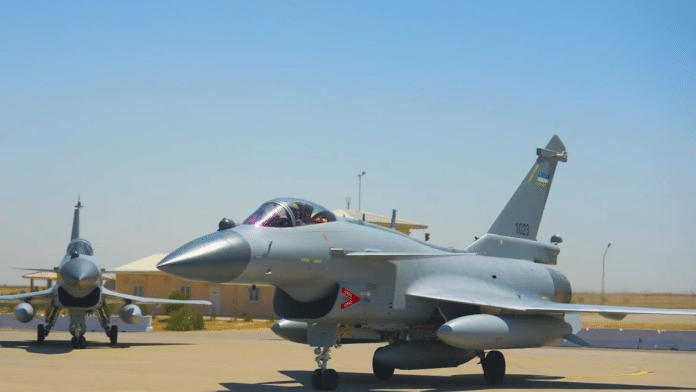

New Delhi: Uzbekistan has unveiled its first six Chengdu J-10CE multirole fighter aircraft, becoming the second foreign country after Pakistan to procure the Chinese combat plane as Tashkent moves to modernise an ageing Soviet-era fleet.
The six aircraft were seen at Karshi-Khanabad Air Base, known as K2, in visuals aired by Uzbek state television on 28 August, just a day before Prime Minister Narendra Modi arrived in Uzbekistan on an official visit. The footage was part of programming ahead of the country’s 35th Independence Day on 1 September.
The aircraft were shown on the runway, flying in formation and receiving a water-cannon salute at the southeastern Uzbek air base. K2 was operated by the US between 2001 and 2005 to support military operations in Afghanistan before Uzbekistan asked American forces to leave.
Uzbekistan’s Defence Ministry released an official video of the fighters, describing them as “modern fighter aircraft guarding our air borders”.
The public unveiling ends months of speculation over the acquisition and provides the first clear visual confirmation of the J-10CE’s entry into Uzbek service.
Uzbekistan has officially inducted the Chinese-made J-10CE fighter jet into its Air Force
On August 30, 2026, the Ministry of Defense of Uzbekistan announced that Chinese-made J-10CE fighter jets have officially entered service with the Uzbek Air Force.#J10CE #AVIC #Chengdu… pic.twitter.com/Zy6U5gG32F
— China Military Bugle (@ChinaMilBugle) August 31, 2026
Reports had suggested that Uzbekistan could acquire as many as 24 J-10CEs. However, neither Tashkent nor Beijing has publicly confirmed the size or value of the reported contract.
The J10s are modern 4.5 generation aircraft and its arsenal of air-to-air missiles includes the PL-10 short-range missile and the PL-15E, a radar-guided weapon for beyond visual range warfare.
The country’s fleet till now relied on Soviet-made MiG-29s, Su-25 Frogfoots and Su-27s, many of which have been in service for several decades. Maintaining them has become complicated due to their age and challenges sourcing spare parts.
Incidentally, China has already established a defence relationship with Uzbekistan beyond fighter aviation. In 2015, Uzbekistan had acquired Chinese HQ-9B, FM-90 and KS-1C surface-to-air missile systems. The latest procurement clearly shows China is gaining a foothold in a market traditionally dominated by Russian fighters.
Bangladesh could be next
The timing is particularly significant because another Asian country is moving towards the J-10CE. Bangladesh has been advancing plans to acquire Chinese J-10CE fighters as part of a broader effort to modernise its air force.
Dhaka has been considering an acquisition that could reportedly involve up to 24 aircraft, although the precise number, cost and delivery schedule remain subject to negotiations and approvals.
“If budget support is available this fiscal year, the purchase will go ahead. Otherwise, it will be deferred to the next budget,” Prime Minister’s Adviser Zahed Ur Rahman said last week.
If the deal proceeds, China would have three foreign J-10CE operators—Pakistan, Uzbekistan, and Bangladesh.
(Edited by Tony Rai)