





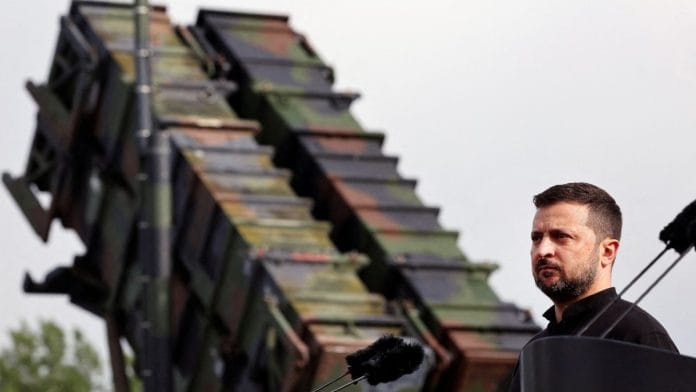



New Delhi: As the conflict in West Asia enters its fourth week, the Pentagon is considering redirecting advanced military equipment, including air defence interceptor missiles from Ukraine, to the Iranian front.
A final decision is yet to be taken, but three persons familiar with the situation told The Washington Post that the intense air action against Tehran has rapidly depleted the American arsenal, forcing the Department of Defense (DoD) to consider such a trade-off.
The US Central Command (CENTCOM) has reportedly struck more than 9,000 targets in just a few weeks of the military action against Iran.
The weapons that can be diverted away were ordered through a specialised NATO-led programme last year under which the partner nations purchased American weapons for the defence of Ukraine. Asked about the divergence in the supply of munitions from Kyiv to West Asia, US President Donald Trump Thursday replied: “we do that all the time.”
However, the current divergence of arms regarding the Prioritized Ukraine Requirements List (PURL) initiative is a significant shift in how the US administration manages its global commitments. The PURL programme has been a vital initiative keeping the flow of select military equipment to Kyiv steady, despite the Trump administration largely curtailing direct security assistance to Ukraine amid the conflict with Russia.
Also Read: Why Bagher Ghalibaf and Abbas Araghchi are the most crucial negotiators in Iran war
Iran drain
Since the launch of the joint operation by the US and Israel against Iran, Europe has been concerned about the rapid use of existing munitions, which could disrupt their own deliveries of US systems to Ukraine under the PURL framework, two European diplomats told The Washington Post on condition of anonymity.
Expressing their anxiety, one diplomat said, “They are really burning through munitions, so there are questions now about how much they will keep providing through the deal.”
Ukraine’s ambassador to the United States Olga Stefanishyna has also said that Kyiv is keeping its partners in contact about the requirements, including air defence. She added, “Any disruptions at the outset of recent operations in the Middle East have been mitigated.”
Among the most demanded assets in the redistribution plan are the Patriot and Terminal High Altitude Area Defense (THAAD) systems. These systems have been reportedly instrumental in defending Ukraine against Russian airstrikes. However, the US military has redirected these air defence systems from other global theaters, including East Asia and Europe, to the US CENTCOM against Iranian drone and ballistic missile counterattacks.
One official familiar with the Pentagon’s approach told The Washington Post that the PURL programme for Ukraine might continue, but future packages might not have the air defence capacities, as Washington is currently more emphatic on replenishing its stockpiles in the Persian Gulf.
Growing geopolitical risk
The reliance on these interceptors has turned the PURL initiative into a complex balancing act, as the deal was brokered by NATO which allowed the Trump administration a “political win” by shifting the financial burden on Europeans. This arrangement was designed to put an end to the Ukrainian fears of abandoning Kyiv in favour of the peace deal with Russia.
However, the crisis in West Asia marks a new period of uncertainty for the Ukrainian leadership.
The Pentagon has maintained a very cautious stance on the ongoing developments in West Asia. In a statement provided to The Washington Post, the spokesperson of the Department of Defense stated that the plan is to “ensure that US forces and those of our allies and partners have what they need to fight and win”. However, the spokesperson declined to comment on the specifications of the equipment that has been diverted.
Similarly, NATO Secretary General Mark Rutte also avoided confirming any rerouting of the American military equipment but said, “This vital US equipment for Ukraine, including interceptors, is continuing to flow.”
Despite the assurances, there has been a wide gap between supply and demand. Rutte himself acknowledged that global arms production has been lagging behind compared to the pace of the ongoing conflict. “We also know that in the Middle East, a lot of stockpiles are being used. We have to produce more,” he said, as quoted by The Washington Post.
Also Read: How Iran choked Strait of Hormuz & why it’s not easy to break the blockade
Financial pivot
The trade-off in military equipment is also visible in the financial allocation of funds. The two US officials told The Washington Post that the Pentagon recently notified the US Congress about its plan to divert nearly $750 million, which were provided by NATO for the PURL programme, to the US military’s own inventories.
Apart from the PURL programme, the US Congress has also initiated a Ukraine Security Assistance Initiative (USAI), under which $400 million will be diverted to the Ukrainian armed forces by the Department of Defence.
However, a notice that the Pentagon sent to Congress, reviewed by The Washington Post, found that the Department of Defense used some of the PURL funds to cover other capabilities that US lawmakers had originally intended to fund through the American taxpayers.
Stakes for Kyiv
For Ukraine, the stakes from this policy change are existential, as Ukrainian President Volodymyr Zelenskyy has noted that even though the delivery of Patriot defense systems has not been stopped, but the broader geopolitical situation has sharply shifted against them.
In an interview with Reuters, Zelenskyy emphasized that the conflict in West Asia has changed Washington’s decision-making process. He further said that “The Middle East definitely has an impact on President Trump, and I think on his next steps.”
The tensions have also escalated for Ukraine, as Zelensky noted that the US was refusing to sign an agreement to provide postwar security guarantees to Ukraine unless Kyiv surrenders to a key Kremlin demand and cedes all of its eastern Donbas region to Russia.
(Edited by Nardeep Singh Dahiya)
Also Read: Iran war can drop India’s beer production by 50%, brewers warn. ‘State govts must waive levies’