







New Delhi: Amid the debate over India’s ambitious proposed deep-water transhipment terminal at Galathea Bay in the Great Nicobar Island, a senior Navy officer came out in support saying it would be a geopolitical lever.
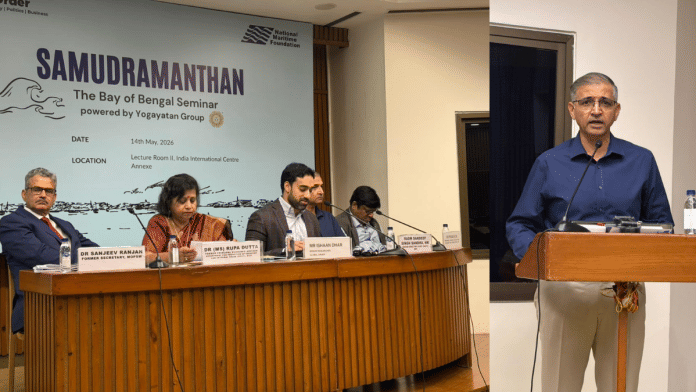
As war in West Asia disrupts global shipping lanes and revives fears over maritime chokepoints, Indian strategists Thursday discussed at a seminar in Delhi why India is turning its attention eastward, toward Nicobar Island nearly 1,500 kilometers from the Indian mainland.
At the center of this shift is the proposed transhipment terminal at Galathea Bay. Analysts and military planners described it as central to New Delhi’s ambitions in the Indo-Pacific and as a counter to China’s Bent and Road Initiative (BRI). Galathea Bay, they said, is India’s bid to command the Indo-Pacific.
The port—India’s 14th major port under Union government control—is being designed with a handling capacity of 16 million twenty-foot equivalent units, or TEUs, the standard industry measure used to calculate container shipping capacity.
“The closure threats in Hormuz have reminded everyone how decisive chokepoints are,” Rear Admiral Sandeep Singh Sandhu, a senior directing staff officer with the Indian Navy at the National Defence College, said at ‘Samrudramanthan’, a seminar on the Bay of Bengal at IIC New Delhi organised by the National Maritime Foundation and Global Order, a New Delhi-based think tank.
Speaking at a session titled ‘Securing Maritime Lifelines: Connectivity and Resilience Across the Bay of Bengal’, focusing on the development of Galathea Bay, Sandhu added: “Great Nicobar gives India a permanent vantage point astride the sea lanes connecting the Indian Ocean to the Pacific.”
The Rs 81,000-crore Great Nicobar development plan includes a transhipment port, an international airport, power infrastructure and a new township. Great Nicobar Island has emerged as the focal point of an ambitious $8–10 billion infrastructure initiative unveiled in 2021 under the government’s ‘Holistic Development of Islands’ programme. The plan seeks to transform the remote island into a major transhipment, logistics and economic hub in the Indo-Pacific.
But its importance extends far beyond economics. Navy officials see the project as a geopolitical lever—one positioned near one of the world’s most critical maritime arteries: the Strait of Malacca.
“This is not just another port under construction. Great Nicobar occupies India’s closest geographical position to the Strait of Malacca, one of the world’s most strategically significant maritime chokepoints. The proposed site lies just 14 nautical miles from the main shipping channel and only 19 nautical miles from Indonesia,” Rear Admiral Sandhu added.
Nearly a third of global maritime trade passes through the narrow waterway, including the bulk of China’s imported energy supplies. The route has taken on renewed strategic significance following recent disruptions in the Strait of Hormuz, which exposed the vulnerability of global supply chains to maritime blockades and regional wars.
“The value is not derived from the hinterland servicing, but from proximity to the global circulation pathways, that is, the trade pathways. And this transhipment port must be therefore understood not as an infrastructure expansion, but as a geoeconomic insertion into a high-economic, high-density maritime corridor,” Sandhu added.
Indian officials insist the project is commercial in nature. Yet the geopolitical undertones are unmistakable. The proposed port would sit roughly 150 kilometres from the western approaches to the Malacca Strait, through which an estimated 75 percent of China’s energy imports travel. For Indian strategists, proximity itself is power.
The project is also being viewed against the backdrop of China’s expanding maritime footprint through Belt and Road-linked ports such as Gwadar, Hambantota and Djibouti. Indian strategists increasingly see commercial port infrastructure as carrying long-term military implications.
“In essence,” Sandhu added, “Galathea Bay is not merely an economic or infrastructure project. It is India’s attempt to shape the Indo-Pacific order rather than simply respond to it.”
The project aligns closely with India’s broader Indo-Pacific strategy and with the objectives of the Quad partnership involving the United States, Japan and Australia. Analysts say the infrastructure could eventually support humanitarian missions, naval exercises and logistics operations across the region.
“This is not merely about building a port,” Sandhu said. “It is about whether India intends to remain a continental power or emerge as a maritime one.”
Air Chief Marshal R. K. S. Bhadauria, the former head of the Indian Air Force who is now affiliated with BJP, last week at an event said the project had become indispensable in light of recent geopolitical instability.

Great Nicobar is home to dense tropical rainforest ecosystems, endangered species and indigenous tribal communities with limited outside contact. Congress leader Rahul Gandhi last month described the project as “one of the gravest crimes against India’s natural and tribal heritage”, accusing the government of masking environmental destruction behind the language of strategic development.
Environmental groups say the project could require the clearing of millions of trees across roughly 160 square kilometers of rainforest and permanently alter the island’s ecological balance.
(Edited by Viny Mishra)
Also read: A year after Op Sindoor, look East. Militarise Nicobar islands urgently