



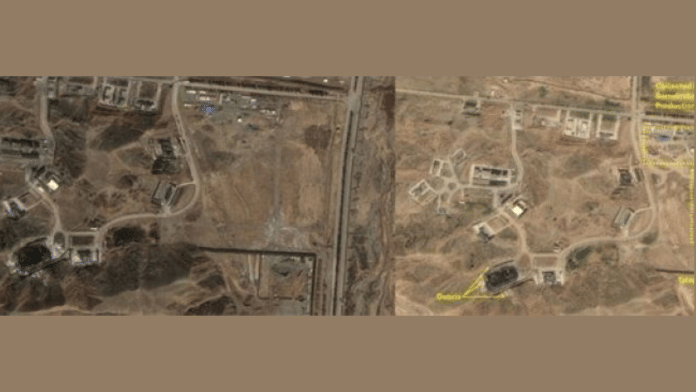
New Delhi: High-resolution satellite imagery from Vantor Technologies shows Iran was reconstructing the destroyed nuclear testing site Taleghan 2 in June-July this year.
The site was struck twice by the Israeli military over the course of two major conflict periods.
Located in the Parchin Military Complex about 30 km southeast of Tehran, the facility was built in 2000 under the AMAD programme to advance Iran’s nuclear weapon design capabilities. While Iran officially suspended structured weaponisation activities in late 2003, watchdogs have monitored the site for covert research.
Situated on a campus which houses the different research processes for creating nuclear bombs, this particular site was designed to diagnose and test weapons capabilities, with the intention of weaponising research from other Iranian nuclear sites.
The first strike on the site was in October 2024, when the Israeli military conducted an aerial counterstrike against Iran, destroying the original Taleghan 2 building and specialised equipment used for nuclear weapons development.
The second strike was in March 2026. After a year spent rebuilding and fortifying the site inside a concrete, coffin-like superstructure buried under the Earth, Israeli forces hit it again using heavy bunker-buster munitions to penetrate the new underground structure. A defensive wall in the front collapsed from an internal blast, the shockwave destroying a support building outside.
Later, between 24 March and 1 April 2026, a fire control and instrument building—part of the Taleghan 1 structure—was hit along with the facility’s nearby headquarters building.
An analysis by the Institute for Science and International Security (ISIS) of the images provided by Vantor Technologies via CNN shows reconstruction efforts starting in mid-June.
On 12 June, images show the three locations that were hit were covered, along with a makeshift path to establish ground-level access, as most routes were rendered unusable—especially on the northern side.
Days later, on 18 June, vehicles including several trucks and a large crane were spotted south of the site.
Images from 20 June show rubble being cleared from the headquarters building which stood nearby, before the second phase of the March 2026 raids.
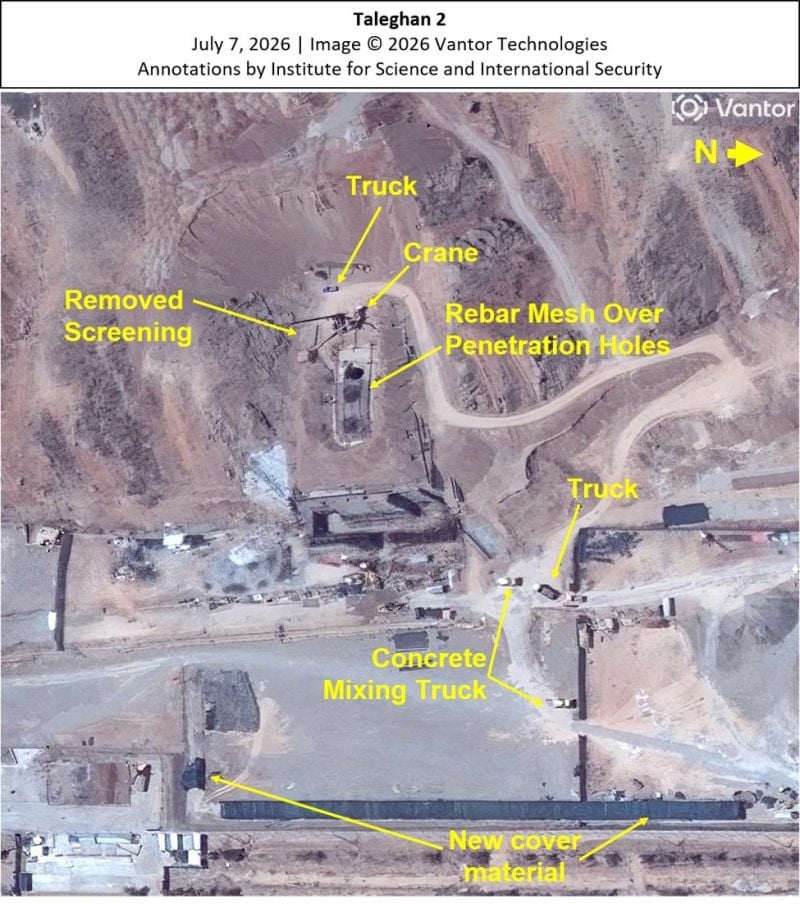
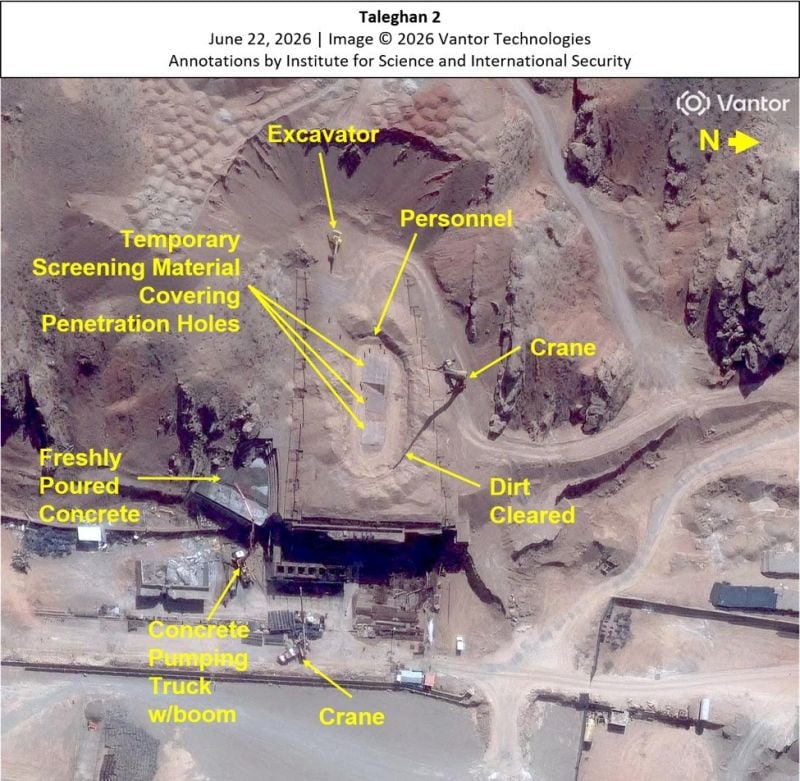
Images from between 22 June and 7 July show Iran’s attempts to permanently cover the holes. The area around the holes had been excavated, cleared, and covered with screening material, which was removed by 7 July. In the 22 June images, workers can be seen pouring concrete to reinforce the facility’s southeast corner.
The images from 7 July also show that the area around the holes was cleared to create further access, while a crane worked directly at the impact zones. Other indicators, such as a mesh, were placed over the area to reinforce the concrete that will eventually be poured over it.
These activities in Iran suggest that the area will be buried under dirt to place the facility underground.
A broader look at Parchin shows debris piles from cleanup and removal efforts at destroyed missile production facilities near Taleghan 2 in May 2026.
(Edited by Viny Mishra)
Also read: Tracing the story of Iran’s nuclear programme & turning points as Israel-US try to obliterate it