



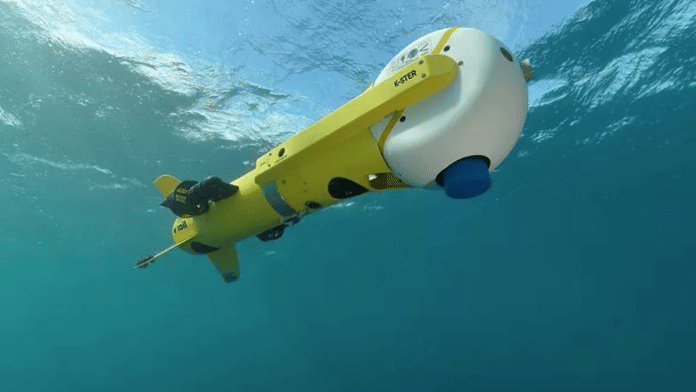
New Delhi: Indian multinational Larsen & Toubro (L&T) has tied up with France-based Exail to deliver an advanced Unmanned Mine Counter-Measure (MCM) Suite for the Indian Navy’s long-pending Mine Counter-Measure Vessels (MCMVs) programme.
L&T and Exail will together provide the Indian Navy with a state-of-the-art unmanned MCM suite incorporating autonomous and remotely operated systems designed to detect, classify, identify and neutralise naval mines in a safe stand-off manner (from a safe distance), the company said in a statement.
L&T, as the prime contractor, will offer the unmanned MCM suite to all shipyards participating in the Indian Navy’s upcoming programme for 12 mine counter-measure vessels, while Exail will serve as the technology partner.
The partnership will enable the delivery of Exail’s mine warfare technologies, already operational with several navies worldwide and validated through extensive real-world deployments.
The development comes even as India continues to wait for dedicated minesweepers years after its last specialised vessel was retired.
Minesweepers are designed to detect, classify and neutralise naval mines laid by adversaries in own waters.
Such mines not only threaten military ships but also blocks ports, block shipping lanes against the threat to merchant vessels.
Minesweepers are critical for protecting harbours and sea lines of communication, especially during conflict.
The threat of Iran potentially mining the Strait of Hormuz, which has brought global economy under risk, shows the need for having minesweepers.
India’s last minesweeper, the Soviet-built Natya-class INS Kozhikode, was decommissioned in 2019 without a replacement in place.
The Indian Navy is currently relying on clip-on mine counter-measure suites mounted on select ships to plug the capability gap.
According to an internal Navy assessment, the force requires at least 24 MCMVs to safeguard India’s 7,516-km coastline, dotted with over 200 major and minor ports.
India had, back in 2005, initiated a programme to build a fleet of indigenous minesweepers with technology transfer from outside. However, the programme has repeatedly run aground.
The original plan for 12 MCMVs began with Goa Shipyard Limited issuing a request for proposal (RFP) seeking bids from Russian, Italian and South Korean shipbuilders.
However, the project failed to take off amid disputes over technology transfer, costs and build strategy.
Former Defence Minister Manohar Parrikar later revived the project, with a plan for the Goa Shipyard to partner South Korea’s Kangnam Corporation. But the effort collapsed in 2018, the same year construction of the first MCMV was expected to begin, after officials said the Korean firm had failed to meet RFP criteria.
Parrikar had by then moved out of the defence ministry and current Finance Minister Nirmala Sitharaman had taken over.
It was only last year that the Indian Navy moved a fresh proposal to acquire 12 MCMVs at an estimated cost of around Rs 45,000 crore, and a request for information (RFI) was issued. However, the formal RFP is yet to be released.
It is estimated that it will take a minimum of seven years for the first ship to be delivered once the contract is signed.
Former Navy chief Admiral Arun Prakash had written in 2019 about the serious operational risks arising from the absence of a dedicated mine counter-measure capability.
In his article for ThePrint, he noted that the Indian Navy had historically maintained adequate MCM capability on both coasts, beginning with British-origin minesweepers acquired in the 1950s and later supplemented by Soviet-built vessels.
He also pointed out that one of the missions assigned to Pakistani submarine PNS Ghazi during the 1971 war was to mine the Visakhapatnam harbour.
During the 1980s, aware of Pakistan’s sizeable stockpile of Chinese-origin mines, the Indian Navy acquired two squadrons of six modern Soviet MCMVs each to protect both the eastern and western seaboards against mine-laying operations, he wrote.
However, the last of these vessels was decommissioned in 2019, leaving India without a dedicated minesweeper fleet for the first time in decades.
(Edited by Viny Mishra)
Also read: India working on lowering military reaction time to hostilities, boosting use of AI—CDS Gen Chauhan