





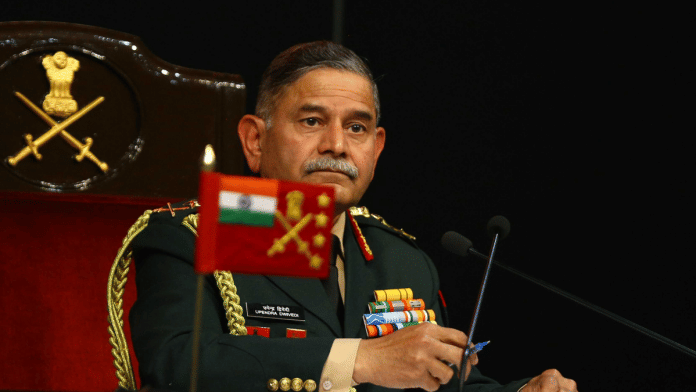



New Delhi: Army Chief General Upendra Dwivedi Tuesday said the government has approved the long-pending proposal for setting up Integrated Battle Groups (IBGs), first of which will come up in the China-focused 17 Mountain Strike Corps.
The Army is in the midst of a massive reorganisation exercise, started in the backdrop of the rise in tensions with China in 2020, and now fuelled by Operation Sindoor.
“A large number of Government Sanction Letters (31) for organisational changes has been approved over the past 14–15 months, including path breaking IBGisation of 17 Corps and raising of aviation brigades. Territorial Army recruitment recommenced in 2025 after a gap of five years,” Gen Dwivedi said addressing the media at his annual press conference here.
At his annual press conference last year, the Army Chief had said the IBG plan, initiated by the late Gen Bipin Rawat when he was the Army chief, was at the cusp of approval.
Explaining the proposed restructuring, General Dwivedi said that the force restructuring focuses on reviewing organisational structures to enhance multi-domain combat potency and achieve an optimal “teeth-to-tail” balance.
“We have adopted a spiral development approach centred on organisation rather than equipment alone,” he said.
The Army chief added, “We have re-oriented and created several new structures: Rudra Brigades (AAB i.e. All-Arms Brigade) for high-tempo multi-domain ops and Bhairav Battalions for agility and disruptive effect.
“Similarly, Shaktibaan Regiments and Divyastra Batteries of artillery will use UAS/C-UAS (Unmanned Aerial Systems and Counter-UAS) for extended reach and real-time targeting. Ashni Platoons and other organisations on the design board will enhance precision, surveillance and strike options at the tactical level,” he said.
As per the plan, the two Division formation of the 17 MSC will be converted into four IBGs to be headed by a Major General-rank officer.
IBGs are envisioned as agile, brigade-sized combat formations having integrated elements of all arms depending on the operational terrain it is set up for.
In case of conflict, the IBGs will be capable of launching swift operations against the enemy. As per the earlier plan, each IBG will have a strength of around 5,000 personnel which would be larger than a brigade (3,000-3,500 troops) but smaller than a division (10,000-12,000 troops).
These IBGs will have elements from the infantry, artillery, armoured units, engineers, signals, air defence, and other arms and services, and can launch an operation within 48 hours when tasked.
Also Read: Army chief says India, China carried out ‘readjustment’ of troops. ‘Trying to increase trust factor’
17 MSC first, then rest all Strike Corps
Sources in the defence and security establishment told ThePrint that while clearance has been received for only 17 MSC, the plan is to have them implemented in all the Strike Corps—Mathuura-based 1 Corps focused on China, Bhopal-based 21 Strike Corps, and Ambala-based 2 Corps, both of which are Pakistan focused.
The sources said that the IBGisation of the 17 MSC should be completed by mid 2027 and the full roll out should be in place by 2029.
“IBGisation is just restructuring the same troops and equipment into specific formations to make them more agile and swift. Strike Corps are anyway designed to carry out quick operations and the IBG will make it faster,” a source explained.
(Edited by Ajeet Tiwari)