





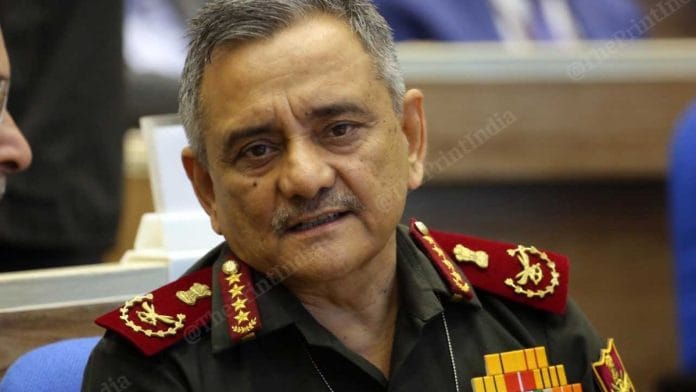



Bengaluru: India is reviewing the mandated reaction time of its military to the breaking out of hostilities given the changing nature of warfare and keeping regional dynamics in mind, Chief of Defence Staff (CDS) General Anil Chauhan revealed during a fireside chat at the Ran Samwad seminar Thursday evening.
General Chauhan said that the Indian military is incorporating Artificial Intelligence (AI) in a major way to not only process multi-domain information, but to make the right decision in the shortest time possible.
The top military commander also revealed that changes have also being brought into the equipment profile of the forces with focus now at 70 percent on supporting manoeuvre warfare, 20 percent on Net-centric warfare, and 10 percent on data-centric or intelligent warfare. This replaces the earlier thought process of 30 percent old, 40 percent contemporary and 30 percent niche technology. “The mindset is changing,” he said.
Talking about the new normal stated by the Narendra Modi government, General Chauhan said that there is a Raksha Mantri Ops Directive that lays down the reaction time given by the government in case hostilities break out. “I can’t disclose the time given but 30, 40, 60, 80 days. These are the kind of timelines given. Are they relevant today? I don’t think they are relevant anymore. That is the new normal,” he said.
The CDS said that as far as conventional operations is concerned, it even lays down how many days of hostilities. “With the kind of warfare that is changing, we will have to relook these timelines,” he said.
Talking about modern warfare, he said that outcome is dependent on two things – timely decisions and the correct decisions. “These are two things which are important. And they are both interrelated. You can’t have a correct decision being taken late. It will not work. So it has to be timely and it has to be correct and the outcome will be favorable to you. It is here where artificial intelligence is going to help us to take a timely decision and correct decision,” he said.
Explaining further, he said that Net-centric warfare is moving to data-centric to intelligent warfare. “When we say Net-centric warfare, we are trying to connect the sensors to the shooters. And over a period of time what has happened, there are a plethora of the sensors are ubiquitous. Hundreds and thousands of sensors of various types are available.”
He said that when warfare is moving towards data-centric warfare, which is decision superiority rather than information superiority, there will be a “requirement of artificial intelligence, some language models and some algorithms, advanced ones to help officers take a correct decision, operational decisions”.
“A step ahead would be intelligent warfare in which maybe artificial intelligence can be predictive and you can forecast. So hence you will be able to predict things faster. And then your decisions are taken much ahead of before you even say observe a particular thing. So here artificial intelligence will run through all, Net-centric, data-centric and intelligent warfare,” he said.
Also Read: Theaterisation in play: Air Headquarters to control strategic assets
‘Iran used geography to advantage’
Talking about the lessons learnt from the ongoing US, Israel and Iran war, the CDS said that while Washington had superior technology and strike capability, Tehran used geography to its advantage.
“I must add that these technologies may have allowed the Americans or the Israelis to win specific combat missions at operational level, at tactical level, but somewhere the larger picture, that geography and strategy is important. Iran probably has used that,” he said.
Explaining further, General Chauhan said that Iran used the geography—the Strait of Hormuz—to its advantage. He said that Iran was probably preparing for such kind of a conflict, having built many underground facilities and stored a large number of missiles.
“And missiles, in fact, they also targeted very precisely American facilities and otherwise in those Gulf countries. Nobody thought they would target military targets in the Gulf countries in that sense,” he said.
(Edited by Nardeep Singh Dahiya)