





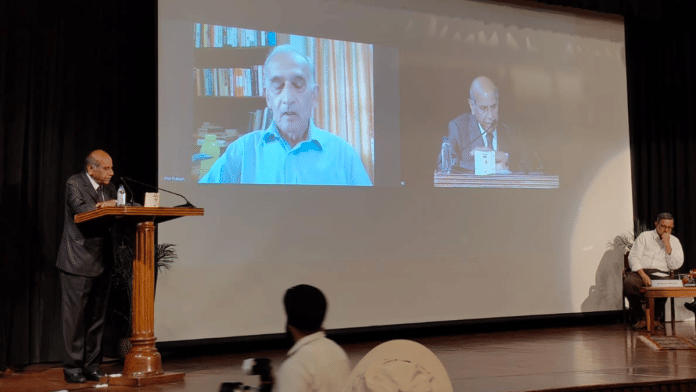


New Delhi: Former Navy chief Admiral (Retd) Arun Prakash has said India would be better served with a dedicated cadre of civil servants having long-term expertise in contract management, defence procurement, and military technology, as the country faces ever-growing challenges in the evolving national and global security environment.
He was speaking during a session on Civil-Military Relations and National Security organised at the India International Centre (IIC) in New Delhi Friday.
The event, exploring the changing dynamics of civil-military relations in a transformed national security environment, saw several observations and recommendations put forward by the distinguished panel of speakers comprising former chiefs of armed forces and former secretaries to the Government of India.
Speaking with his own experience, Admiral (Retd) Prakash highlighted the bureaucratic hurdles and structural anomalies that underlie the existing framework.
The former Chief of Naval Staff further noted the “asymmetric hierarchy favouring civilian cadres” that has emerged as a result of the Pay Commissions’ decisions and policies like Non-Functional Upgradation (NFU) of posts of civilian cadres.
Lt. Gen D.S. Hooda (Retd), a former commander of the Army’s Northern Command, said the country lags in military capability building because long-term development plans are rarely backed by actual long-term financial commitments.
He noted this is primarily because defence funds are processed on a yearly basis, thus leaving very little financial predictability to sustain multi-year procurement programmes.
He suggested finance ministry officials should come to operational military briefings so that those controlling the budget actually understand the operational necessities. making long-term planning more seamless.
“We are seeing an Indian political leadership that is more directly involved in military operations than before, and one that is less risk-averse to the use of military force. Whether we like it or not, the fact is that this political leadership is more willing to use military force as opposed to perhaps some leadership in the past,” he added.
At the same time, he cautioned the audience about the dangers of the politicisation of a country’s armed forces.
Former defence secretary Sanjay Mitra advocated for handing the complete ownership of defence hardware procurement directly to the armed forces as a means to bypass bureaucratic and political hurdles.
He also noted that the current “crisis-to-crisis” approach serves the Indian setup well, and expecting flawless peacetime coordination between the military and civilian leadership is an unrealistic expectation.
He further noted that the politicisation of a country’s armed forces to some degree is inevitable in the current global scenario, while also dismissing the pressing need for a written National Security Strategy.
Earlier, calling for a National Security Administration Service to effectively run a pan-India security apparatus across states and districts, former defence secretary N.N. Vohra strongly advocated the creation of a distinct and specialised administrative cadre.
Vohra, while delivering the keynote address, also called the absence of a National Security Policy for the country “unacceptable”. Addressing persistent criticisms from military leadership, Vohra firmly dismissed the notion that civil servants have “hijacked” decision-making powers in the Defence Ministry.
Reflecting on his own years in the ministry, he clarified that no single secretary has the operational capacity to exceed their bounds without facing swift removal.
He urged military academies to introduce core constitutional lectures so officers understand the exact legal boundaries of authority.
The session was chaired by former Foreign Secretary Shyam Saran. In his opening remarks, he noted that despite Civil Military Relations being a subject of such national importance, thought leaders are often reluctant to talk about the same.
However, the evolving global situation demands that such a critical matter be paid adequate attention, he said, noting that India has an elaborate national security structure, but often with no legislative sanction, making it highly discretionary and prone to instability.
He highlighted the need to fuse the new offices and institutions of the national security apparatus within the constitutional framework that the civil-military relationship operates in.
The session was attended by senior government officials, military representatives, former civil servants, and senior journalists, among others.
Akshat Mohan is an alumnus of ThePrint School of Journalism. He is currently interning with ThePrint.
Also Read: Ladakh decisions fell within military responsibility. Political class mustn’t have been burdened