





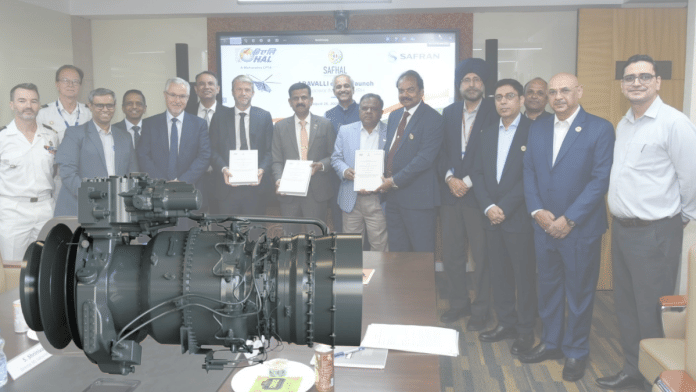

New Delhi: State-run Hindustan Aeronautics Limited (HAL) and Safran Helicopter Engines have come together to jointly design, develop and manufacture an engine called ‘Aravalli’ to power India’s planned 13-ton Indian Multi-Role Helicopter (IMRH) and its naval variant, the Deck-Based Multi-Role Helicopter (DBMRH).
Signed through their 50:50 joint venture SAFHAL Helicopter Engines Private Limited, the contract also involves supply and lifecycle support of the new-generation 3,500–4,000 shaft horsepower (shp) Aravalli.
This is the first time in aviation history that a high-power helicopter engine is being designed and developed in India.
The Aravalli programme marks an important transition from licensed production to joint development of a high-power helicopter engine, giving India an opportunity to build deeper capabilities in critical propulsion technologies, HAL officials said.
“The signing of this contract marks a significant step forward in India’s pursuit of self-reliance in aero-engine technologies. Through this collaborative programme with SAFHAL and Safran Helicopter Engines, we are creating a strong foundation for powering next-generation Indian helicopter platforms,” Ravi K, Chairman and Managing Director, HAL, said in a statement.
“The Aravalli engine programme will not only support the operational requirements of the IMRH and DBMRH but will also contribute meaningfully to the development of a robust domestic aerospace industrial ecosystem,” the statement added.
Both IMRH and DBMRH have potential applications beyond military helicopters, including offshore transportation, utility missions, and VVIP transport, opening avenues for future civil aerospace opportunities.
The engine will be manufactured by SAFHAL at Tumakuru, Karnataka. The programme will provide HAL access to core engine technologies including the High Pressure Compressor, power turbine, fuel and oil systems components, accessory gearbox and engine external systems capabilities that are critical for developing future generations of indigenous aero-engines, HAL officials said.
They added that the programme will enable HAL to gain expertise and intellectual property in the areas of engine design, while Indian engineers will work alongside Safran engineers throughout the development programme.
“This will provide exposure to international design methodologies, testing practices, and certification requirements. The knowledge and experience developed through Aravalli can provide a foundation for future indigenous aero-engine development programmes,” HAL said.
The design and development of the Aravalli engine is expected to be completed by 2032–33. This is while awaiting approval of Acceptance of Necessity and CCS for the twin helicopters.
The 13-tonne helicopter programme is strategically important because the Indian military still depends heavily on the Russian-origin Mi-17 family for medium-lift operations.
IMRH will eventually provide an indigenous replacement.
(Edited by Gitanjali Das)