






New Delhi: British aerospace giant Rolls-Royce has submitted what it describes as its final offer to jointly design and manufacture a new 120 kN-plus fighter engine for India’s Advanced Medium Combat Aircraft (AMCA).
This final offer lays out a specific timeline for the new engine by promising an engine core test by 2030, first flight by 2034 and production by 2036 if the contract is signed by end of 2026.
Making an aggressive pitch against French rival Safran, the company said it was willing to create a full-spectrum propulsion ecosystem in India—from design and development to manufacturing, maintenance, repair and overhaul (MRO), and future upgrades.
This, along with 100 percent complete transfer of technology and intellectual property generated under the programme that stays with India.
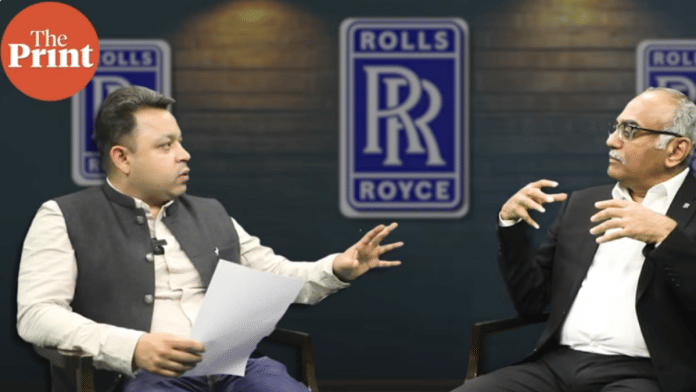
“There are only three genuine aero-engine manufacturers in the world. Two of them are in the US and the third is Rolls-Royce,” the company’s executive vice president (transformation) for India, Sashi Mukundan, told ThePrint in an interview, taking a dig at Safran. His argument is that the three companies he mentioned have continued to develop multiple engines on their own and have a proven history.
The plans for a new engine to power the AMCA were put out in 2013, with three players showing interest—GE, Safran and Rolls-Royce.
Cut to 2026, the competition has narrowed down to Rolls-Royce and Safran.
Under Phase 1 of the project, the initial lot of AMCA will be powered by the GE F414 engine, the same powerplant selected for the Tejas Mk-2.
The indigenous 120 kN-class engine is intended for later AMCA variants under Phase 2. As per the plan, the AMCA is supposed to enter production by 2035-36.
Defence sources said any delay in the new engine programme could strengthen the case for additional orders of the GE F414, which is already slated for production in India under a 80 percent technology-transfer arrangement between GE Aerospace and Hindustan Aeronautics Limited (HAL).
However, it is likely to be more of licence production rather than actual developmental capability.
For Rolls-Royce, the AMCA engine project is about more than a single programme. The company says it wants India to become its fourth global propulsion hub after the UK, the US and Germany, supporting military and civil aerospace, naval propulsion and land-system power solutions from a common industrial ecosystem.
Underling that even Dassault Aviation, the manufacturers of Rafale fighter jets which are powered by the Safran engine, have chosen Rolls-Royce engine or the latest Falcon business jet, Mukundan said the company sees India as a strategic partner.
“We want to be a strategic partner to India. What do I mean by that? Essentially, we want to do everything that we do in our home markets, which is like the hub. We have got the UK, USA, and Germany. We are saying we want to create the fourth one in India, which means we will do everything in terms of propulsion,” he said.
He added that by propulsion, he meant, “Whether it’s propulsion for, you know, airlines, military, Navy, Coast Guard and Army… So we want to do all of that in India.”
“The idea is that we will have the design of the new engine done here, then we will develop it, prototype it, and then we will set up a manufacturing facility and then we’ll have a MRO, plus we will be looking at life extension, aftercare and beyond that,” he said.
Talking about the timelines offered by Rolls-Royce to India, he said that if a contract is signed by the end of 2026, they will have the new 120 kN-plus engine carrying out its first test flight in 2034.
“The whole idea would be that we would have a core that we will test in 2030, the hot section. It would be a new design completely, everything made in India. We are designing it here. Then the first actual flying in 2034 and by 2036, it will enter actual production,” he said.
Mukundan underlined that there will be 100 percent ToT, with India having IP control.
“The key is as that as we develop the project in India, there will be IP being developed. That stays in India. It stays with the government. And what happens is that in order to get the new IP, we will need the background IP because there’s 80 years of history that we have. We will bring that into the design centre which will work on our IP and help create the new engine,” he said.
He added that over the last 30 years, they have reached one new engine designed every 18 months and no other European company has come close to this feat.
He said that Rolls-Royce’s plans in India are not limited to just aero engines but also naval and land systems, besides, of course, gensets.
(Edited by Viny Mishra)
Also read: AMCA tender issued, HAL sits out as private sector takes centre stage
Rolls Royce with proven history would be ideal.
But our PM Modiji is personally close to Macron!!
Sadly in India such relationships matter.
The bribes have to be paid properly!!:)