





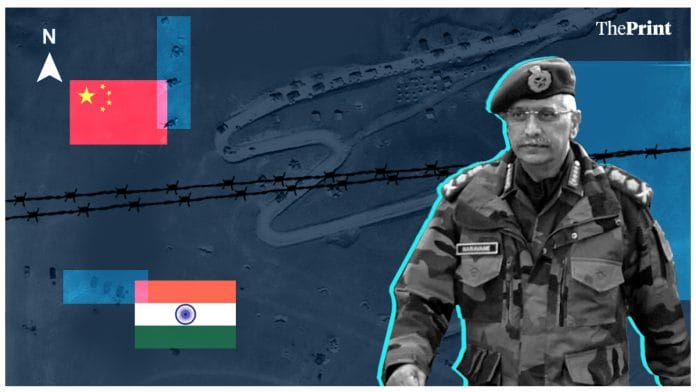



New Delhi: In his yet-to-be-published memoir, the then Army chief General Manoj Naravane writes that at 2230 hours on 31 August 2020 Defence Minister Rajnath Singh told him: ‘Jo ucchit samjho woh karo (Do whatever you deem appropriate).’
This was in response to him informing the leadership that Chinese People’s Liberation Army (PLA) moved tanks and troops to Rechin La, a mountain pass along the Line of Actual Control (LAC), in eastern Ladakh and were inching closer to Indian positions.
Gen Naravane’s words are captured in the excerpts published by news agency PTI in December 2023 from his book that is awaiting publication pending clearance by the Army. As a rule, all books written on operational matters by veterans or serving officers have to be cleared by the Services concerned.
“At 2015 hours on the evening of 31 August, Jo (Joshi) rang me up, quite worried. He reported that four tanks supported by infantry had slowly started moving up the track towards Rechin La…They had fired an illuminating round but this had no effect. I had clear orders not to open fire, ‘till cleared from the very top’. A flurry of calls followed, between the RM, EAM, NSA, CDS and myself over the next half-hour,” the excerpts further said, talking about then Northern Army Commander Lt Gen Y.K.Joshi informing him of the Chinese movement.
The excerpts have now become a political hot potato with the Congress raising the issue in Parliament.
Back at Rechin La, the Chinese action led to firing of the first shot at the LAC breaking the over four decades of silence despite an unsettled border that witnesses several face-offs every year.
Not only was an illumination round and a rocket launcher on a mountain peak fired as warning, several rounds were shot in air as warning to the Chinese to stop their aggressive action following which they backed down. The Chinese had first opened fire in the air to intimidate the Indian troops.
However, while the focus is on what transpired on the 31st, the real story is what happened before that, which is not captured in the excerpts so far.
The Chinese did try to move their light tanks along with soldiers to Rechin La to capture the heights. “It was an attempt to capture the heights from Indian soldiers who had outwitted the PLA and occupied the critical heights earlier much to the surprise of the Chinese,” a source in the defence establishment told ThePrint.
Also Read: Gen Naravane’s legacy can only be understood over time. But it’s altered LAC dynamics forever
What happened on South banks heights in Aug 2020
As reported first by ThePrint, on 31st August 2020 morning, on the intervening nights of 29/30 August and during the day, the Indian Army had carried out ‘Operation Snow Leopard’ using specialised troops to capture key features along the Southern banks of Pangong Tso.
‘Snow Leopard’ is the same name of the overall operation that was launched in May 2020 following Chinese aggression in Eastern Ladakh.
The operation was a result of the Galwan clash in June 2020 that led to the death of the 20 Indian soldiers and injuries to several others. Following the clash, the rules of engagement at the LAC, which put certain restrictions on soldiers, had been changed.
ThePrint exclusively reported on 20th June in which a source explained: “The rules of engagement have changed. The Army commander on the ground will decide on the tactics to be used to counter any kind of aggression. There is nothing now that binds the commander from taking certain kinds of tactical decisions.”
How August operation unfolded
While ThePrint first reported the 29/30 August night operation in detail in December 2020, fresh details have emerged since then which throws light on finer details of the operation.
Sources explained that following the Galwan clash, the military was tasked to come up with possible solutions to get an upper hand in. The Indian Army was working on tactical manuvering which is also known as a quid pro quo to what the Chinese had done.
While the Leh based 14 Corps remained entrenched and in face-off situations at multiple locations in Eastern Ladakh, the commander of the then only Strike Corps focussed on China was flown in from the Eastern Sector to come up with possible contingency plans.
What followed then was a series of meetings between the then Army chief and the Northern Army Commander along with others. Finally, a plan was sent to the government which approved the same.
Nearly a month’s planning in utter secrecy, quiet induction of specialised troops and unorthodox deployment of multiple units and false flag manoeuvring followed next, culminating in the operation on 29th August night in the Southern banks of Pangong Tso and the Finger area.
The sources explained that at least half a dozen places were identified along the LAC where the Indian soldiers can gain an upper hand over the PLA.
Once the plan was finalised, the then only offensive formation against the Chinese—Panagarh (West Bengal)-based 17 Mountain Strike Corps (MSC)—was put into action.
Multiple units of the Army’s elite Para SF and the Chakrata (Uttarakhand)-based Special Frontier Force (SFF), largely made up of Tibetan refugees, were roped in.
While the operations were overseen by the Northern Army Command, then General Officer Commanding (GOC) of 17 MSC Lt Gen Savneet Singh was tasked with the operation on the ground.
In early August, on just 24-hour notice, a crack team from the MSC, without any big equipment and led by Lt. Gen. Singh, flew out to Ladakh. For the outside world, the movement was routine because there was no mass movement and things carried on as normal at the MSC.
So, in Eastern Ladakh, there were two Corps Commanders—Lt Gen Savneet Singh and the then GOC of 14 Corps Lt Gen Harinder Singh—on the ground.
The sources said that defensive operation came under the 14 Corps Commander since it was a holding Corps and the operations came under the MSC.
Also Read: The curious case of Pakistan’s JF-17 ‘orders’
How plan unfolded
The Chinese, in their attempt to put more pressure on the Indian side or as a precautionary step, carried out a tactical operation in the Southern banks of Pangong Tso and managed to climb up to two features called Black Top and Helmet locations in Southern banks, closer to their holding positions.
Seeing this, the Indian troops also started their movement in what was to be mirror-deployment. And that is when the Army brass gave the green signal to MSC Commander to set his action plan rolling.
On 30 August, soldiers from multiple selected units came together while equipment came from a different pool. There were also troops and equipment from the mechanised and armoured units.
In the meantime, India carried another tactical move in the Finger area in Northern banks, which made the Chinese believe that the Indian military was focusing there while the main action took place in the Southern banks.
“The Northern banks ops was also a successful one. The Indian troops had managed to climb up the heights of Finger 4 and station themselves directly opposite the Chinese there, while troops in the Southern Banks started capturing the heights,” another source explained.
On the Southern side, specialised Indian elements managed to surprise the Chinese and dominate the Southern banks of the Pangong Tso and capture heights on what is known as Kailash Range, which was disputed by both sides.
The key height to be captured by Indians was Mukhpari. While the heights were captured by a crack team of specialist operators, regular soldiers were pumped in to back them in numbers and to set up proper defences and logistics.
Seeing the troops take tactical heights in the southern banks, the Chinese also launched their troops but in the race for passes, the Indians won.
Until August end, neither India nor China occupied these heights. The heights include Rechin La and Rezang La, and these along with some other peaks allowed India to dominate Spanggur Gap under the Chinese control and also the Moldo Garrison on the Chinese side.
What happened 31 August
Taken aback by the sudden Indian movement, the Chinese rolled in their light tanks and deployed over 1,000 soldiers to take back the heights from Indian troops in the Southern banks.
India responded by moving its own armoured columns forward on to the Kailash Range.
Gen Naravane writes, as per PTI report on December, 2023, at 2015 hours on the evening of 31 August, Lt. Gen. Joshi rang him up. The next half-hour saw a flurry of calls.
“To each and every one my question was, ‘What are my orders?’ At 2110 hours, Northern Command again rang up, the tanks had continued moving ahead and were now less than a kilometre from the top…I rang up the RM again at 2125 hours, with the latest and once more asked for clear directions. The situation was tense. Telephone lines were buzzing,” he writes, referring to the Defence Minister, EAM S Jaishankar, NSA Ajit Doval, and CDS General Bipin Rawat.
Gen Naravane notes that there had been an exchange of hotline messages with PLA Commander, Maj Gen Liu Lin, suggesting that both sides refrain from any moves and that the two local commanders should meet at the pass at 0930 hours the next morning.
The Army chief then called up the Defence Minister and the NSA at 2200 hours to share this news. “I had hardly put the phone down when Jo rang up once again at 2210 hours. He said that the tanks had started moving up again and were now only about 500 metres away,” he writes.
Gen Naravane writes how Lt Gen Joshi recommended that the only way to stop the PLA was by opening up with medium artillery, which he said was ready and waiting.
“’We cannot be the first ones to fire,’ I told him (Lt Gen Joshi), as it would provide the Chinese with an excuse, a casus belli, to escalate and paint us as the aggressors…Even at Mukhpari (on the Kailash Range) the previous day, it had been the PLA who had fired first (being only two rounds by the PLA and three rounds by us, it had escaped the attention of the media).”
“Instead, I told him to move a troop of our tanks right to the forward slopes of the pass and depress their guns so that the PLA would be staring down the barrels of our guns,” Gen Naravane writes. “This was done forthwith and the PLA tanks, which had by then reached within a few hundred metres of the top, stopped in their tracks.”
“Their light tanks would have been no match for our medium tanks. It was a game of bluff and the PLA blinked first.”
Over the next few days, China continued to carry out provocative tactics to try and dislodge the Indian troops, who stood on the ground without moving an inch.
(Edited by Tony Rai)