





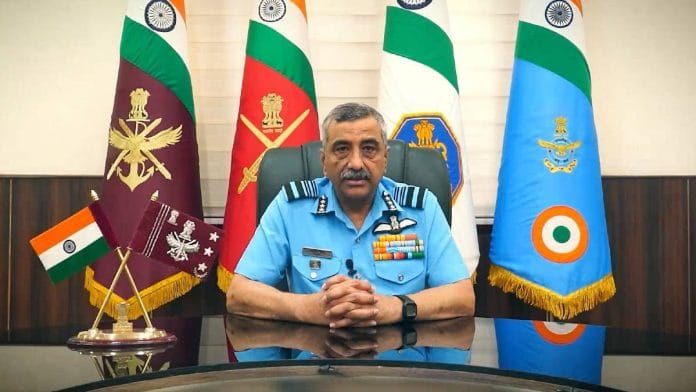



Bengaluru: Emphasising on the importance of technological sovereignty, Air Marshal Ashutosh Dixit Thursday said atmanirbharta (self-reliance) in defence cannot be just about making weapons in India.
Air Marshal Dixit, who is Chief of Integrated Defence Staff, said that atmanirbharta is about controlling the architecture and software of systems, among other things, because without control, the country will be dependent on others at the worst possible moments.
The officer also spoke about the theaterisation of the Indian armed forces and said that over 90% agreement has been reached on the same. ThePrint exclusively reported Wednesday on what has been agreed upon by the Indian military and what is yet to be.
Talking about defence production, Air Marshal Dixit, who was speaking at the Indian military’s marquee brainstorming seminar Ran Samwad in Bengaluru, said: “Atmanirbharta in defence is not just about making weapons in India. It is about controlling architectures–software, encryption, data standards and upgrade cycles. Without that control, we are dependent on others at the worst possible time.”
His remarks assume significance in the backdrop of India working towards procuring 114 more Rafale fighters with production in India, besides teaming up with France, US and possibly UK for separate aero engine programmes.
Incidentally, the UAE this month pulled back from funding the development of Rafale’s F5 version over restricted access to technology. India is not only procuring more Rafale jets but is also in talks with France to possibly join its 6th generation aircraft programme, FCAS. Germany, which is part of the programme, is at odds with France over work share and technology know-how.
Air Marshal Dixit said India’s military progress cannot be measured just by the number of platforms it procures or the doctrine documents published.
“But by effects we collectively generate that matter operationally. How quickly can we fuse multi-source data into a coherent operational picture? How fast that picture translates into executable orders? How resilient are our networks under cyber or electronic attack? How well can degraded systems be reconstituted in the field,” he asked.
He added that the answers to the above questions are the benchmark of genuine multi-domain integrated capability.
According to him, multi-domain operations are not about cosmetic jointness where the three services are talking to each other at seminars and conferences, but by planning separately.
Taking the examples of both India’s Operation Sindoor and US’ Operation Epic Fury, the senior officer said that multi-domain operations are key. He said that during the Israel-US and Iran conflict, no single domain has been decisive and every domain was contested.
“And closer home, our own experience with operation Sindoor in May 2025 underscored, sharper than any doctrine document ever will, that jointness is the need of the hour. Integrated operations coordinated across services and domains in real time define the new standard. That lesson must be embedded into how we train, how we equip and how we fight,” Air Marshal Dixit said.
He also noted that while the nature of war has not changed, its character is transforming at a pace rarely witnessed in history. “The battlefield no longer unfolds sequentially or phase by phase. It unfurls simultaneously across every domain, where a single tactical action can produce strategic consequences within minutes,” he explained.
(Edited by Nida Fatima Siddiqui)