



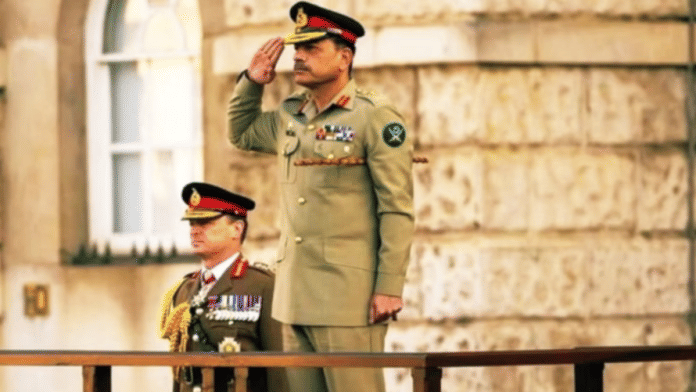
New Delhi: The Pakistan Army has reshuffled its senior command structure with the elevation of several Major Generals to Lieutenant Generals while also making new appointments to key Corps Commander-level positions.
This was made public immediately after the 277th Corps Commanders’ conference held in Rawalpindi on 2 October.
Analysts are looking at potential ramifications on Pakistan’s internal political and security landscape and the Pakistan Army’s posture vis-a-vis India. Most appointments, however, are routine.
That Field Marshal Asim Munir has picked officers based on his preference is not surprising; every Army Chief strives to do the same.
Munir’s Corps Commanders
For 11 Corps, Peshawar, Mohammed Naeem Akhtar from the Azad Kashmir Regiment has been selected. He has replaced Lt Gen Omar Ahmed Bukhari, 22 Baloch Regiment, who has now been given the post of Chief of General Staff, a highly coveted post after the Chief of the Army Staff (COAS).
The Peshawar-based XI corps is closely watched, for it is not only among the army’s key field formations, but those heading it typically assume a bigger public role. It also sees a greater degree of activity, liaisons more closely with the ISI, and has a larger footprint in civilian affairs since its commander sits on Khyber Pakhtunkhwa’s Provincial Apex Committee. The logic, hence, goes that those who are selected to head this corps are tapped for bigger roles in the future.
Umar Bashir, Artillery, has been made Corps Commander, 4 Corps, Lahore, by Field Marshal Asim Munir.
Field Marshal Asim Munir has appointed Lt Gen Shakirullah Khattak, Armoured Corps (13 Lancers) who was chairman, Heavy Industries, Taxila, the new Corps Commander at Mangla, or the I Corps. This follows a recent convention of sending either armoured corps or artillery officers there.
Khattak will be replacing Lt Gen Nauman Zakaria, who was also an Armoured Corps officer. While being the commander of I corps, Zakaria was simultaneously heading the newly established Army Rocket Force Command (ARFC), announced by Prime Minister Shehbaz Sharif in August 2025. He captured headlines at this year’s Shangri-La Dialogue in Singapore in May. Though he leaves the I Corps, there has been no reported change of guard for the ARFC.
The Mangla Corps deals with Pakistan’s eastern border—India. It has historically had three Infantry divisions, and one Armoured Division under it, positioned at Jhelum, Kharian and Mangla.
Rana Banerji, who headed the Pakistan desk at R&AW, in a monograph dated September 2013 writes: “After the 2003 ceasefire on the Line of Control (LOC), one of these divisions was temporarily deployed to the Western sector, to assist XI Corps, Peshawar in counter-insurgency (COIN) operations against tribal insurgencies in Swat and FATA.” Presently, the Mangla Corps retains its armoured components alongside infantry and mechanised infantry divisions.
Field Marshal Asim Munir has appointed Mohammad Amer Najam, 19 Sind Regiment, who was serving as inspector general, training and evaluation at General Headquarters, as corps commander, 2 Corps, Multan. The I Corps Mangla, along with II Corps Multan, forms the Pakistan Army’s Strike Corps.
Lieutenant General Inayat Hussain, Frontier Force Regiment, hitherto chief of logistics staff at GHQ, has been appointed the new corps commander, 12 Corps, Quetta by Field Marshal Asim Munir.
Among three-star appointments, including at the corps-commander level, the Army Chief strives for ensuring representation from all major arms (Armoured Corps, Infantry, Artillery, Engineers, Air Defence) to maintain institutional equity and cohesion across the service.
Three-star ranks never retire
According to Rana Banerji’s column for Rediff, at least six lieutenant generals of the 80th Pakistan Military Academy long courses, who were due for retirement after completing four years in this rank, may now be phased out.
These include Lt Gen Inam Haider Malik (Engineers, Chairman, National Disaster Management Authority) and Lt Gen Fayyaz Hussain Shah (Sind Regiment, Corps Commander, 4 Corps, Lahore); Lt Gen Muhammad Zafar Iqbal (Air Defence, commander, Air Defence Command, Rawalpindi); Lt Gen Shahid Imtiaz (Azad Kashmir Regiment, Military Secretary); Lt Gen Ahsan Gulrez (Frontier Force Regiment, Corps Commander, 2 Corps, Multan) and Lt Gen Nauman Zakaria (Armoured Corps, Corps Commander, 1 Corps, Mangla).
Formally, three-star generals in Pakistan do retire. In practice, retirement doesn’t equal being out of the army’s orbit. They only move out of General Headquarters (GHQ), Rawalpindi, into positions that the high command at GHQ continues to shape.
Take the example of Lt General Nauman Mahmood (Retd), who was appointed as the first secretary general of the Makkah Defence Alliance in September 2026. He had notably commanded the XI Corps, Peshawar and his tenure had coincided with one of the most sensitive periods along Pakistan’s western border, witnessing the withdrawal of the United States from Afghanistan.
A 2018 study by Paul Staniland et al., shows that retired corps commanders rarely enter electoral politics. There is an “institutionalised transmission belt that shifts retired elites into military-owned charitable foundations and affiliated corporations, posts in the civilian government, and other positions of real and/or symbolic authority”.
These positions, labeled “off-ramps”, provide officers strong incentives to toe the organisational line while serving and to avoid directly participating in politics after retirement, the study adds. More so as for most of the Pakistani military elite, their first corps command is their last major command.
There’s the Water and Power Development Authority (WAPDA) that is chaired by a retired Lt Gen—Muhammad Saeed—who had earlier served as the CGS and corps commander of 5-Corps Karachi. Even Pakistan’s National Disaster Management Authority (NDMA) has more or less been headed by a three-star level officer.
However, the dominant post-retirement slot is a blend of foundations and associated corporations led by the military—and for the military, such as the Fauji Foundation and its subsidiaries, Army Welfare Trust and Defence Housing Authority.
Ayesha Siddiqa, in her seminal work Military Inc., termed the military’s deep penetration into Pakistan’s economy as ‘Milbus’ (Military-Business).
Fauji Foundation is headed by a retired lieutenant general—Anwar Ali Hyder. The governing body of the Defence Housing Authority (DHA) is chaired by Lt Gen Muhammad Ali (Retd) who is also the Secretary Defence, Ministry of Defence. DHA acquires land for real estate purposes to provide premier housing to the military fraternity, which has resulted in the army being known as Pakistan’s “biggest land grabber”.
The post-retirement trajectory of three-star generals reinforces that Pakistan is not a state with an army, but rather its army has a state to itself.
Pakistan’s intelligence chiefs
Last month, ThePrint reported on the Pakistan Army carrying out a series of new appointments at the two-star level. Most notable was a change in command of Director General-Military Intelligence (DG-MI), now assigned to Major General Adil Iftikhar Warraich.
This post matters because it is a stepping stone, given the convention of DG-MI ascending to the head of ISI. Take the example of the incumbent army chief, Field Marshal Asim Munir, who served as the head of MI and ISI both, later bagging the biggest post of army chief.
If DG-MI’s appointment was noteworthy last month, then the one-year extension given to the DG ISI (Inter-Services Intelligence)—Lt Gen Asim Malik—who has been serving the post since September 2024 stands out.
(Edited by Viny Mishra)
Also read: In Pakistan, every PM and army chief are jodi No.1—until they aren’t