



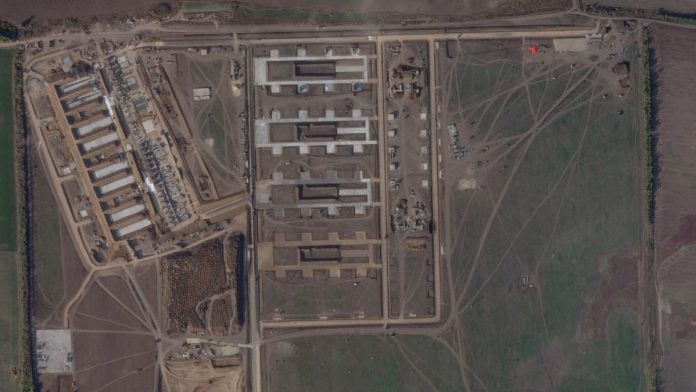
New Delhi: News agency Reuters confirmed Thursday the assessment by Telegram OSINT channels that Russia completed construction of a major new attack drone facility in approximately six weeks.
The rapid construction comes as Russia expands deployment of jet-powered strike drones capable of reaching speeds of 600 km/h, posing fresh challenges to Ukrainian air defences.
Planet Labs imagery from 31 August, 2026 showed an undeveloped field near Millerovo in Russia’s Rostov region. Groundwork began the following day, with construction captured by the Copernicus Sentinel-2 and commercial satellites.
By 11 October, Planet Labs imagery showed launch pads and buildings taking shape, while high-resolution Airbus and Planet Labs images from 12-14 October confirmed that the facility was nearing completion, with launch rails being installed.
The 0.9-sq km facility features eight launch pads and 32 preparation zones.
High-resolution imagery shows that physical launch rails have been erected on two pads, while guidance tracks are being installed at two others. The preparation zones would allow launch crews to fuel, programme and equip drones before deployment.
According to Ukrainian OSINT analysts, the facility’s layout closely mirrors that of an existing Russian jet-powered strike drone installation in Tsymbulova, in the Oryol region. The new site is just 3.5 km from Millerovo airbase, placing it within the air-defence coverage associated with the base, according to private threat intelligence firm DroneSec.
DroneSec analyst Mike Monnik told Reuters that the facility could support Russia’s deployment of Geran-4 and Geran-5 jet-powered drones as part of a network of more than 11 strike locations across the country.
He warned that the speed of construction, combined with faster drones and gaps in NATO-provided counter-drone capabilities, could create significant vulnerabilities for Ukraine.
“The speed of construction demonstrates just how easily Russia can quickly deploy its already established offensive capabilities,” Monnik told Reuters. He added that the facility could launch more than 100 jet-powered unmanned aerial vehicles (UAVs) a day, although actual deployments would generally occur in smaller waves.
Ukrainian forces have claimed that Russian deployments of jet-powered strike drones have reportedly increased six-fold over the past three months. Kyiv and surrounding areas have been among the principal targets as Moscow increasingly relies on jet-propelled systems to conduct strikes against Ukrainian territory.
Their higher speeds also complicate interception. Although relatively inexpensive interceptors costing less than $2,000 have been used against Geran-3 and Geran-4 drones, the long-term effectiveness of such systems remains uncertain.
The expansion of Russia’s drone capabilities comes amid a wider dispute over attacks on energy infrastructure and the role of US military assistance to Ukraine.
US President Donald Trump has urged Kyiv to halt strikes on Russian energy infrastructure ahead of a US-Russia diesel agreement, amid wider conflicts in West Asia.
In an interview with Financial Times published Wednesday, Ukrainian President Volodymyr Zelenskyy said that Ukraine had refrained from conducting deep strikes against Russian energy targets for three days, but Russian attacks on Ukrainian civilian and energy infrastructure continued to intensify. He said Kyiv would continue targeting Russian oil facilities, claiming that Ukrainian strikes had taken between 40 and 50 percent of Russia’s capacity offline.
Zelenskyy also said he would agree to stop attacks on Russian energy infrastructure in exchange for American Patriot air-defence interceptors, describing them as the “minimum” Ukraine would require. However, he said the response instead involved degraded Starlink services.
Ukraine separately reported a one-day restriction on SpaceX’s Starshield service which it said affected drone interceptions and strikes. SpaceX CEO Elon Musk said that the restrictions were imposed by US Central Command.
Ashwin Shekhar is an alum of ThePrint School of Journalism, currently interning with ThePrint.
(Edited by Amrtansh Arora)
Also Read: Ukraine’s National Academy of Sciences was at the heart of discovery. Russian drone just hit it