







The history of the University of Delhi as one of India’s premier institutions has often been marred by incidents of politically motivated attacks on faculty members for the sake of media sensationalisation and meticulously orchestrated displays of power.
One such instance occurred last October, when a professor was publicly assaulted by a student union leader, sparking nationwide outrage about politicisation of educational campuses. This is not an isolated case, but part of a troubling continuum, with such cases coming to light from across the nation.
While it’s noteworthy that grassroots participatory governance truly finds utterance when scholars themselves get involved in university-level politics, we should keep ourselves abreast of the very reality of hooliganism that occurs in these campuses.
The conventional rhetoric about student agency often posits them as mere cogs in the wheel of the broader educational framework, yet their functional importance in determining the trajectory of this nation is undeniable. In this vein, it’s imperative to reassess the intent and purpose of student agency. With such campus-wide violence being normalised, the question of restraint on unchecked liberty imparted to such groups remains paramount.
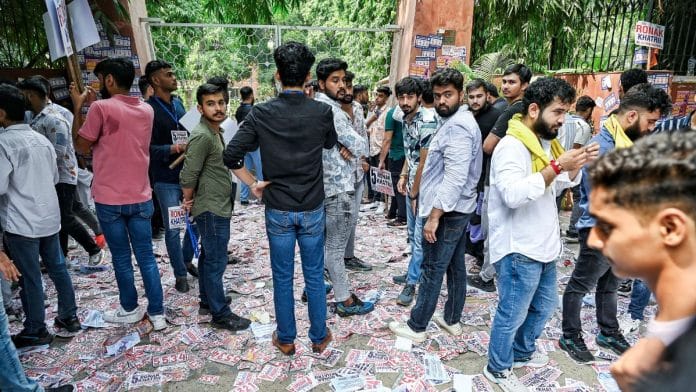
A troubling manifestation of this is the trend adopted by student union leaders, who facilitate defacing and vandalising university infrastructure. Often proudly advertised as machismo, such acts reveal the naked reality of political trajectory towards which our student community is hurtling. (Defacement policies by the university were introduced in 2025, mandating a bond of Rs 1 lakh from the candidates at the time of nomination)
The real challenge, thus, lies not in curbing student activism but in transforming it into an incubator of constructive change.
Furthermore, at a time when social media has ascended to the zenith of cultural and political influence, the role of narrative building remains quite pertinent to this situation.
In December last year, a case emerged where a DU student lodged harassment charges against two professors, sparking national headlines. This was further sensationalised by using Instagram to concoct a dramatic narrative, amplifying the issue beyond university circles.
Taking cognisance of the case, the university formed a panel to probe harassment charges against these professors but concluded that the allegations were devoid of merit.
Rather than acting in service of a polarising spectacle, student agency could be used as a counter-reactive force to resist the spread of misinformation rooted in fact-based activism. In a rare turn of events, such an instance arose when students from the same college stepped forth to expose the false narrative in the aforementioned case.
The efficacy of social media platforms is largely contingent on the intent of the users. These days, platforms like Instagram, Facebook and X, among others have become potent tools of digital doxxing and echo-chambers of victimhood.
One such landmark case is that of a DU professor whose email account was hacked and private photos sent to senior colleagues, prompting legal recourse.
While such acts are often fueled by a select few, the wider academic milieu bears the brunt of the consequences.
There seems to exist a possibility of authoritarian crackdown in response to such hooliganism, which in turn would create a domino effect stifling dissent and curtailing the very essence of political engagement on campus.
Furthermore, such acts tend to jeopardise academic freedom and teacher autonomy in a university, which has gained national fame for its intellectual rigour. They also foster faculty self-censorship and reluctance to engage in concerted academic discourse on important topics that may be perceived as sensitive.
This climate of aggression has not remained confined to university spaces. In another reported incident, a Class 12 student slapped a female teacher upon being questioned about arriving late to the examination hall. The episode intensified the ongoing debate over whether this culture of violence has seeped into the minds of high-school-going youths.
It comes as no surprise, as impressionable teenagers often laud such acts of machismo displayed by the so-called youth leaders on social media.
Our country has long held a deep reverence for the role of teachers as architects of the nation’s future. But incidents such as these, where their dignity is undermined, threaten the sanctity and credibility of this very tradition. It’s high time we reaffirm the value of academic integrity and create an environment conducive to open discourse by safeguarding the autonomy of our educators.
Tanuj Samaddar is a B.A. (Hons) Geography student at Kirori Mal College, University of Delhi. Views are personal.