


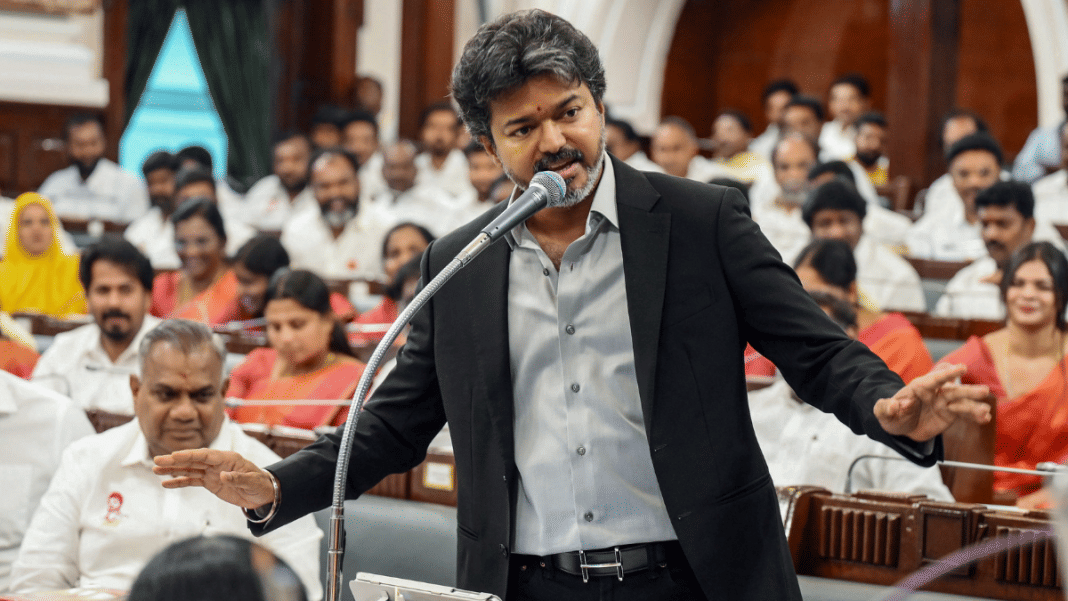
It is a truth universally acknowledged, at least in Tamil cinema, that a woman in possession of a problem must be in want of a man to solve it. For decades, Tamil cinema has perfected this arrangement. Its heroes have saved women from villains, society and sometimes from their own choices. C. Joseph Vijay, popularly known as Thalapathy, is one of the most popular actors to have played the role.
Now, with Thalapathy having traded his movie stunts for political drama, one can only wonder what would happen when the guy who has been saving women on screen asks them to put their trust in him for their political future.
The solution might not lie in Vijay’s political rhetoric, but in the strange bond between patriarchy, love and the soothing presence of anna.
The gentleman who protects
In February this year, Newslaundry had an interesting conversation with 29-year-old Pavithra from Tiruppur, who had joined Vijay’s Tamilaga Vettri Kazhagam (TVK). She said her parents allowed her to be involved in politics as it was Vijay’s party. His reputation as someone who made women feel safe apparently made political participation acceptable.
This is a very revealing set-up, but not exactly as the participants would have liked. It was okay for a woman to go into politics, an activity she should have no need of permission for, because her family trusted another man. The patriarchal gatekeepers did not give up their power. They only discovered a gentleman to whom they could temporarily entrust it.
To be clear, Pavithra’s participation is not an absence of agency, it is an exercise of it. She has moved into a political arena that she may not have had access to otherwise. However, the context of that entry provides clues to the society in which such decisions are made.
The irony is hard to miss—the very culture that limits women’s freedom can make the prospect of masculine protection seem liberating. Vijay, by design or by the quirk of circumstance, is an exceptionally good beneficiary of this arrangement.
A hero of great achievements
The benevolent patriarch is not hard to find in Vijay’s filmography. Take, for example, the film Bigil (2019), which is supposedly about women empowerment. Its female footballers struggle against discrimination, violence and social expectations. They are ambitious, determined and have a good sporting ability.
They also have Vijay, which is a good thing for the commercial viability of the film. His character becomes the essential person through which their aspirations are given direction and their struggles are resolved. The women can score the goals, but the emotional structure of their success is built around the man who leads them.
The movie isn’t entirely reactionary. It’s important because it’s celebrating women’s sporting success, which is so rare in a film culture that has long been dominated by men. But it also presents a familiar paradox: women are urged to be independent, as long as they are independent under the right kind of male guidance.
It’s a fine line between helping women and being indispensable to them. It is not always been observed by Tamil commercial cinema. Vijay’s larger screen image has often been one of righteousness and physical power. He’s not just a guy who beats up bad guys. He is the man who steps in when the world has not acted as it should. A hero provides viewers with something more satisfying than institutional reform. Vijay assures us that some good man, somewhere, somehow, will come. This is a pretty good idea for a movie. When transferred to politics, it gets a bit trickier.
From Thalapathy to Anna
Tamil Nadu is no stranger to such a shift in affection and its political legitimacy. There are plenty of examples in the state’s political history of people becoming political. But Vijay’s popularity with women warrants a special look at the emotional acceptability of masculine authority.
The anna, or elder brother, has a unique position in the Tamil social imagination. He is loving, knowable and protective. His authority doesn’t have to be a declaration of authority; it comes in the form of responsibility. The anna seems to provide a relationship, unlike the distant politician who calls for loyalty. He is not just a man to be chosen. He is someone to be trusted.
That distinction matters.
Patriarchy is usually thought of as a system that is enforced by intimidation, restriction and obedience. It has these attributes. But it also lives on in tenderness, reassurance and the assurance that women will be safe if the right men are in charge. The protective brother is thus a particularly powerful political figure. His power seems benevolent because it is expressed in the language of care.
Vijay’s political career gives him a new institutional aspiration, the protector of the people. The hero who was once willing to bring justice within the confines of a three-hour movie now wants to be trusted with the far more unpredictable business of public life.
His female fans don’t necessarily have to mistake fiction for reality. They might like his political stances, dislike the political parties, or find in him that they can’t find in others. Yet his film experience gives him an emotional lexicon that allows for the expression of political trust. However, that vocabulary is not innocent of the culture of the patriarchy that gave birth to it.
The curious business of women’s support
There’s another weirdness to the celebration of Vijay’s female fanbase. Women’s visible
enthusiasm turns into a valuable political asset. They attend rallies, make statements of allegiance and defend the leader, which helps to create an impression of public confidence. A man who is a favourite of women can be given as a man who knows women. Yet these are two rather different accomplishments. It is not love that makes a man a good politician, nor is it being a good protector on screen that makes him a good protector in public office.
But political legitimacy has never been built on a purely logical basis. The image of the
enthusiastic female supporters can be a very convincing endorsement of the masculine leadership. It implies that the leader’s authority is not only accepted but is also embraced by those whom he promises to protect. This is where the patriarchy culture comes in handy politically.
A society that has historically honoured the good man as the protector of the women is particularly receptive to a political figure who convincingly plays that role. The women who help him don’t necessarily give up their independence. However, their support can also help to strengthen a political narrative that imagines women’s security and progress as a gift from a powerful man.
There is no contradiction in recognising both realities. In fact, denying women agency will create the very paternalism that is being criticised.
The limits of protection
Actor Ranjana Natchiyaar claimed in March 2026 that she had been subjected to online abuse by TVK supporters after she had quit the party. The allegations were not proof of wrongdoing by Vijay or be indiscriminately blamed on his supporters. However, the debate brings up a question that transcends any political party. What if a woman stops loving the man who promises to protect her? The protective ideal is most readily affirmed when women are grateful, loyal and agreeable. Its democratic value is more apparent when women dissent, criticise and withdraw their support.
A movement for women’s empowerment that is truly committed to women’s independence should not compromise their independence even if it leads to politically inconvenient decisions. This is the difference between protection as benevolence and rights as an entitlement. The benevolent protector provides safety because he chooses to provide it.
A rights-based political system ensures safety, whether a woman likes the person in power or not. One depends upon the character of the gentleman. The latter relies on institutions that are still held accountable even if the gentleman is disappointing. Jane Austen knew a very important lesson about attracting men: good behaviour and reassuring statements do not necessarily indicate good character. A similar suspicion is welcome in democratic politics.
The man who need not be asked
None of this proves that Vijay intentionally swayed women to support him. Nor does it imply that his female fans lack political acumen. The connection between cinema, gender and political affiliation is too complex to be reduced to such easy answers.
But it does indicate that Vijay’s political popularity has grown in an environment that is already primed to accept masculine protection as a desirable form of leadership. He was not the first to create this expectation in his films. They were involved in its reproduction.
The figure of the protective anna did not exist in his political career. It took over a cultural icon with a proven emotional connection. And the excitement of women who back him, for whatever reason, can be converted into political legitimacy in that old mold.
So the big question is, can Vijay protect women? That is the reason why women’s political futures should be continued to be envisioned through the promise of protection, in the first place. The best thing that could happen to a society that truly wants women to be independent is to find a better man to save them.
It would be constructing a political system in which there is no need for a saviour.
Chiranjeev T is an M.A Political Science student of Madras Christian College, University of Madras, Chennai. Views are personal.
Also Read: The morality of the untested