








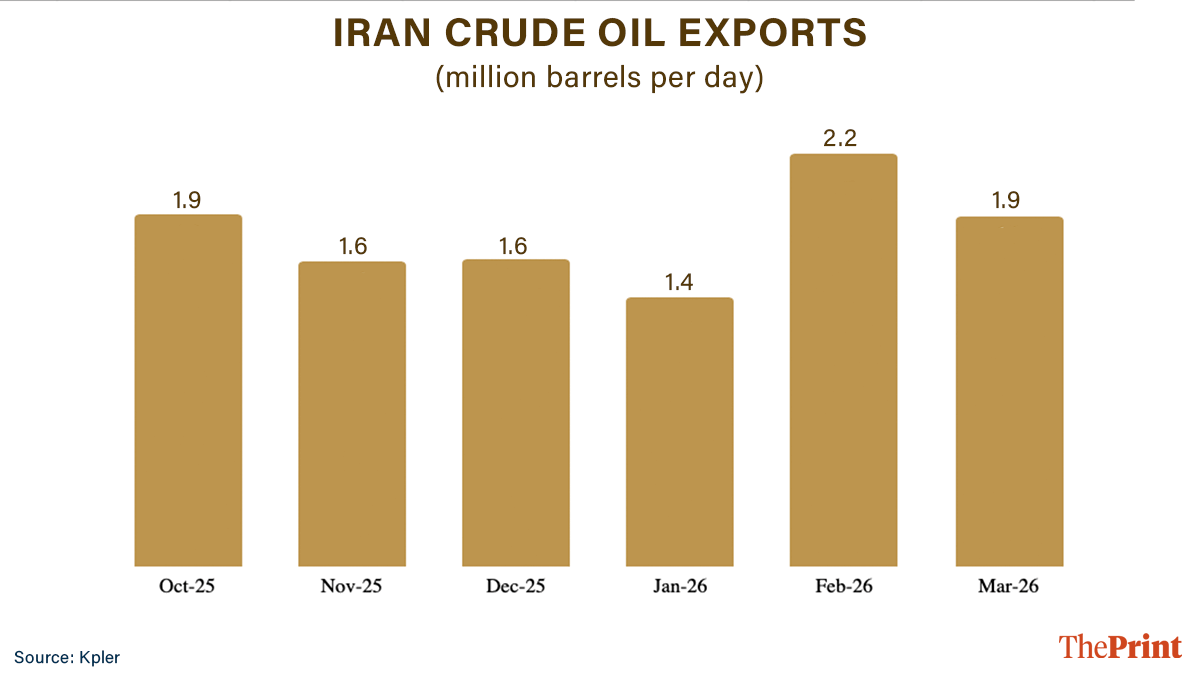
New Delhi: Iran’s crude oil exports remained strong in March despite heightened regional tensions, signalling resilience in flows even as conflict disrupted wider Gulf supplies.
According to Kpler, the country exported around 1.9 million barrels per day (mbpd) in March—only 15 percent lower than February’s 2.2 mbpd, but higher than levels seen in December 2025 and January 2026.
“Iranian crude oil exports in March have remained relatively stable compared to other Gulf exporters,” Nikhil Dubey, senior research analyst for refining and modelling at trade data intelligence firm Kpler, told ThePrint. “A significant portion of these flows continues to head toward China, largely facilitated through opaque or ‘dark fleet’ activities designed to bypass sanctions.”
India, meanwhile, may be cautiously re-entering the Iranian crude market after a prolonged gap. “India has reportedly purchased Iranian crude oil, indicating early signs of a potential re-emergence of trade flows,” Dubey said. “As of now, vessel tracking shows one VLCC [very large crude carrier] carrying around 2 million barrels signalling India, as its discharge destination, although such movements remain fluid and subject to change.”
A sustained return could benefit Indian refiners, which were consistent buyers of Iranian crude prior to the sanctions on it in 2019. “Any sustained return of Iranian crude into India would be a constructive signal,” Dubey said.
He added that these grades remain well suited to domestic refining needs. “Iranian crudes are relatively rich in middle distillates, aligning with India’s product slate, which is skewed toward maximizing middle distillate yields.”
Russia, Venezuela factor
Even as Iran signals a potential comeback, Russian crude continues to dominate India’s import basket.
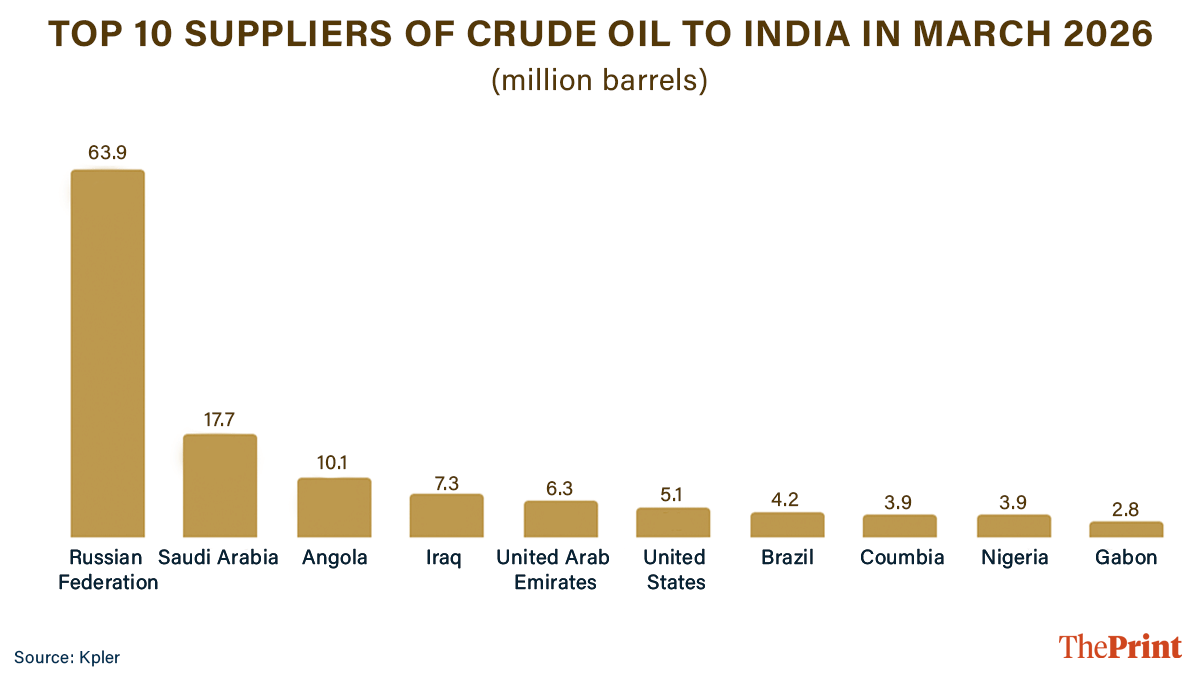
Last week, ThePrint reported that Russian crude imports surged to a nine-month high of around 64 million barrels (~2 mbpd) in March, supported by a US waiver for purchases at sea and India’s efforts to offset supply disruptions from Gulf suppliers amid the West Asia conflict.
Preliminary April data suggests the trend is holding. Kpler estimates show around 12 million barrels of Russian crude were imported in just the first week of the month.
While it is too early to determine whether April volumes will surpass March levels, Dubey indicated that imports are likely to remain elevated compared to January and February levels.
“Indian refiners have increased intake of Russian barrels, driven by availability and energy security considerations,” he said, adding that strong buying in March is likely to keep arrivals firm into April too, alongside a re-entry of Venezuelan crude.
Venezuelan crude is also making a notable return to India’s supply mix. Kpler estimates indicate around 8.7 million barrels are en route to India in April, with another 7.7 million barrels expected in May. However, Dubey noted that these projections are based on vessel signals and could evolve as voyages progress.
Also Read: How Russian oil makes its way to India—two key routes, a backup & a sanctions hack
Gulf flows adjust
Alongside Russia and Venezuela, India is also seeing increased inflows from key Gulf producers, particularly Saudi Arabia and the UAE. Against 17.7 million crude barrels received from Saudi Arabia in March, India had already imported around 9.7 million barrels by 8 April – crossing 50 percent of the previous month’s total within days.
Much of this supply, according to Dubey, is being routed through Saudi Arabia’s East-West pipeline to Yanbu, allowing shipments to bypass the Strait of Hormuz.
Similarly, the UAE has supplied around 2.6 million barrels in early April, with flows routed through the Abu Dhabi Crude Oil Pipeline (ADCOP), which transports crude from Habshan to Fujairah, also avoiding Hormuz.
Beyond traditional suppliers, India is further diversifying its crude basket. Kpler data shows imports from countries such as Angola, Brazil, Republic of Congo, Gabon and Ecuador, with early April estimates indicating new entrants including Algeria and Egypt.
Ceasefire’s limited relief
The two-week ceasefire, which includes a window to partially reopen the Strait of Hormuz, can provide some relief to disrupted oil flows–but uncertainty remains high.
“The current ceasefire appears to be in disarray, although it could create a key window for trapped barrels, laden on ships, to exit through the Strait of Hormuz,” Dubey said.
Kpler estimates suggest that “around 130 million barrels of crude oil [are] stranded inside the Strait of Hormuz,” along with another 40 million barrels of refined petroleum products, highlighting the scale of the disruption.
However, any easing of supply constraints may be short-lived. “This depends entirely on how the situation is implemented on the ground. If it holds, it could provide some relief to Asian buyers, who are scrambling for every barrel of oil,” Dubey said.
The Kpler senior analyst had a word of caution. “This relief would likely be temporary until a final peace plan is reached, as tankers may remain hesitant to enter the strait due to fears of being trapped.”
(Edited by Tony Rai)