




VMPL
Rohtak (Haryana) [India], September 12: For nearly 20 years, a 55-year-old patient from Panipat lived around the limits of her own knees. Both had progressively bent out of shape, and ordinary movement, walking any real distance, climbing a flight of stairs, sitting on the floor for a meal, had stopped being simple long before it stopped being possible. It had happened slowly enough that discomfort came to feel less like a problem and more like a condition of daily life.
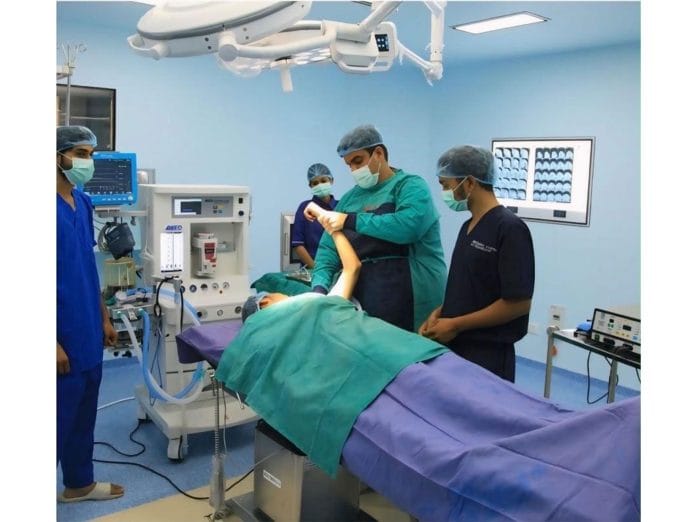
That changed after a bilateral knee replacement performed by Dr. Karan Siwach at Siwach Sanjeevani Hospital, Rohtak. Today, the same patient walks unaided, climbs stairs without difficulty, and sits cross-legged again, a posture that had been out of reach for two decades.
Two Decades of a Slow Decline
Knee deformity of this severity rarely appears suddenly. It develops over years, sometimes decades, as cartilage wears down and the joint gradually loses its alignment. In much of India, patients delay surgery well past the point their doctors recommend it, usually out of fear of the operation itself, concern about time away from family responsibilities, or a belief that pain is something to be managed rather than treated. By the time many patients reach a joint replacement surgeon, the deformity has advanced far enough that simpler options such as physiotherapy or medication are no longer effective on their own.
That was broadly the pattern here. Both knees had deformed progressively over 15 to 20 years, and by the time the patient came to Siwach Sanjeevani Hospital, walking, standing for any length of time, using stairs and sitting on the floor had all become difficult.
The Decision to Operate
After clinical assessment and imaging, Dr. Karan Siwach recommended replacing both knees in a single sitting rather than staging them months apart, a decision surgeons weigh case by case based on a patient’s overall fitness and how evenly the deformity has progressed on both sides. Operating on both knees together means one hospital stay and one recovery timeline instead of two, provided the patient is fit enough to tolerate it.
The surgery used a DePuy implant, placed using a minimally invasive technique. The distinction matters clinically: a minimally invasive approach works through a smaller incision and disturbs less of the surrounding muscle than conventional open replacement, which is part of why patients on this protocol are typically standing within days rather than weeks.
The First Two Weeks
Recovery began almost immediately. The patient was standing and taking supported steps on the third day after surgery. By the fourth day, she was practicing stairs, a milestone that in many recovery protocols is not attempted for weeks. Discharge followed once the care team was satisfied with how recovery was progressing.
The visible part of recovery, standing and walking again, happened fast. What followed over the next several weeks was the slower, less visible part: physiotherapy, rebuilding strength and range of motion, and gradually returning to activities that had been off-limits for years.
Walking Back Into an Ordinary Life
A month or two after surgery, the patient attended a family wedding. It was the kind of event her knees had quietly kept her from for years.
“Before the surgery, I had almost stopped stepping out of the house or going to weddings and family functions because of my knee pain. A month or two after the operation, I went to a wedding, and my relatives couldn’t believe it when they saw me walking. Everyone asked where I’d had the surgery done,” the patient says.
For a patient who had spent two decades restructuring daily life around a pair of knees that no longer cooperated, walking into a wedding hall unassisted, and being asked by relatives how it happened, was not a small thing.
Dr. Karan Siwach on the Recovery Gap
“Most patients wait years before coming in because they assume knee replacement means months in bed,” says Dr. Siwach. “My protocol gets patients standing on day three and on stairs by day four. Recovery time, not just the surgery itself, is where the real gap is in orthopaedic care in this region. A lot of patients I see have simply stopped expecting their knees to get better. A large part of the first consultation is explaining that a deformity someone has lived with for fifteen or twenty years is still treatable, and showing them what recovery actually looks like once it is.”
About Dr. Karan Siwach
Dr. Karan Siwach, MBBS, MS (Orthopaedics), is a Joint Replacement and Trauma Surgeon at Siwach Sanjeevani Hospital, Rohtak, where he has run his own practice since 2021. His work spans joint replacement and orthopaedic trauma, from complex bilateral knee replacements to fracture management, built around early mobilization protocols meant to get patients back to independent movement as quickly as it is safe to do so, rather than the extended bed rest many patients still associate with joint surgery.
About Siwach Sanjeevani Hospital
Siwach Sanjeevani Hospital in Rohtak provides orthopaedic care including knee and hip replacement, fracture and trauma management, spine care, deformity correction and sports injury rehabilitation. The hospital is empanelled with the Haryana government, ESI, and several private TPAs, and serves patients from Rohtak and surrounding districts including Panipat, Jhajjar, Bhiwani, Jind and Sonipat. It was founded by Dr. Ram Chander Siwach.
Dr. Siwach documents patient recovery journeys and answers common questions on joint health and knee replacement recovery on Instagram at @drkaranortho
(ADVERTORIAL DISCLAIMER: The above press release has been provided by VMPL. ANI will not be responsible in any way for the content of the same)
This story is auto-generated from a syndicated feed. ThePrint holds no responsibility for its content.