






VMPL
New Delhi [India], September 2: Delhi, India, is recording a sharp rise in (AVN) Avascular Necrosis treatment cases, with AVN after COVID-19 emerging as a growing national concern among adults in their twenties, thirties, and forties. Healthcare reports cited in the client brief point to a 4- to 5-fold increase in AVN cases since 2020, with clinicians observing a marked climb among adults aged 20-35, a pattern rarely seen before the pandemic.
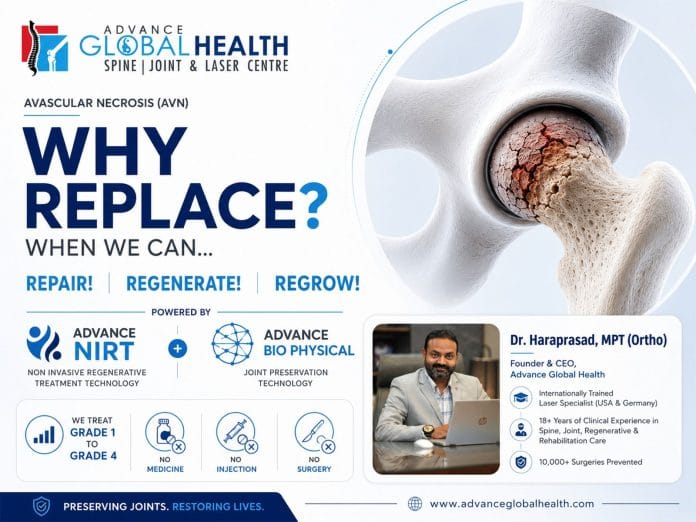
Against this backdrop, Advance Global Health – Spine | Joint & Laser Centre, which operates in Delhi and Haldwani, says it has been offering AVN treatment in India through a non-surgical, regenerative approach built on its Advance NIRT technology and Advance biophysical joint preservation treatment technology, under Dr. Haraprasad (MPT-Ortho), an internationally certified laser specialist. The centre states that its protocol has helped avoid more than 5,000 hip replacement and core decompression surgeries to date, a claim made by the centre itself rather than an independently verified statistic.
Why AVN Is Rising Among Younger Adults
According to the client document, experts link the post-COVID rise in AVN to several overlapping factors. High-dose corticosteroids administered during COVID-19 treatment are associated with fat emboli that disrupt blood supply to the femoral head, one of the established drivers of osteonecrosis. Separately, COVID-19 itself has been tied to microvascular thrombosis, in which damage to the endothelial lining triggers clotting in small arteries and reduces circulation to the joint. Immune dysregulation and prolonged inflammation triggered by the infection are also cited as suppressing bone-forming cells and speeding degeneration. Doctors quoted in the brief note said that many of the younger patients now presenting are developing bilateral AVN, affecting both hips at once.
Understanding AVN (Avascular Necrosis) and Its Progression
AVN develops when blood supply to the femoral head is compromised, leading to bone weakness, microfractures, and, if untreated, structural collapse, a process sometimes described as treatment for femoral head necrosis territory once damage sets in. Common symptoms include hip and groin pain, stiffness, difficulty walking or standing, and restricted movement as the femoral head degenerates. The centre describes AVN as fundamentally a vascular disease rather than a purely mechanical “bone problem,” which is why it emphasises early diagnosis. The condition progresses through three clinical stages, and the client document identifies Stage 1, Stage 2, and early Stage 3 as a “Golden Window” during which AVN treatment without surgery has the greatest chance of reversing damage.
Most AVN (Avascular Necrosis) patients reach us in Stage-4 after prolonged medication, by which time the subchondral bone has already collapsed. Unfortunately, medicines alone cannot reverse bone death or prevent further structural damage at this stage.
However, Stage-4 AVN is still treatable.
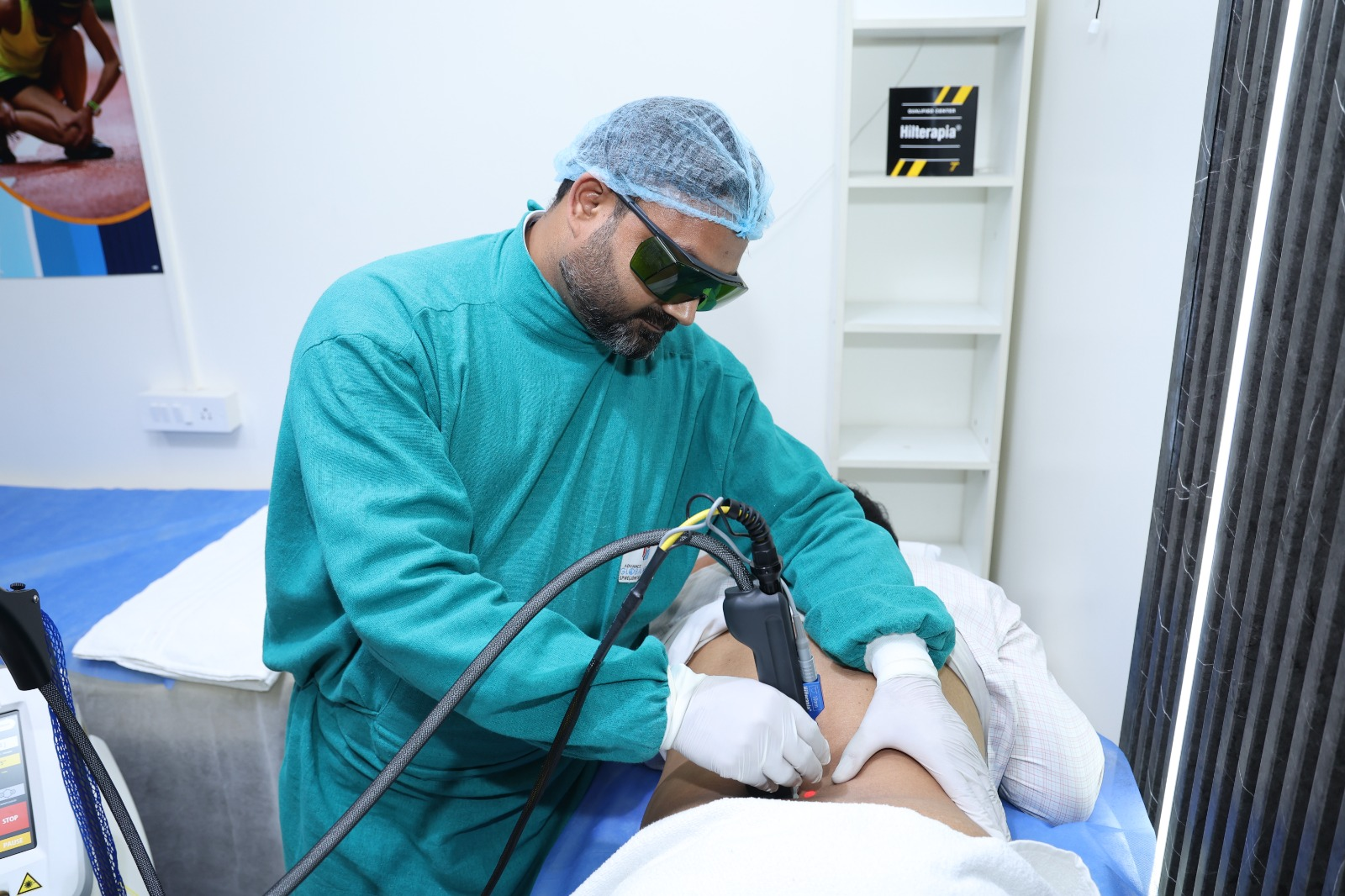
With Femoral Angiogenesis Therapy, the disease process can be effectively halted. This advanced non-surgical treatment stimulates new blood vessel formation (angiogenesis) in the necrotic femoral head, restoring microcirculation to the affected area.
Once blood supply improves:
* The necrosis process stops immediately
* Inner bone matrix repair begins
* Bone density gradually increases
* Pain significantly reduces
* Joint function improves
As a result, many patients are able to avoid or delay hip replacement surgery and live with minimal discomfort, maintaining mobility and quality of life.
How LASER and Orthotripsy Support Blood Flow and Bone Repair
For earlier-stage disease, the centre says it relies on a combination of two technologies delivered as part of its broader Femoral Angiogenesis Therapy framework: a High-Power Pulsed Nd:YAG Robotic LASER and Orthotripsy, a form of focused regenerative shockwave therapy. Per the centre’s description, the LASER penetrates the necrotic zone and activates photobiomodulation (PBM), the release of VEGF (Vascular Endothelial Growth Factor), PDGF and FGF stimulation, and nitric-oxide-mediated dilation of blood vessels, alongside osteoblast activation for bone regeneration.
Orthotripsy, meanwhile, is described as stimulating stem-cell migration, enhancing microcirculation, remodeling the bone matrix, repairing microfractures, and reducing inflammation. Used together, the centre states that the two therapies create a regenerative treatment for the AVN environment intended to halt disease progression, strengthen weakened bone, and prevent collapse of the femoral head, positioning the combination as a hip replacement alternative for eligible patients.
Dr. Haraprasad Highlights the Importance of Early Treatment
“AVN is fundamentally a vascular and cellular disease. If we restore circulation early using advanced regenerative technology, we can prevent collapse and avoid surgery. Our centre has saved more than 5,000 hips from unnecessary replacement surgeries, especially in post-COVID young adults,” said Dr. Haraprasad, founder of Advance Global Health – Spine | Joint & Laser Centre. He added that Stage 1, Stage 2 and early Stage 3 show the highest success rates, and that timely intervention up to Stage 3 can substantially change a patient’s long-term outcome.
The centre describes the procedure as walk-in, walk-out, involving no incision, no anesthesia, and no downtime, with patients reporting rapid pain relief, improved mobility within weeks, and X-ray or MRI improvement within four to six months. Treatment is guided by MRI-based mapping and stage-based protocols, combined with lifestyle modifications and regular follow-ups, an approach the centre positions within its wider non-surgical AVN treatment offering.
From Hip Replacement to Regenerative Treatment
The client document notes that many hospitals still recommend surgery for AVN, which experts attribute to limited awareness of regenerative technologies, since conventional orthopedic training centres on core decompression and hip replacement rather than laser-based angiogenesis therapy. The centre points to its clinical results as evidence of a broader shift in AVN management, from replacement toward regeneration.
As AVN cases continue to climb in the wake of the pandemic, the underlying message from clinicians remains consistent: early diagnosis matters, restoring blood flow to the femoral head is central to recovery, and timely, non-surgical intervention offers a route to preserving the natural hip and avoiding unnecessary surgery.
Website: https://advanceglobalhealth.com
(ADVERTORIAL DISCLAIMER: The above press release has been provided by VMPL. ANI will not be responsible in any way for the content of the same.)
This story is auto-generated from a syndicated feed. ThePrint holds no responsibility for its content.