




Thank you dear subscribers, we are overwhelmed with your response.
Your Turn is a unique section from ThePrint featuring points of view from its subscribers. If you are a subscriber, have a point of view, please send it to us. If not, do subscribe here: https://theprint.in/subscribe/
The demand for 33% women’s reservation was never just about seats—it was about correcting a historic imbalance in India’s democracy. For decades, women remained underrepresented despite being equal citizens, making this reform a constitutional necessity rather than a political option. Yet, progress has repeatedly stalled—often because it has been unnecessarily entangled with the entirely separate issue of delimitation. That confusion must end. Women’s reservation is about who represents; delimitation is about how representation is distributed. Linking them weakens both reforms.
The defeat of the Constitution (131st Amendment) Bill on April 17, 2026, was not merely a legislative stalemate; it was a constitutional signal. It forces India to confront a deeper question: should representation remain tied to a framework that relies almost entirely on population, or should it evolve to reflect national progress and outcomes?
As India moves toward a potential expansion of Parliament to nearly 850 seats, a purely population-based approach risks creating unintended structural distortions. States that have stabilized population growth, invested in education, and improved human development could see their relative voice diminish, while those still catching up gain weight solely due to demographic expansion. This is not a flaw of democracy—but a limitation of a one-dimensional metric.
To move toward the goal of Viksit Bharat by 2047, India must begin transitioning from a Democracy of Quantity to a Democracy that also values Quality.
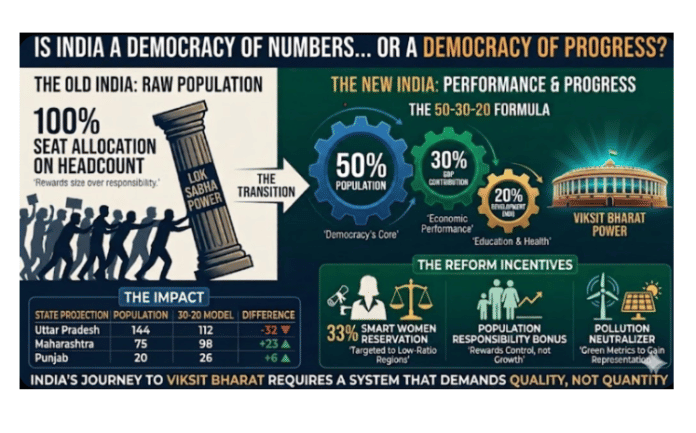
And this is where a new structural approach to seat allocation becomes essential—not as a rejection of delimitation, but as its evolution. Instead of relying solely on headcount, India can adopt a balanced framework that preserves democratic fundamentals while incorporating contribution and outcomes. The proposed 50-30-20 model emerges from this need: retaining population as the core, while integrating economic output and human development into how representation is distributed across states. This is not a dilution of democracy—it is its modernization.
The 50-30-20 Rule: A Calibrated Democratic Framework
The principle of “one person, one vote” remains untouched. But the distribution of seats across states can be broadened through a three-pillar system:
- 50% Population (Demographic Mandate)
- 30% Economic Contribution (GDP Share)
- 20% Human Development (HDI Performance)
Such a framework ensures that representation reflects not just how many citizens a state has, but how effectively it contributes to national growth and human capital formation.
A Parliament of Performance
Using an illustrative projection of an 850-seat Lok Sabha (based on population trends and current GDP/HDI shares), the contrast between models becomes clear:
- Uttar Pradesh: 144 → 112 seats (−22%)
- Maharashtra: 75 → 98 seats (+31%)
- Gujarat: 41 → 52 seats (+27%)
- Tamil Nadu: ~70 → 78 seats (+11%)
- Punjab: 20 → 26 seats (+30%)
- Bihar: 74 → 60 seats (−19%)
These shifts are not punitive or preferential—they are directional. They signal that governance outcomes, economic contribution, and human development matter alongside population.
Under such a system, states do not lose representation arbitrarily—they are incentivized to earn greater voice through measurable progress. The political message becomes clear: improve education, expand economic capacity, and strengthen human development to enhance representation.
Women’s Reservation: A Separate and Urgent Reform
Independent of delimitation, women’s reservation must move forward as a standalone constitutional commitment. The 33% quota cannot remain contingent on seat redistribution debates.
However, implementation must go beyond symbolic allocation. To ensure real impact, representation should be directed toward regions where gender inequality is most pronounced areas with low female literacy, skewed sex ratios, and limited participation of women in public life.
This transforms reservation from a numerical guarantee into a tool of structural correction.
Targeted Inclusion: The “Red Zone” Approach
A more outcome-driven approach would prioritize women’s representation in districts facing the most severe gender disparities. By placing leadership in the very regions where women face the greatest barriers, political power becomes an instrument of change.
The principle is straightforward: representation must translate into measurable social progress.
Aligning Representation with Responsibility
A modern democratic framework must also recognize responsibility. States that achieved population stabilization, ensured food security, or contributed significantly to economic growth have played a stabilizing role in India’s development trajectory.
Incorporating a modest “responsibility weightage,” along with incentives for environmental performance, can further align representation with national priorities such as sustainability and resource management.
A Dynamic and Adaptive Framework
Any such model must remain flexible linked to Census updates and reviewed periodically. As states achieve higher development benchmarks, the system can gradually shift focus toward supporting lagging regions, ensuring balanced national progress.
The Choice Before India
This is not a debate between regions, nor a partisan argument. It is a constitutional question about how India defines fairness in representation.
A democracy anchored only in numbers of risks overlooking outcomes. A democracy that incorporates progress creates incentives for better governance.
India does not need to abandon its democratic foundations—it needs to refine them.
Because the strength of a republic will not be defined only by how many voices it counts, but by what those voices collectively achieve.
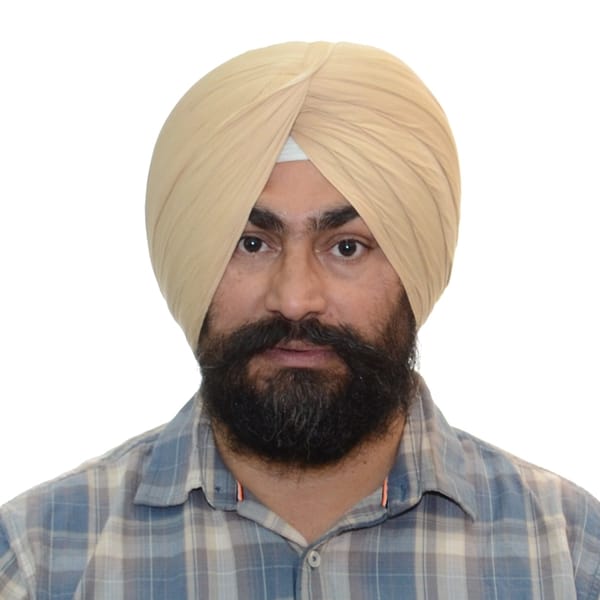
Gurbarn Singh, P.Eng., is a professional engineer with over 20 years of industry experience and a doctoral researcher in Metallurgical Engineering through a joint programme between the Indian Institute of Technology Madras and the University of Alberta. He writes on public policy, systemic reforms, infrastructure development, education improvement, and sustainable resource management, with a focus on strengthening foundational systems required for India’s long-term growth as a developed nation.
Cell Number: +91 7009069115 / +1 7807141055
Email: gurbarn@ualberta.ca
https://x.com/SinghGurbarn
These pieces are being published as they have been received – they have not been edited/fact-checked by ThePrint.