



Thank you dear subscribers, we are overwhelmed with your response.
Your Turn is a unique section from ThePrint featuring points of view from its subscribers. If you are a subscriber, have a point of view, please send it to us. If not, do subscribe here: https://theprint.in/subscribe/
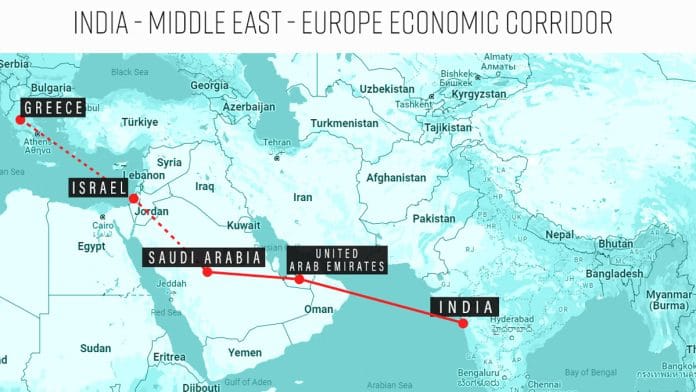
When India unveiled the India-Middle East-Europe Economic Corridor at the G20 summit in New Delhi in September 2023, the timing felt historic. A trade route linking Mumbai to Marseille through the Gulf and Israel, announced on Indian soil, backed by the United States, endorsed by Europe, and celebrated as a credible answer to China’s Belt and Road Initiative. It was, briefly, India’s most consequential diplomatic moment in a generation.
That was thirty-three months ago. Since then, Gaza, Iran, and the Strait of Hormuz have done to IMEC what no rival could: exposed every assumption it rested on.
A Corridor Built on Three Bets That All Lost Simultaneously
IMEC’s architecture rested on three interlocking assumptions. First, that Saudi-Israeli normalisation, the diplomatic foundation of the overland route, was on an irreversible trajectory following the Abraham Accords. Second, that Gulf maritime entry points like Jebel Ali and Fujairah would remain commercially stable. Third, that Israel, as the corridor’s Mediterranean gateway through Haifa port, would remain a viable
and politically neutral node for Arab trade.
All three assumptions collapsed at roughly the same time. Since February 2026, when a joint US-Israel campaign against Iran triggered Tehran’s closure of the Strait of Hormuz, the same sea lines IMEC was designed to traverse have become the global economy’s most distressed maritime artery. Kuwait’s exports dropped to zero barrels in April, and Qatar’s exports fell by 90%. Gulf states that were meant to be IMEC’s commercial anchors have spent the year managing existential logistics crises of their own. And Netanyahu’s
public framing of IMEC as a mechanism to reroute Gulf oil through Israel, bypassing Hormuz, has recast the corridor in Gulf eyes as a hostile alignment against Iran, inviting sustained attacks on its infrastructure.
The project designed to reduce chokepoint vulnerability now finds its entire route threading through the world’s most actively contested chokepoints.
The Israel Problem Nobody Wanted to Name
IMEC’s Israeli dimension was always its most diplomatically delicate feature. Israel is not a founding signatory, but it is geographically indispensable, goods were to arrive overland from the UAE, Saudi Arabia and Jordan and reach Haifa before crossing the Mediterranean to Europe. India’s Adani Group had purchased a stake in Haifa port precisely in anticipation of this logic.
That logic now sits in suspension. Saudi Arabia, IMEC’s most important Arab partner, has spent two years managing the political toxicity of being seen as aligned with Israel. Riyadh is already seeking alternatives, with Egypt as its first stop, a $4 billion causeway linking the Saudi coast to Egypt’s Sinai already underway, and Syria being courted as a potential Mediterranean node. The corridor’s central land bridge is being quietly
rerouted around its most critical segment.
India’s Connectivity Dilemma
IMEC’s difficulties leave India in an uncomfortable position. Its other grand connectivity bet, the International North-South Transport Corridor through Iran, is equally compromised. The Chabahar-Zahedan railway, a key INSTC component due for completion in 2026, faces indefinite delays, and India’s $120 million investment in the Shahid Beheshti terminal remains under sanctions uncertainty, with the US waiver that
allowed India to operate it despite sanctions already expired.
India’s two routes to Europe and Central Asia are both, at this moment, either suspended or severely constrained. The irony is sharp: India has never had more trade to move, more markets to access, or more strategic reason to build connectivity, and its two principal corridors are both hostage to conflicts it did not start and cannot resolve alone. Meanwhile, container traffic through the Trans-Caspian Middle Corridor has grown significantly in the aftermath of the Hormuz crisis, and route choices embedded in carrier contracts and insurance frameworks become self-reinforcing. The commercial gravitational pull of alternatives is already filling the void that IMEC has left open.
What the Crisis Actually Reveals
As of May 2026, IMEC has no firm funding commitments or construction timelines. The governance vacuum is the deeper problem, without a central coordinating body, each signatory can quietly defect from commitments while publicly affirming them. The 2026 G20 cycle, under the US presidency, offers a credible convening moment to establish a formal IMEC secretariat with the authority to act. Whether Washington deploys that leverage with urgency is the open question.
But the crisis has also clarified something useful: the case for IMEC has never been stronger. Major carriers have suspended Red Sea-Suez Canal transit, pushing freight rates on India-Europe routes 40-50% higher and adding 10-20 days to delivery timelines. Every week the disruption persists is a week that demonstrates precisely why an overland alternative is necessary.
IMEC was conceived for a more stable world. The more unstable the world becomes, the more necessary it is and the harder it is to build. That is India’s connectivity paradox, and it will not resolve itself.
Submitted By: Siddhartha Arora
These pieces are being published as they have been received – they have not been edited/fact-checked by ThePrint.